


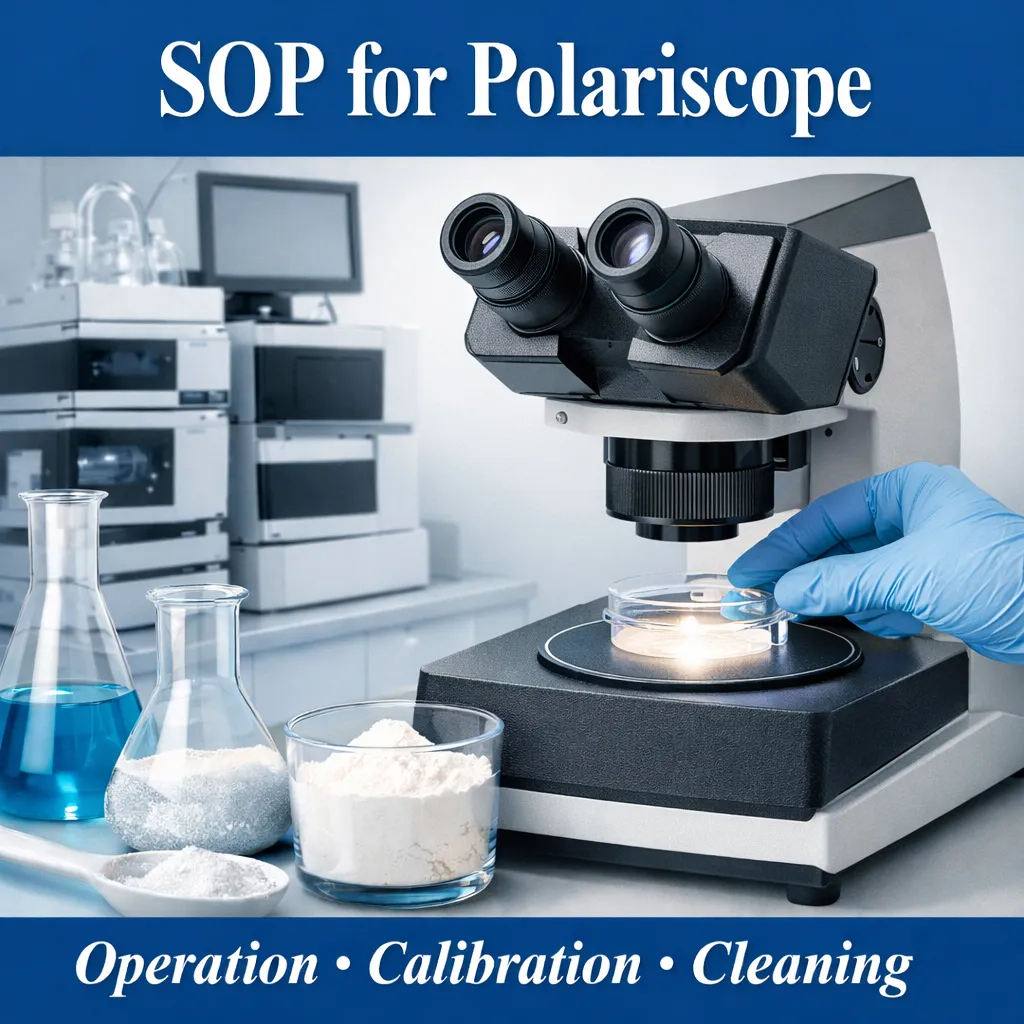

Master the SOP for polariscope operation, calibration, and cleaning. Ensure precise optical testing and compliance.
Introduction
In pharmaceutical and quality control laboratories, precision optical instruments like the polariscope play a critical role in analyzing birefringence, stress patterns, and optical activity in materials.
To ensure consistent performance and reliable results, a well-defined Standard Operating Procedure (SOP) is essential. This guide provides a complete SOP for operating, calibrating, and cleaning a polariscope, written in a practical, easy-to-follow format for lab professionals.
1.0 OBJECTIVE
To clearly lay down the procedure for operating, calibrating, and cleaning the polariscope to ensure accurate and reliable performance.
2.0 SCOPE
This procedure is applicable to the polariscope installed in the Quality Control Laboratory.
3.0 RESPONSIBILITY
3.1 Doing
- Technical Assistant / Executive
3.2 Checking
- Executive / Manager
4.0 ACCOUNTABILITY
- Head of the Department
5.0 PROCEDURE
5.1 Operation of Polariscope (Step-by-Step)
Quick Featured Snippet: Operation Steps
- Switch ON the polariscope and allow stabilization
- Place the sample on the viewing platform
- Adjust polarizer and analyzer alignment
- Observe optical patterns or birefringence
- Record observations and remove sample
Detailed Procedure
- Ensure the instrument is clean and properly calibrated
- Switch ON the mains and allow the light source to stabilize
- Place the sample carefully on the stage
- Adjust the polarizer and analyzer for optimal contrast
- Rotate the sample if required to observe stress patterns
- Note down observations or measurements
- Remove the sample after analysis
5.2 Calibration of Polariscope
Quick Featured Snippet: Calibration Steps
- Verify zero alignment
- Use standard calibration plate
- Adjust polarizer/analyzer settings
- Record calibration data
Detailed Calibration Procedure
- Check the zero position of the analyzer
- Use a certified quartz or standard reference plate
- Align the polarizer and analyzer properly
- Observe expected optical patterns or rotation values
- Adjust settings if deviations are found
- Document calibration results in the logbook
- Perform calibration as per defined schedule
5.3 Cleaning Procedure (As Provided SOP)
Step-by-Step Cleaning SOP
- 5.3.1 After completion of testing, remove the samples from the instrument
- 5.3.2 Switch “OFF” the mains
- 5.3.3 Clean the outer surface of the instrument and other parts using a cotton cloth
- 5.3.4 Record the cleaning activity in the specified format
- 5.3.5 Frequency: Daily
6.0 ABBREVIATION
- SOP – Standard Operating Procedure
Safety Precautions
- Always switch OFF the instrument before cleaning
- Handle optical components with care to avoid scratches
- Avoid direct contact with lenses and filters
- Use only approved cleaning materials
- Ensure proper electrical safety during operation
Common Mistakes to Avoid
- ❌ Misalignment of polarizer and analyzer
- ❌ Skipping calibration checks
- ❌ Touching optical surfaces with bare hands
- ❌ Improper sample placement
- ❌ Not maintaining cleaning records
Best Practices for Accurate Results
- ✔ Perform regular calibration using certified standards
- ✔ Keep optical components dust-free
- ✔ Maintain consistent lighting conditions
- ✔ Train personnel on instrument handling
- ✔ Document all activities for audit compliance
10 Frequently Asked Questions (FAQs)
1. What is a polariscope used for?
It is used to detect birefringence and stress patterns in transparent or semi-transparent materials.
2. How often should a polariscope be cleaned?
Cleaning should be done daily after use.
3. Why is calibration important for a polariscope?
Calibration ensures accurate optical measurements and reliable results.
4. What type of samples can be analyzed?
Glass, plastics, crystals, and pharmaceutical materials.
5. Can I touch the lenses during cleaning?
No, avoid touching lenses to prevent scratches or contamination.
6. Who performs the SOP activities?
Technical Assistant or Executive.
7. What is birefringence?
It is the optical property where light splits into two rays in a material.
8. What should be recorded in the format/logbook?
Cleaning, calibration, and operational details.
9. What happens if alignment is incorrect?
It can lead to inaccurate or unclear observations.
10. How often should calibration be performed?
As per schedule or whenever deviations are observed.