


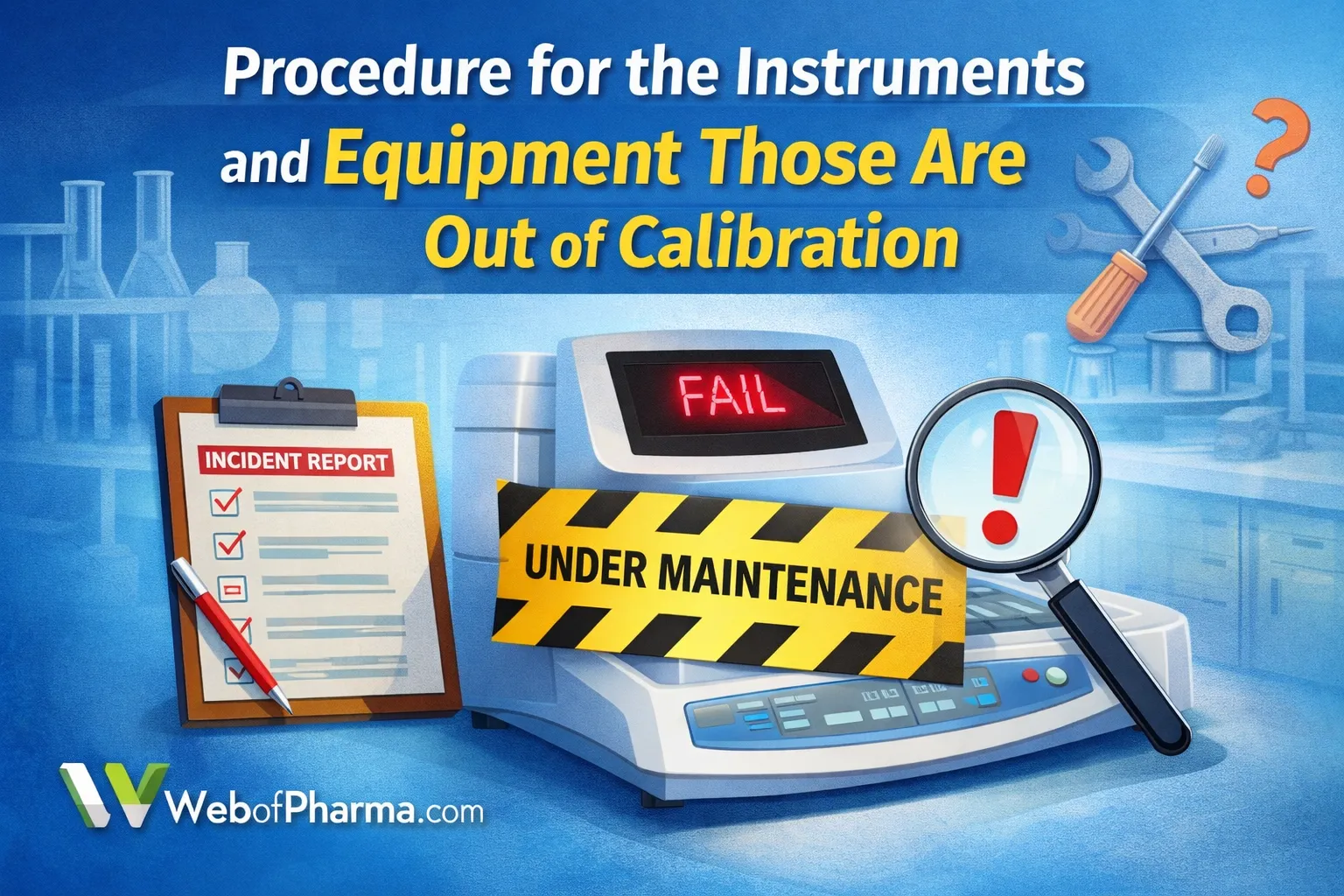

Learn the complete GMP-compliant procedure for the instruments and equipment those are out of calibration in Quality Control and non-QC areas. Understand labeling, investigation, repair, recalibration, and QA responsibilities to ensure product quality and regulatory compliance.
In pharmaceutical manufacturing and quality control environments, the accuracy and reliability of instruments and equipment are essential to ensure product quality, patient safety, and regulatory compliance. Any instrument that fails calibration or shows unexpected malfunction must be handled immediately according to established procedures.
A well-defined procedure for the instruments and equipment those are out of calibration helps organizations maintain data integrity, prevent product quality risks, and comply with Good Manufacturing Practice (GMP) requirements.
This article outlines the standard operating procedure (SOP) for managing out-of-calibration instruments and equipment in both Quality Control (QC) laboratories and other operational departments.
Why Proper Handling of Out-of-Calibration Instruments Is Important
When instruments operate outside their calibration limits, they may produce inaccurate measurements that can directly impact product quality and regulatory compliance.
Proper management of out-of-calibration equipment ensures:
- Accurate analytical results
- Reliable manufacturing operations
- Product quality assurance
- Regulatory compliance with GMP
- Prevention of product recalls
- Protection of patient safety
Common Situations That Indicate Equipment Is Out of Calibration
An instrument or equipment may be considered out of calibration under the following conditions:
- Failure during scheduled calibration
- Sudden malfunction or abnormal readings
- Physical damage or operational failure
- Inconsistent measurement results
- Unexpected process deviations
- Maintenance or repair activities affecting accuracy
Recognizing these situations early allows organizations to implement corrective actions quickly.
Procedure for Instruments and Equipment Those Are Out of Calibration
(Other Than Quality Control Laboratory)
The following procedure applies to manufacturing, engineering, warehouse, and utility equipment outside the Quality Control laboratory.
Step 1: Stop the Use of the Instrument or Equipment
Immediately discontinue the use of the instrument or equipment if:
- It fails calibration
- A sudden malfunction occurs
- Measurement accuracy is questionable
This step prevents further risk to product quality.
Step 2: Affix “UNDER MAINTENANCE” Label
Clearly label the instrument or equipment with:
UNDER MAINTENANCE
This ensures that personnel do not use the equipment unintentionally.
Step 3: Raise an Incident Report
Document the issue by completing an:
Incident Report
The report should include:
- Equipment identification number
- Description of failure
- Date and time of occurrence
- Responsible department
The engineering department must be informed immediately.
Step 4: Investigation by Engineering Department
The engineering department shall:
- Identify the root cause of failure
- Determine whether calibration drift occurred
- Evaluate equipment performance history
- Assess the potential impact on product quality
A critical requirement is to evaluate:
The effect of failure on product quality since the last calibration
Step 5: Repair the Instrument or Equipment
The defective instrument or equipment shall be handed over to the engineering department for repair.
Repair activities may include:
- Mechanical adjustment
- Component replacement
- Software correction
- Preventive maintenance
Step 6: Send Equipment to External Agency (If Required)
If the instrument cannot be repaired internally:
The equipment shall be sent to:
- Manufacturer
- Authorized service provider
- External calibration laboratory
This ensures specialized repair and calibration services.
Step 7: Recalibrate the Instrument After Repair
After repair completion:
The instrument or equipment must be calibrated according to the respective Standard Operating Procedure (SOP).
Calibration verification ensures:
- Measurement accuracy
- Operational reliability
- Compliance with regulatory standards
Step 8: Replace the Instrument if Beyond Repair
If the instrument or equipment cannot be repaired:
It shall be replaced with an identical instrument having:
- Same make
- Same model
- Same size
- Same measurement range
- Same least count
If identical equipment is not available:
A formal Change Control Procedure must be followed before replacement.
Procedure for Instruments and Equipment Those Are Out of Calibration
(Quality Control Laboratory)
The handling of out-of-calibration instruments in the QC laboratory requires additional documentation and quality evaluation due to their direct impact on analytical results.
Step 1: Stop the Use of the Instrument Immediately
If the instrument fails calibration testing:
Stop using the instrument without delay.
This prevents the generation of incorrect analytical data.
Step 2: Affix “UNDER MAINTENANCE” Label
Place a visible label on the instrument:
UNDER MAINTENANCE
This step ensures clear communication to laboratory personnel.
Step 3: Contact Manufacturer or Service Engineer
If sudden malfunction or out-of-calibration results occur during routine operation:
Contact:
- Equipment manufacturer
- Authorized supplier
- Service engineer
This ensures professional diagnosis and corrective action.
Step 4: Investigation and Rectification
The service engineer shall:
- Identify the root cause
- Repair the equipment
- Restore operational functionality
- Verify performance accuracy
Step 5: Perform Partial or Complete Calibration
After maintenance or repair:
The instrument must undergo:
- Partial calibration
or - Full calibration
This confirms the instrument is suitable for use.
Step 6: Maintain Service and Calibration Records
The following documentation must be filed:
- Service report
- Cause of failure
- Corrective action taken
- Calibration report
- Maintenance record
Proper documentation supports:
- GMP compliance
- Audit readiness
- Traceability
Step 7: Evaluate Product Quality Impact
A formal investigation must determine:
- The reason for calibration failure
- The time period affected
- The potential impact on product quality
This step is essential for regulatory compliance.
Step 8: QA Decision on Re-Analysis of Samples
The Head of Quality Assurance (QA) shall evaluate whether previously tested samples need re-analysis.
Re-analysis may be required to:
- Confirm result accuracy
- Prevent product quality issues
- Ensure regulatory compliance
This decision is critical for maintaining data integrity.
Documentation Required for Out-of-Calibration Equipment
Typical documentation includes:
- Incident report
- Calibration report
- Maintenance record
- Service engineer report
- Root cause investigation report
- Corrective and preventive action (CAPA) record
- Change control record (if replacement occurs)
Proper documentation is essential during regulatory inspections.
Key GMP Compliance Points
Organizations must ensure:
- Immediate stoppage of equipment use
- Proper labeling and isolation
- Root cause investigation
- Product quality impact assessment
- Recalibration before reuse
- Complete documentation
- QA approval before release
These practices align with:
- GMP requirements
- Data integrity principles
- Regulatory inspection expectations
Conclusion
A clear and well-documented procedure for the instruments and equipment those are out of calibration is essential for maintaining product quality, data reliability, and regulatory compliance. Prompt action, proper investigation, accurate documentation, and timely recalibration help organizations minimize risk and ensure consistent pharmaceutical manufacturing and testing operations.
Frequently Asked Questions (FAQ)
1. What should be done first when an instrument is found out of calibration?
Immediately stop using the instrument and label it UNDER MAINTENANCE.
2. Why is labeling equipment important?
Labeling prevents accidental use of faulty equipment and ensures workplace safety and compliance.
3. Who investigates out-of-calibration equipment?
The engineering department or authorized service engineer investigates the cause of failure.
4. Is recalibration required after repair?
Yes. Recalibration is mandatory after repair or maintenance before the instrument can be used again.
5. What is the role of Quality Assurance in out-of-calibration cases?
Quality Assurance evaluates product impact and decides whether re-analysis of samples is necessary.
6. Can equipment be used before recalibration?
No. Equipment must not be used until calibration is successfully completed.
7. What happens if equipment cannot be repaired?
The equipment must be replaced with an identical instrument or managed through change control.
8. Why is impact assessment required after calibration failure?
It ensures that previously produced or tested products are not affected by inaccurate measurements.
9. What records must be maintained for out-of-calibration equipment?
Records include incident reports, calibration reports, service reports, investigation reports, and CAPA documentation.
10. Is handling out-of-calibration equipment a GMP requirement?
Yes. Proper management of out-of-calibration equipment is a mandatory requirement under GMP regulations.