


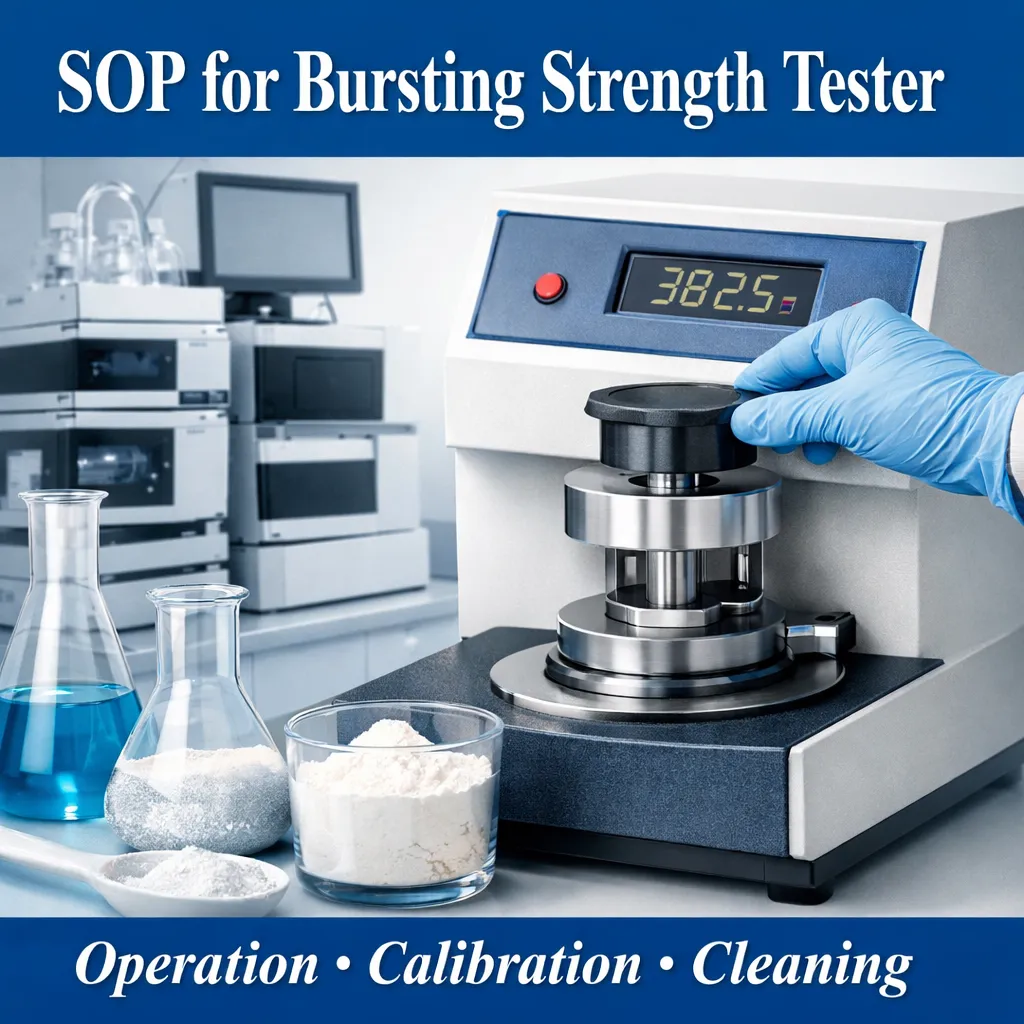

Learn the complete SOP for operating, calibrating, and cleaning a bursting strength tester. Ensure accuracy, safety, and compliance.
Introduction
In any quality control laboratory, maintaining precision and consistency is critical—especially when working with instruments like the bursting strength tester. This equipment plays a vital role in evaluating the strength of paper, packaging materials, and textiles.
A well-defined Standard Operating Procedure (SOP) ensures:
- Accurate test results
- Longer equipment lifespan
- Compliance with quality standards
This guide provides a complete, step-by-step SOP covering operation, calibration, and cleaning—written in a practical, easy-to-follow format.
1.0 OBJECTIVE
To clearly lay down the procedure for operating, calibrating, and cleaning the bursting strength tester to ensure accurate and reliable performance.
2.0 SCOPE
This procedure is applicable to the bursting strength tester installed in the Quality Control Laboratory.
3.0 RESPONSIBILITY
3.1 Doing
- Technical Assistant / Executive
3.2 Checking
- Executive / Manager
4.0 ACCOUNTABILITY
- Head of the Department
5.0 PROCEDURE
5.1 Operation of Bursting Strength Tester (Step-by-Step)
Quick Featured Snippet: Operation Steps
- Switch on the instrument and allow stabilization
- Place the sample securely on the test area
- Apply pressure gradually
- Record bursting strength at rupture
- Remove sample and reset machine
Detailed Procedure
- Ensure the instrument is clean and calibrated before use
- Switch ON the mains and allow warm-up (if required)
- Place the test specimen properly between clamps
- Tighten the clamping mechanism evenly
- Start applying hydraulic pressure steadily
- Observe the gauge reading until the sample bursts
- Record the bursting strength value
- Release pressure and remove the sample
5.2 Calibration of Bursting Strength Tester
Quick Featured Snippet: Calibration Steps
- Use standard calibration foil or weights
- Apply pressure and compare readings
- Adjust zero and span if needed
- Record calibration results
Detailed Calibration Procedure
- Verify zero setting before starting
- Use certified calibration standards
- Apply pressure and check readings against known values
- Adjust calibration settings if deviation is observed
- Document calibration in logbook
- Perform calibration as per scheduled frequency
5.3 Cleaning Procedure (As Provided SOP)
Step-by-Step Cleaning SOP
- 5.3.1 After completion of testing, remove the sample from the instrument
- 5.3.2 Switch OFF the mains
- 5.3.3 Clean the outer surface of the instrument and gauge meter using a dry cotton cloth
- 5.3.4 Record the cleaning activity in the instrument log card
- 5.3.5 Frequency: Daily
Note: Take care that the zero setting of the scale is not disturbed.
6.0 ABBREVIATION
- SOP – Standard Operating Procedure
Safety Precautions
- Always switch off the instrument before cleaning
- Do not touch moving or pressurized parts during operation
- Avoid using wet cloths or chemicals on the gauge
- Ensure proper clamping to prevent sample slippage
- Use PPE if required by lab standards
Common Mistakes to Avoid
- ❌ Ignoring zero calibration before testing
- ❌ Applying pressure too quickly
- ❌ Using damaged or uneven samples
- ❌ Skipping daily cleaning
- ❌ Not recording data in the logbook
Best Practices for Accurate Results
- ✔ Perform routine calibration checks
- ✔ Maintain a clean and dust-free instrument
- ✔ Use standardized sample sizes
- ✔ Train operators regularly
- ✔ Keep detailed logs for traceability
10 Frequently Asked Questions (FAQs)
1. What is a bursting strength tester used for?
It measures the pressure required to rupture materials like paper, cardboard, or fabric.
2. How often should the tester be cleaned?
Cleaning should be performed daily after use.
3. Why is calibration important?
Calibration ensures accuracy and reliability of test results.
4. What happens if zero setting is disturbed?
It can lead to incorrect readings and unreliable data.
5. Can I use a wet cloth for cleaning?
No, always use a dry cotton cloth to prevent damage.
6. Who is responsible for performing the SOP?
Technical Assistant or Executive.
7. How do I know if calibration is required?
If readings deviate from standard values, calibration is needed.
8. What should be recorded in the log card?
Cleaning, calibration, and operational details.
9. What type of samples can be tested?
Paper, packaging materials, corrugated boards, and textiles.
10. What is the biggest error in testing?
Improper clamping and uneven pressure application.