


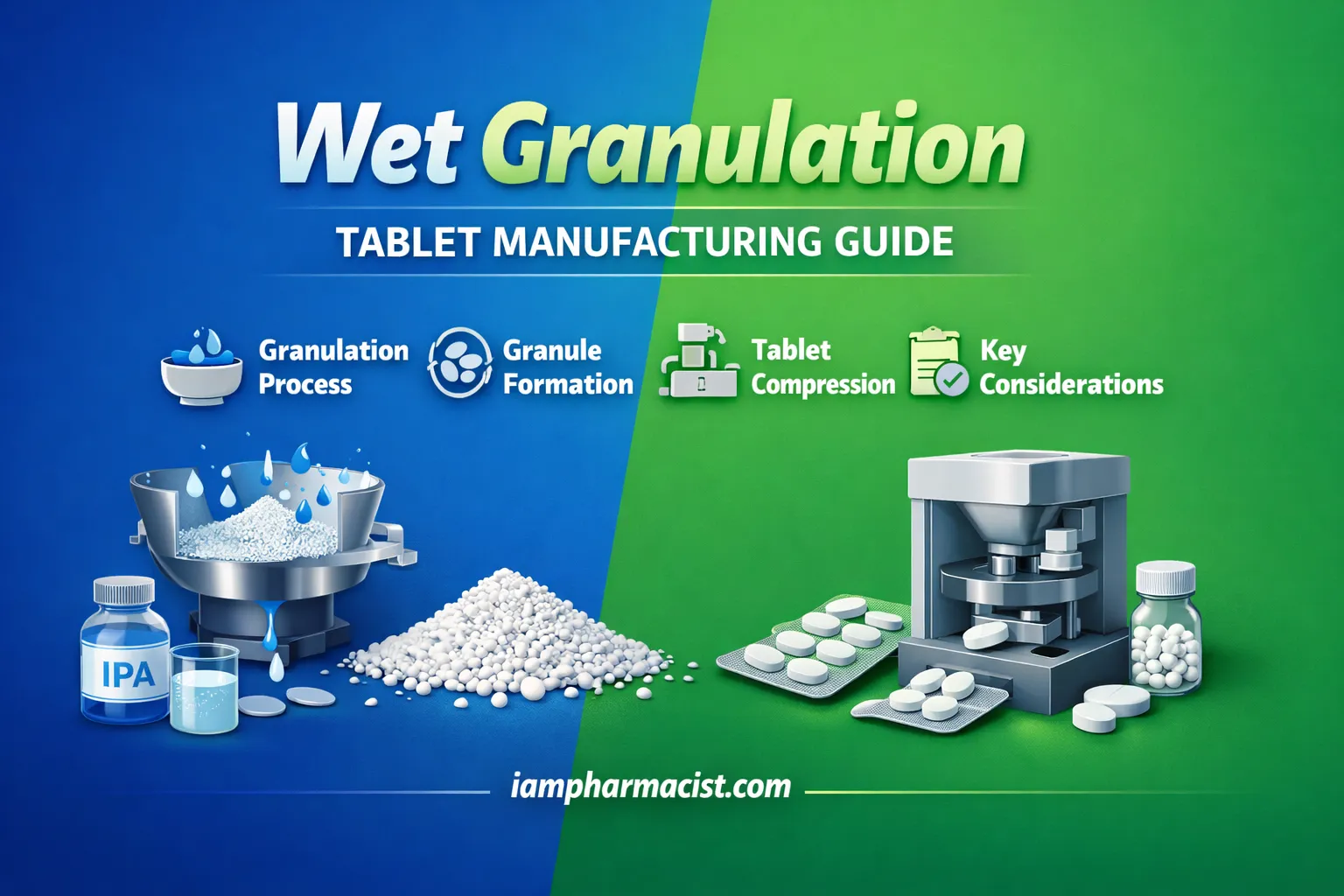

Learn wet Wet Granulation Tablet Manufacturing method, steps, benefits, and key process parameters in pharma production.
Wet Granulation Tablet Manufacturing GuideMethod
Tablet manufacturing by wet granulation method is one of the most reliable and widely used techniques in pharmaceutical production. It ensures better flow, compressibility, and uniformity compared to direct compression.
In this guide, we’ll break down the complete process, key materials, mechanisms, and critical parameters involved in wet granulation.
What Is Wet Granulation?
Wet granulation is a process where fine powder particles are agglomerated using a binder solution or granulating fluid to form larger, stronger granules.
These granules improve handling, flow properties, and compression behavior, making them ideal for tablet production.
The granulating fluid can be:
- Used alone (e.g., water)
- Combined with binders (e.g., PVP, HPMC)
Selection of Granulating Fluid
Choosing the right granulating fluid depends on the formulation and material sensitivity.
1. Organic Solvents
- Used for moisture-sensitive drugs
- Fast drying due to volatility
- Higher cost
- Less environmentally friendly
Examples:
- Isopropyl Alcohol (IPA)
- Rectified Spirit
- Dichloromethane
2. Aqueous Fluids
- Cost-effective
- Non-flammable
- Environmentally safe
- Longer drying time
Example: Water
Binders Used in Wet Granulation
Binders provide cohesion between particles.
Common binders include:
- PVP (Kollidon)
- HPMC
- HPC
- Starch
- Gelatin
- Natural gums
Why Granulation Is Important
Granulation is essential in tablet manufacturing by wet granulation method for several reasons:
- Improves powder flow
- Reduces dust formation
- Prevents segregation
- Enhances compressibility
- Minimizes product loss
- Reduces cross-contamination
Ideal Characteristics of Granules
For efficient tablet compression, granules should:
- Be spherical for good flow
- Have uniform composition
- Contain an optimal mix of fines and coarse particles
- Be strong but not overly hard
- Resist segregation during handling
- Disintegrate properly after compression
- Be adequately lubricated
Mechanism of Granule Formation
The wet granulation process follows the Ennis & Lister (1980) mechanism:
1. Wetting and Nucleation
Binder spreads over powder particles forming liquid bridges and nuclei.
2. Coalescence (Growth Stage)
Small particles combine into larger granules through collisions and adhesion forces.
3. Consolidation
Granules densify, improving strength and durability.
4. Attrition (Breakage)
Some granules break and reform, improving uniformity.
Steps in Wet Granulation Tablet Manufacturing
Step 1: Weighing
Accurate measurement of all ingredients as per batch manufacturing records.
Step 2: Sifting
Removal of lumps using sifters for uniform particle size.
Step 3: Pre-Mixing
Blending drug, diluents, and disintegrants to ensure uniform distribution.
Step 4: Binder Preparation
Preparing binder solution using suitable solvents.
Step 5: Wet Mass Formation
Binder is added to powders to form a damp mass (critical step).
Key variables:
- Binder quantity
- Mixing time
- Agitation speed
Step 6: Wet Screening
Reducing wet mass size using a sieve (6–8 mesh).
Step 7: Drying
Removing moisture using:
- Tray dryers
- Fluid bed dryers
Step 8: Sizing
Achieving uniform granule size (12–30 mesh).
Step 9: Lubrication
Adding lubricants, glidants, and final excipients.
Step 10: Compression
Granules are compressed into tablets using rotary machines.
Step 11: Coating and Packaging
Tablets may be coated, blister-packed, and prepared for distribution.
Critical Process Considerations
- Over-wetting → hard granules, poor drug release
- Under-wetting → fragile granules, compression issues
- Over-drying → capping and lamination
- Under-drying → sticking and picking
Conclusion
Tablet manufacturing by wet granulation method transforms fine powders into strong, uniform granules using binders and granulating fluids. These granules are dried, sized, lubricated, and compressed into tablets, ensuring high-quality pharmaceutical products.
Frequently Asked Questions (FAQs)
1. What is wet granulation in tablet manufacturing?
It is a process of forming granules by adding a binder solution to powder particles.
2. Why is wet granulation preferred over direct compression?
It improves flow, compressibility, and content uniformity.
3. What are common binders used in wet granulation?
PVP, HPMC, starch, gelatin, and gums.
4. Which solvent is most commonly used?
Water is the most commonly used aqueous solvent.
5. What happens if over-wetting occurs?
It produces hard granules and affects drug release.
6. What equipment is used for drying?
Tray dryers and fluid bed dryers as per Wet Granulation Tablet Manufacturing.
7. What is the role of lubrication?
To prevent sticking and improve tablet compression.
8. What is LOD in granulation?
Loss on Drying—measures moisture content in granules.
9. What are ideal granule properties?
Good flow, strength, uniformity, and proper disintegration.
10. What is the final step in tablet manufacturing?
Compression followed by coating and packaging.