


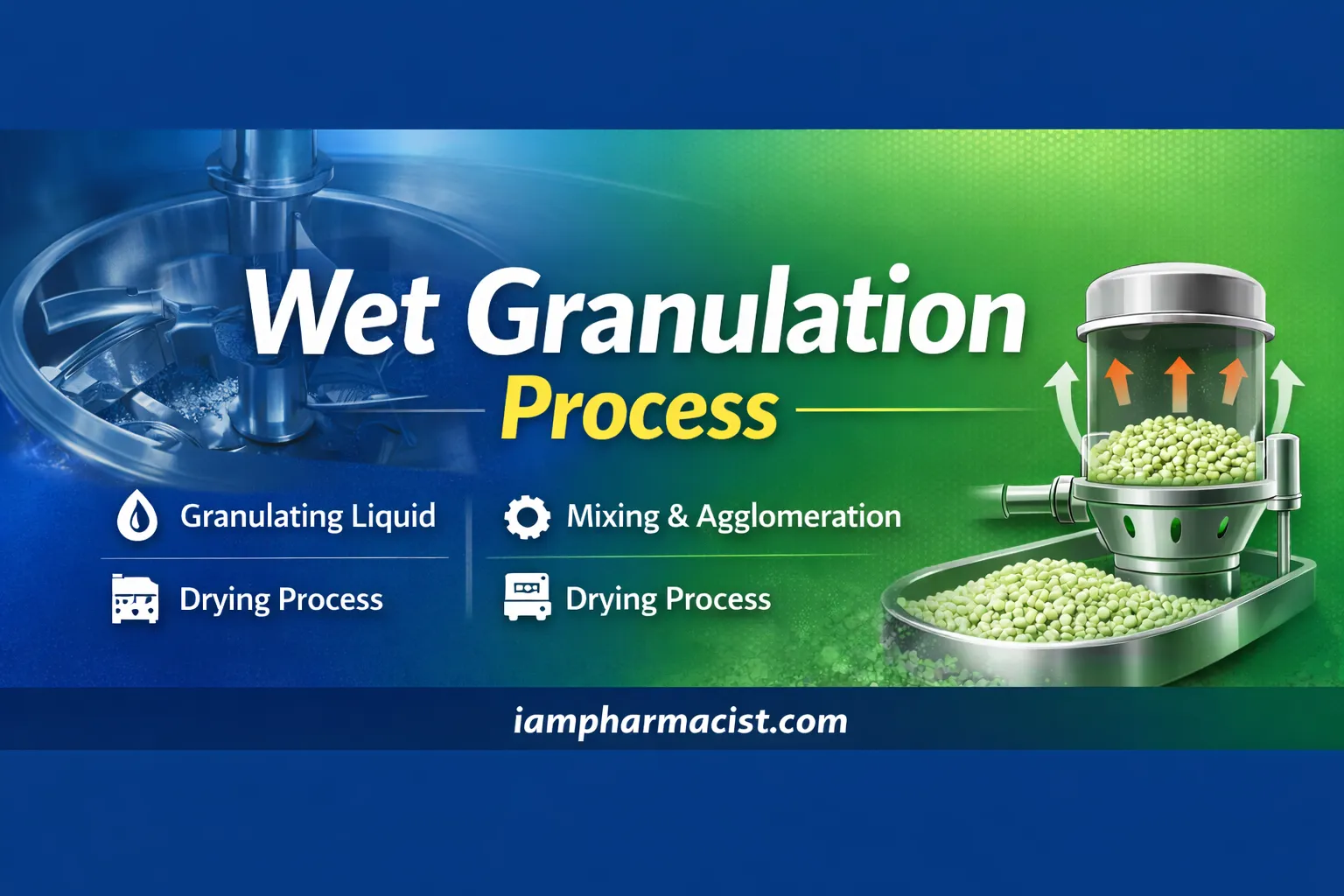

Learn the wet granulation process, steps, equipment, and comparison with dry granulation process in simple terms.
Wet Granulation Process: Complete Guide
The wet granulation process is one of the most widely used methods in pharmaceutical manufacturing. It improves powder flow, compressibility, and uniformity by binding particles together using a liquid solution.
While industries also use the Dry Granulation Process for moisture-sensitive materials, wet granulation remains the preferred choice when stronger and more uniform granules are required.
What is Wet Granulation?
Wet granulation involves combining dry powder particles with a granulating liquid to form granules. This liquid contains a solvent such as water, ethanol, or isopropanol, often mixed with a binder that enhances particle adhesion.
As liquid is added, bridges form between particles, increasing bond strength and creating stable granules.
Types of Granulating Liquids
1. Organic Solvents (Ethanol, Isopropanol)
- Ideal for moisture-sensitive materials
- Fast evaporation
- Higher cost and environmental handling requirements
2. Water (Aqueous Systems)
- Cost-effective and safe
- Easy to handle and dispose
- Longer drying time
- May affect product stability
Key Stages of Wet Granulation
1. Powder Wetting
This stage uses up to 80% of the total liquid. It prepares the powder for granule formation.
2. Nucleation
Small particle clusters (nuclei) begin forming as particles bind together.
3. Agglomeration
Particles collide and combine rapidly, forming larger granules.
Process Changes Over Time
- Particle size increases
- Distribution becomes more uniform
- Granules become more spherical
- Density increases
- Porosity decreases
Types of Wet Granulators
Planetary Mixer
- Used for wet mixing and kneading
- Ensures uniform granule formation
Rapid Mixer Granulator (RMG)
- High-speed mixing with chopper blades
- Efficient and widely used
Single Pot Processor
- Combines granulation and drying in one unit
Drying Methods in Wet Granulation
Tray Dryers
- Traditional method
- Long drying time
- Manual handling required
Fluid Bed Dryers
- Faster drying (minutes instead of hours)
- Uses hot air to fluidize granules
- May cause particle attrition
Microwave / Vacuum Dryers
- Rapid drying at low temperatures
- Limited batch size
Milling, Screening, and Sizing
Milling ensures uniform granule size and removes lumps:
- Wet Milling: Before drying
- Dry Milling: After drying
Equipment like Comil machines push granules through screens without high-energy size reduction.
Binder Preparation Guidelines
- Use clean and calibrated equipment
- Follow standard operating procedures (SOPs)
- Ensure proper documentation and line clearance
- Maintain proper ventilation during preparation
Granule Lubrication
After drying:
- Lubricants like magnesium stearate are added
- Improves flow properties
- Prevents sticking during tablet compression
Fluid Bed Granulation: Pros and Cons
Advantages
- Fast processing
- Combined mixing, granulation, and drying
- Less labor-intensive
Disadvantages
- Risk of uneven mixing
- Particle sticking to filters
- Possible material loss
Wet vs Dry Granulation Process
| Feature | Wet Granulation | Dry Granulation Process |
|---|---|---|
| Liquid Use | Required | Not required |
| Suitable For | Most formulations | Moisture-sensitive materials |
| Cost | Higher | Lower |
| Equipment | Complex | Simpler |
| Granule Strength | High | Moderate |
The Dry Granulation Process is ideal when heat or moisture can damage the product, while wet granulation is preferred for better granule quality.
Frequently Asked Questions (FAQs)
1. What is the wet granulation process used for?
It is used to improve powder flow, compressibility, and uniformity in pharmaceutical manufacturing.
2. How does wet granulation work?
It binds powder particles using a liquid and binder to form granules.
3. What solvents are used in wet granulation?
Common solvents include water, ethanol, and isopropanol.
4. What is the difference between wet and dry granulation?
Wet granulation uses liquid, while the Dry Granulation Process uses compaction without liquid.
5. Why is drying important in wet granulation?
Drying removes solvent and stabilizes the granules.
6. What equipment is used in wet granulation?
Planetary mixers, rapid mixer granulators, and fluid bed dryers are commonly used.
7. What is nucleation in granulation?
It is the initial stage where small particle clusters form.
8. Why are binders used?
Binders help particles stick together and maintain granule strength.
9. What is fluid bed granulation?
It is a process where particles are fluidized with air and sprayed with granulating liquid.
10. When is dry granulation preferred?
When materials are sensitive to heat or moisture.