


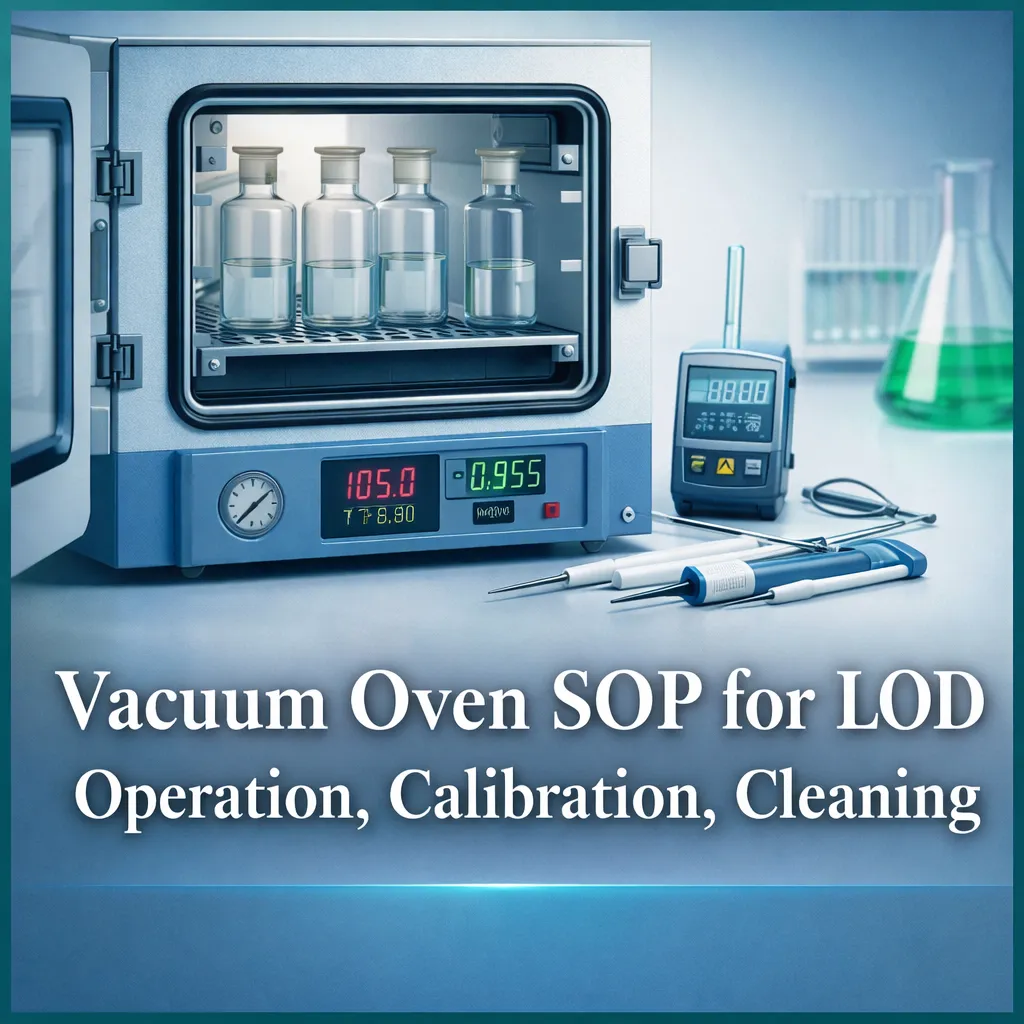

Master vacuum oven SOP for LOD—operation, calibration & cleaning steps to ensure accuracy, safety, and compliance in QC laboratories.
Introduction
In pharmaceutical quality control laboratories, the vacuum oven is a critical instrument used for Loss on Drying (LOD) determination. Accurate moisture analysis depends heavily on proper operation, calibration, and cleaning of the equipment.
A well-defined SOP ensures consistency, compliance with regulatory standards, and reliable results. This guide provides a complete, step-by-step procedure for operating, calibrating, and cleaning a vacuum oven used in LOD testing.
1.0 Objective
To establish a standardized procedure for the operation, calibration, and cleaning of the vacuum oven to ensure accurate and reliable LOD results.
2.0 Scope
This SOP applies to the vacuum oven installed in the Quality Control (QC) laboratory used for loss on drying determination.
3.0 Responsibility
- Doing: Technical Assistant
- Checking: Executive / Manager
4.0 Accountability
- Head of the Department
5.0 Step-by-Step SOP for Vacuum Oven (LOD)
5.1 Operation of Vacuum Oven
5.1.1 Pre-Operation Checks
- Ensure the instrument is clean and calibrated
- Verify vacuum pump functionality
- Check temperature controller and pressure gauge
5.1.2 Loading the Sample
- Place LOD samples in clean, dry bottles
- Position bottles evenly inside the oven
5.1.3 Setting Parameters
- Set required temperature as per method
- Apply vacuum gradually using regulator
5.1.4 Monitoring
- Observe temperature and pressure stability
- Avoid sudden pressure fluctuations
5.1.5 Completion
- After test completion, switch OFF the instrument
5.2 Calibration of Vacuum Oven
5.2.1 Temperature Calibration
- Use a calibrated thermometer or sensor
- Compare displayed vs actual temperature
- Record deviations and adjust if required
5.2.2 Vacuum Calibration
- Verify pressure gauge readings with standard reference
- Ensure accurate vacuum levels
5.2.3 Frequency
- Perform calibration as per SOP schedule (monthly/quarterly)
5.2.4 Documentation
- Maintain calibration records for audit and compliance
5.3 Cleaning Procedure
5.3.1 Switch Off Instrument
- Turn OFF the vacuum oven after use
5.3.2 Release Vacuum
- Slowly release vacuum using pressure regulator
- Ensure zero pressure on gauge
5.3.3 Cooling
- Allow oven to reach room temperature
5.3.4 Remove Samples
- Open door carefully
- Remove LOD bottles and place in desiccator
5.3.5 Remove Waste
- Clear any residue or unidentified materials
5.3.6 Clean Shelves
- Remove shelves and wipe with dry cotton cloth
5.3.7 Clean Inner Chamber
- Use a clean, dry cloth to wipe surfaces
5.3.8 Reassemble
- Place shelves back properly
5.3.9 Restart
- Switch ON and set temperature as required
6.0 Abbreviations
- SOP: Standard Operating Procedure
- LOD: Loss on Drying
Safety Precautions
- Always release vacuum slowly to avoid hazards
- Do not open the oven under pressure
- Use PPE (gloves, goggles, lab coat)
- Ensure proper ventilation
- Avoid contact with hot surfaces
Common Mistakes to Avoid
- Opening oven before pressure normalization
- Skipping calibration checks
- Cleaning with wet cloths
- Improper sample placement
- Ignoring documentation
Best Practices
- Clean the oven after every use
- Maintain calibration logs
- Perform routine maintenance checks
- Train staff regularly on SOP compliance
- Use only validated methods for LOD
FAQs (Frequently Asked Questions)
1. What is a vacuum oven used for in LOD?
It removes moisture under reduced pressure for accurate analysis.
2. Why is calibration important?
To ensure accurate temperature and pressure readings.
3. How often should calibration be done?
As per SOP—typically monthly or quarterly.
4. Can I open the oven under vacuum?
No, always release vacuum first.
5. What PPE is required?
Gloves, goggles, and lab coat.
6. Why is gradual vacuum release important?
To prevent damage and ensure safety.
7. Can water be used for cleaning?
No, use dry cloth unless specified.
8. Where should samples be placed after removal?
In a desiccator.
9. Who is responsible for operation?
Technical Assistant performs; Manager verifies.
10. Why is documentation necessary?
For compliance, traceability, and audits.