


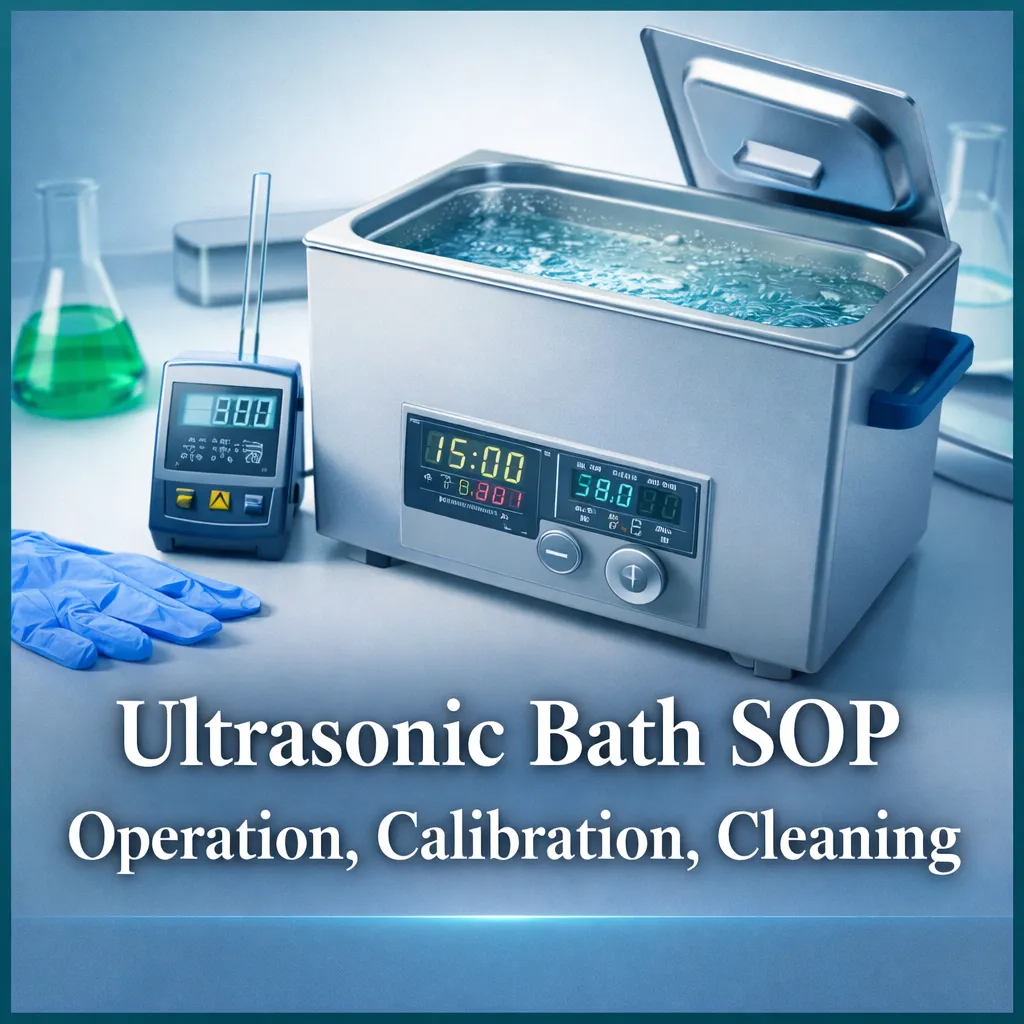

Learn ultrasonic bath SOP for operation, calibration, and cleaning. Ensure accurate results, safety, and compliance in QC laboratories.
Introduction
The ultrasonic bath is an essential laboratory instrument used for cleaning glassware, degassing solvents, and sample preparation in pharmaceutical quality control labs. Proper operation, calibration, and cleaning are critical to ensure consistent performance and accurate results.
This SOP provides a comprehensive guide for handling the ultrasonic bath, ensuring safety, compliance, and efficiency in laboratory operations.
1.0 Objective
To define a standardized procedure for the operation, calibration, and cleaning of the ultrasonic bath.
2.0 Scope
This SOP applies to the ultrasonic bath installed in the Quality Control (QC) laboratory.
3.0 Responsibility
- Doing: Technical Assistant
- Checking: Executive / Manager
4.0 Accountability
- Head of the Department
5.0 Step-by-Step SOP for Ultrasonic Bath
5.1 Operation of Ultrasonic Bath
5.1.1 Pre-Operation Checks
- Ensure the bath is clean and filled with purified water
- Check power supply and control panel
5.1.2 Filling the Bath
- Fill water up to 3/4th level of the tank
- Avoid overfilling
5.1.3 Running the Bath
- Switch ON the mains
- Set required time and temperature (if applicable)
- Place items properly inside the bath
5.1.4 During Operation
- Ensure proper cavitation
- Do not run the bath dry
5.1.5 Completion
- Switch OFF after use
- Remove cleaned items carefully
5.2 Calibration of Ultrasonic Bath
5.2.1 Performance Check (Foil Test)
- Place aluminum foil in the bath
- Run for a few minutes
- Uniform perforation indicates proper functioning
5.2.2 Timer Calibration
- Verify timer accuracy with a calibrated stopwatch
5.2.3 Temperature Verification (if applicable)
- Cross-check temperature with a calibrated thermometer
5.2.4 Frequency
- Perform calibration periodically as per SOP
5.3 Cleaning Procedure (Weekly or As Needed)
Frequency: Once a week or when water becomes dirty
5.3.1 Switch OFF Power
- Turn OFF the mains before cleaning
5.3.2 Remove Lid
- Take off the lid carefully
5.3.3 Clean Lid
- Wash the lid with purified water
5.3.4 Drain and Clean Tank
- Remove water from the bath
- Wash tank with purified water
- Wipe with clean, dry cotton cloth
5.3.5 Refill Water
- Fill purified water up to 3/4th level
5.3.6 Replace Lid
- Put the lid back properly
5.3.7 Documentation
- Record cleaning activity in logbook
Note: If water becomes dirty, repeat steps 5.3.1 to 5.3.7 immediately
6.0 Abbreviations
- SOP: Standard Operating Procedure
Safety Precautions
- Always switch OFF power before cleaning
- Do not operate without water
- Avoid contact with electrical components
- Use PPE (gloves, lab coat)
- Handle hot water carefully if heated
Common Mistakes to Avoid
- Running the bath dry
- Overfilling the tank
- Skipping routine cleaning
- Ignoring calibration checks
- Using contaminated water
Best Practices
- Replace water regularly
- Perform weekly cleaning
- Maintain calibration records
- Use purified water only
- Train staff on proper usage
FAQs (Frequently Asked Questions)
1. What is an ultrasonic bath used for?
It is used for cleaning, degassing, and sample preparation using ultrasonic waves.
2. How often should the bath be cleaned?
At least once a week or when water becomes dirty.
3. What type of water should be used?
Purified water is recommended.
4. Can the bath run without water?
No, it can damage the equipment.
5. What is the foil test?
A method to check ultrasonic performance using aluminum foil.
6. Why is calibration necessary?
To ensure accurate performance and reliability.
7. Who is responsible for cleaning?
Technical Assistant performs; Manager verifies.
8. What happens if the bath is overfilled?
It may lead to spillage and inefficient operation.
9. Is documentation required?
Yes, for compliance and audit purposes.
10. Can dirty water affect performance?
Yes, it reduces cleaning efficiency.