


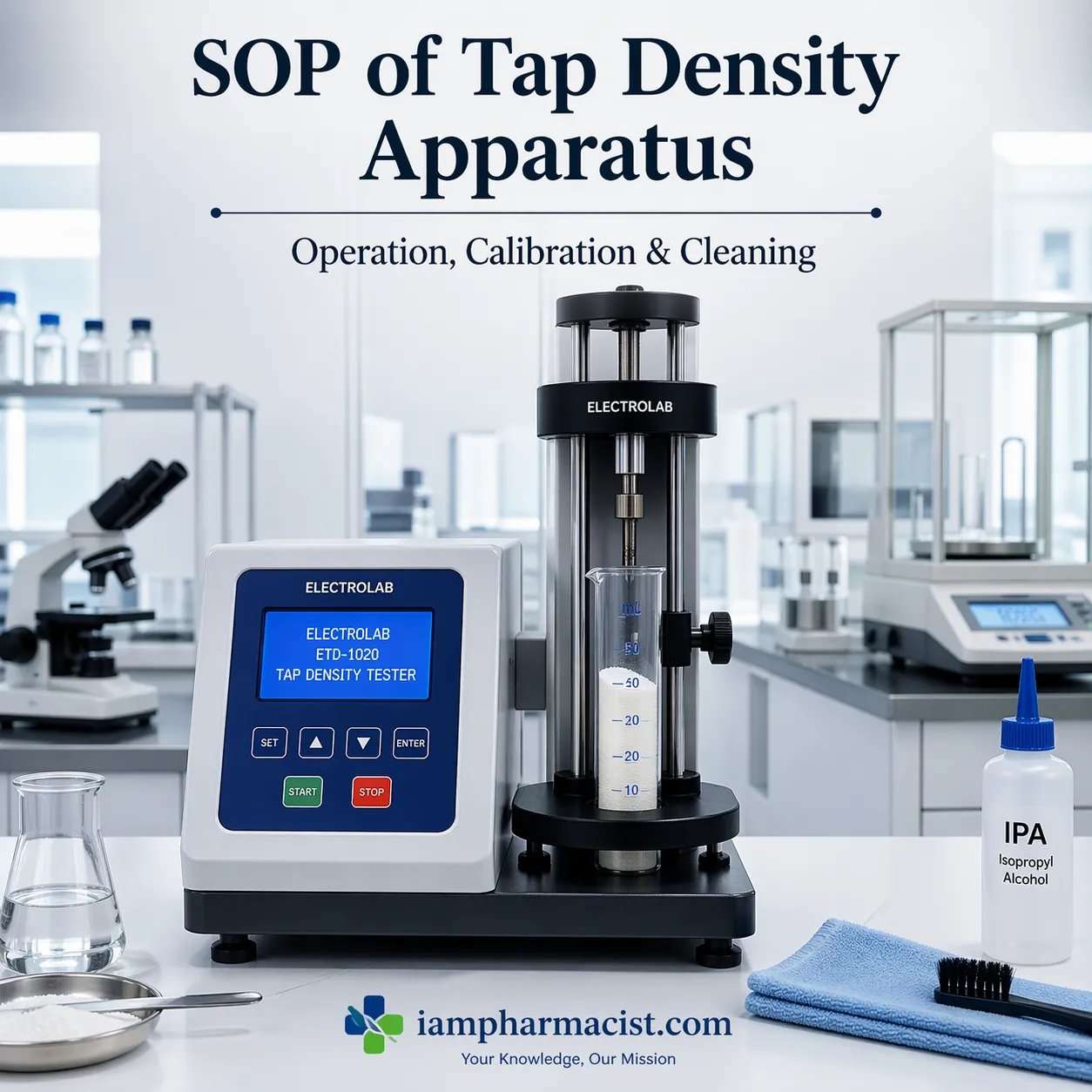

Learn the complete SOP of Tap Density Apparatus including operation, calibration, and cleaning with step-by-step guidance for accurate powder testing.
Introduction
In pharmaceutical and powder-processing industries, accurate density measurement is essential for ensuring product quality, flowability, and compressibility. The Tap Density Apparatus plays a critical role in determining how powders settle under mechanical tapping. This SOP provides a comprehensive, SEO-optimized, and technically accurate guide to operating, calibrating, and maintaining a Tap Density Tester such as the Electrolab ETD-1020.
Definition
Tap density is the density of a powder after it has been mechanically tapped or compacted, calculated as the mass divided by the tapped volume. It indicates powder packing behavior and is widely used in pharmaceutical quality control.
| Parameter | Description |
|---|---|
| Bulk Density | Density before tapping |
| Tapped Density | Density after tapping |
| Tap Count | Number of mechanical taps applied |
| Cylinder Volume | Volume occupied by powder |
| USP Mode | Validated method with reporting |
| User Mode | Custom settings without validation |
Step-by-Step Process
- Switch ON the apparatus and initialize
- Set tap count parameters
- Weigh and load sample
- Record initial volume
- Run tapping cycle
- Measure final tapped volume
- Calculate tapped density
1.0 OBJECTIVE
To describe the operation and calibration procedure of Tap Density Apparatus.
2.0 SCOPE
This SOP is applicable to the operation and calibration procedure of Tap Density Apparatus.
3.0 RESPONSIBILITY
Officer / Executive – Quality Control
4.0 ACCOUNTABILITY
Manager – Quality Control
5.0 PROCEDURE
5.1 Operation
- Ensure the working area is clean.
- Connect the power cord and switch ON the instrument.
- The instrument initializes and displays startup screen:
ELECTROLAB ETD-1020 – TAP DENSITY TESTER
Mode Selection
- Select USP Mode or User Mode:
- USP Mode: Validation + report generation
- User Mode: Stops at set taps without validation
Parameter Setting
- Press SET key
- Configure:
- Tap Count 1 (1–9999)
- Tap Count 2
- Tap Count 3
- Set date & time
- Select print option
Sample Preparation
- Weigh sample and enter weight
- Fill into measuring cylinder
- Level without tapping
- Record initial volume
Test Execution
- Place cylinder in holder
- Lock assembly
- Press START
- Monitor:
- Elapsed taps
- Drops per minute
Post-Test
- Measure tapped volume
- Enter value
- Press ENTER
- Press STOP to display results
- Record usage in logbook
5.2 Calibration Procedure
- Set instrument for:
- 100 taps
- 250 taps
- 750 taps
- 1250 taps
- Count actual taps manually
- Record observations
- Ensure deviation is within acceptable limits
5.3 Cleaning Procedure
- Switch OFF and unplug the instrument
- Remove measuring cylinder and holder
- Clean with dry lint-free cloth
- Avoid water contact with electronic parts
- Clean spills immediately
- Maintain cleaning log
6.0 ABBREVIATIONS
- SOP – Standard Operating Procedure
- USP – United States Pharmacopeia
Technical Insight: Bulk vs Tapped Density
Bulk density reflects powder behavior in its loose state, while tapped density shows its compacted state. The difference helps determine Hausner Ratio and Carr’s Index, key indicators of powder flowability.
FAQs
1. What is a Tap Density Apparatus?
A device used to measure tapped density of powders by mechanically tapping a sample.
2. Why is tapped density important?
It helps assess powder flowability and compressibility in pharmaceuticals.
3. What is USP method for tap density?
A standardized method involving fixed tap counts and validation.
4. What is difference between bulk and tapped density?
Bulk density is before tapping; tapped density is after compaction.
5. How many taps are used in testing?
Typically 100, 250, 750, and 1250 taps.
6. What is Electrolab ETD-1020?
A widely used tap density tester in pharmaceutical labs.
7. How to calibrate tap density apparatus?
By verifying tap counts against set values.
8. What is Hausner Ratio?
Ratio of tapped density to bulk density.
9. What errors occur in tap density testing?
Improper leveling, incorrect volume reading, or calibration issues.
10. How often should calibration be done?
Periodically as per SOP or regulatory requirements.