


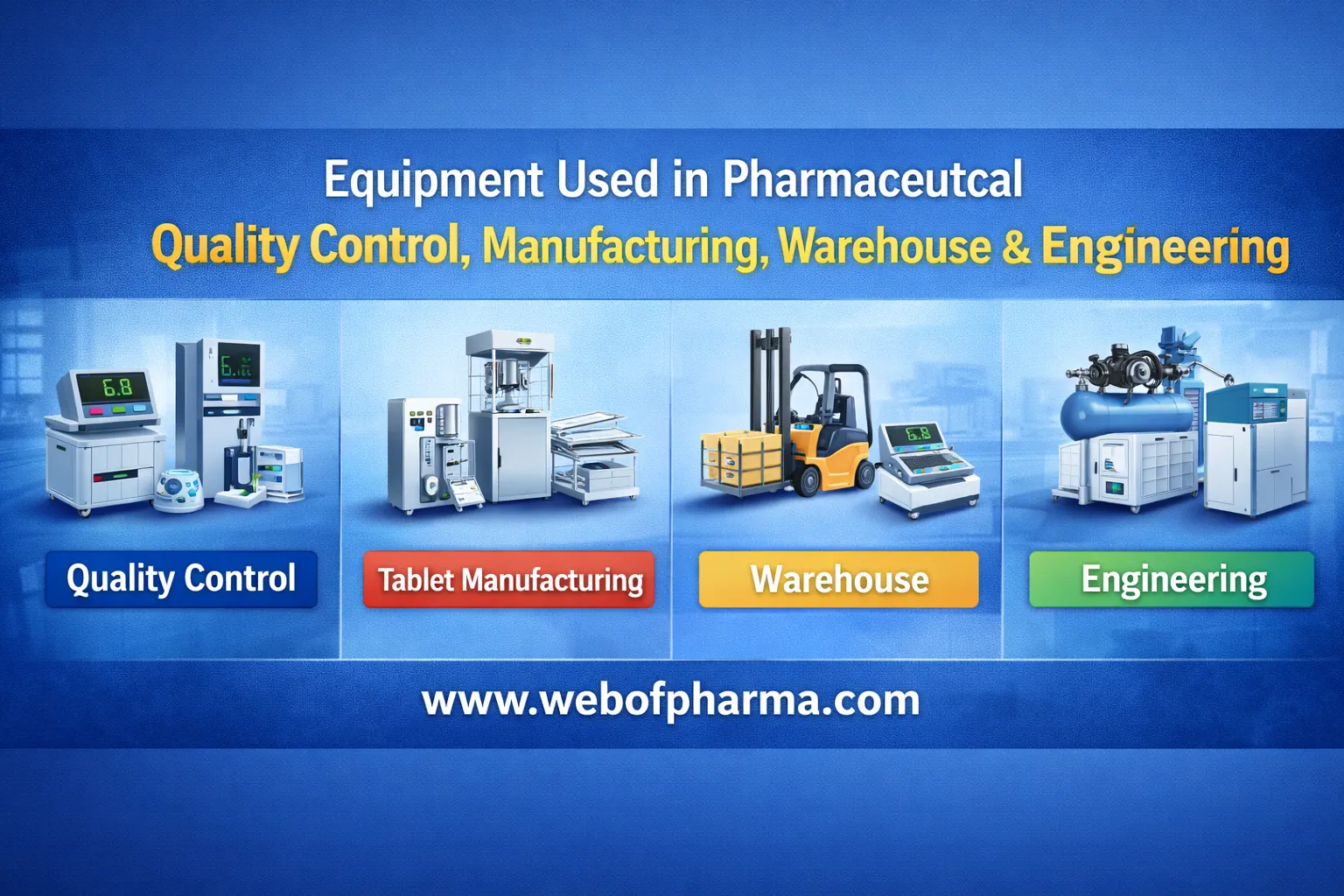

Explore the complete list of all equipment and instruments used in pharmaceutical quality control, tablet manufacturing, liquid manufacturing, warehouse and engineering departments with functions and applications.
Pharmaceutical manufacturing facilities rely on a wide range of equipment and instruments to ensure product quality, safety, and regulatory compliance. From testing raw materials in quality control labs to large-scale production and storage, each department uses specialized tools.
This guide provides a comprehensive list of all equipment and instruments used in pharmaceutical quality control, tablet manufacturing, liquid manufacturing, warehouse and engineering departments, along with their roles in daily operations.
1. Equipment Used in Pharmaceutical Quality Control (QC)
Quality Control laboratories are responsible for testing raw materials, in-process samples, and finished products.
Key Instruments:
- Analytical Balance
- Autoclave (Manual & Automatic)
- Autotitrator
- Bacteriological Incubator
- BOD Incubator
- Burst Strength Tester
- Centrifuge
- Colony Counter
- Conductivity Meter
- Digital Vernier Caliper
- FTIR (Fourier Transform Infrared Spectrometer)
- Fuming Cupboard
- Heating Mantle (500 ml & 1000 ml)
- Hot Air Oven
- HPLC (High Performance Liquid Chromatography)
- Karl Fischer Titrator
- Laminar Air Flow Unit
- Magnetic Stirrer
- Melting Point Apparatus
- Microscope
- Milli-Q Water System
- Muffle Furnace
- pH Meter
- Polarimeter
- Refractometer
- Refrigerated Water Bath
- Sieve Shaker
- Sonicator
- Stability Chambers (30°C/60%RH, 30°C/65%RH, 40°C/75%RH)
- UV-Visible Spectrophotometer
- Vacuum Oven
- Viscometer
- Zone Reader
Purpose:
These instruments ensure:
- Accurate chemical analysis
- Microbiological testing
- Stability studies
- Compliance with pharmacopeial standards
2. Equipment Used in Tablet Manufacturing
Tablet manufacturing involves granulation, blending, compression, coating, and packaging.
Key Equipment:
- Blister Packing Machine
- Bunker
- Cage Blender
- Capsule Filling Machine
- Coating Machine
- Colloid Mill
- Co-Mill
- Compression Machine (Tablet Press)
- Fluid Bed Dryer (FBD)
- Leak Test Apparatus
- Rapid Mixer Granulator (RMG)
- Strip Packing Machine
- Tippler
- Vibro Sifter
- Weighing Balance
Purpose:
These machines are used for:
- Mixing and granulation
- Drying and size reduction
- Tablet compression and coating
- Packaging and quality assurance
3. Equipment Used in Liquid Manufacturing
Liquid dosage forms require precise mixing, filtration, and filling systems.
Key Equipment:
- Basket Filter
- Homogenizer
- In-Line Homogenizer
- Inspection System
- Labeling Machine
- Bottle Washing Machine
- Lobe Pump
- Manufacturing Vessel
- Filling & Sealing Machine (Mono Bloc)
- Packing Conveyor
- ROPP Cap Loader
- Steam Jacketed Vessel
- Storage Vessel
- Strapping Machine
- Sugar Syrup Manufacturing Vessel
- Turn Table
- Zero Holdup Filter Press
Purpose:
Used for:
- Mixing and emulsification
- Filtration and purification
- Filling and packaging
- Ensuring product uniformity
4. Equipment Used in Warehouse
Warehouse operations focus on material handling, storage, and dispensing.
Key Equipment:
- Cage Trolley
- Drum Carrier, Lifter, and Tilter
- Electronic Weighing Balances (3kg to 600kg)
- High Reach Stacker
- Hydraulic Trolley
- RLAF (Reverse Laminar Air Flow)
- SS Dust Bin
- SS Writing Table
- Stacker Charger
- Standard Weight Box
- Vacuum Cleaner
Purpose:
These tools help in:
- Safe material handling
- Accurate weighing
- Clean storage conditions
- Inventory management
5. Equipment Used in Engineering Department
The engineering department ensures utilities and systems run smoothly across the facility.
Key Equipment:
- Air Compressor
- Air Dryer
- Boiler
- Chiller
- Cooling Tower
- DG Set (Diesel Generator)
- Distribution Pumps
- Feed Pumps
- Purified Water System
- Softener Plant
- Transformer
- VCB Panel (HT Panel)
- Chilled Water Circulation Pump
- Condensate Recovery System
Purpose:
Supports:
- Utility generation (steam, air, water)
- HVAC and temperature control
- Power supply and backup
- Water treatment systems
Conclusion
The pharmaceutical industry depends heavily on specialized equipment across different departments. This list of all equipment and instruments used in pharmaceutical quality control, tablet manufacturing, liquid manufacturing, warehouse and engineering departments highlights how each tool contributes to product quality, safety, and efficiency.
Understanding these instruments not only helps in regulatory compliance but also improves operational excellence in pharmaceutical manufacturing.
Frequently Asked Questions (FAQs)
1. Why is equipment important in pharmaceutical manufacturing?
Equipment ensures accurate production, testing, and compliance with regulatory standards.
2. What are the main departments in a pharma plant?
Quality Control, Manufacturing, Warehouse, and Engineering are the key departments.
3. What is the role of HPLC in QC?
HPLC is used for precise chemical analysis and quantification of compounds.
4. What equipment is used in tablet compression?
Compression machines (tablet presses) are used to form tablets from granules.
5. Why are stability chambers used?
They simulate environmental conditions to study product shelf life.
6. What is a fluid bed dryer used for?
It dries granules during tablet manufacturing.
7. What is the function of a homogenizer?
It ensures uniform mixing of liquid formulations.
8. Why is RLAF used in warehouses?
It provides clean air to prevent contamination during material handling.
9. What is the purpose of a purified water system?
It produces high-quality water required for pharmaceutical processes.
10. How does engineering support pharma production?
Engineering ensures utilities like water, air, power, and temperature systems operate efficiently.