



Learn SOP for washing HPLC columns after analysis, including solvent selection, flushing methods, and storage practices for accurate results.
📌 Definition
Washing an HPLC column after analysis is a controlled process of flushing the column with appropriate solvents to remove residual analytes, prevent contamination, and maintain chromatographic performance and column lifespan.
🔢 Step-by-Step SOP
- Select appropriate washing solvent
- Flush column with minimum 30 ml solvent
- Maintain recommended flow rate
- Follow column-specific cleaning method
- Rinse with water if required
- Disconnect column from system
- Store in designated area
🔍 Introduction
High Performance Liquid Chromatography (HPLC) columns are critical components in analytical testing. Improper cleaning can lead to carryover, peak distortion, and reduced column life. This SOP ensures systematic cleaning of HPLC columns after each analysis, maintaining accuracy, reproducibility, and compliance with Good Laboratory Practices (GLP).
🧠 Semantic Content Layer
HPLC column maintenance involves proper flushing with compatible solvents, controlled flow rates, and appropriate storage conditions. Different column chemistries such as C18, protein pack, and L17 require specific cleaning procedures. Adhering to SOP minimizes contamination, enhances column efficiency, and ensures reliable chromatographic results in QC laboratories.
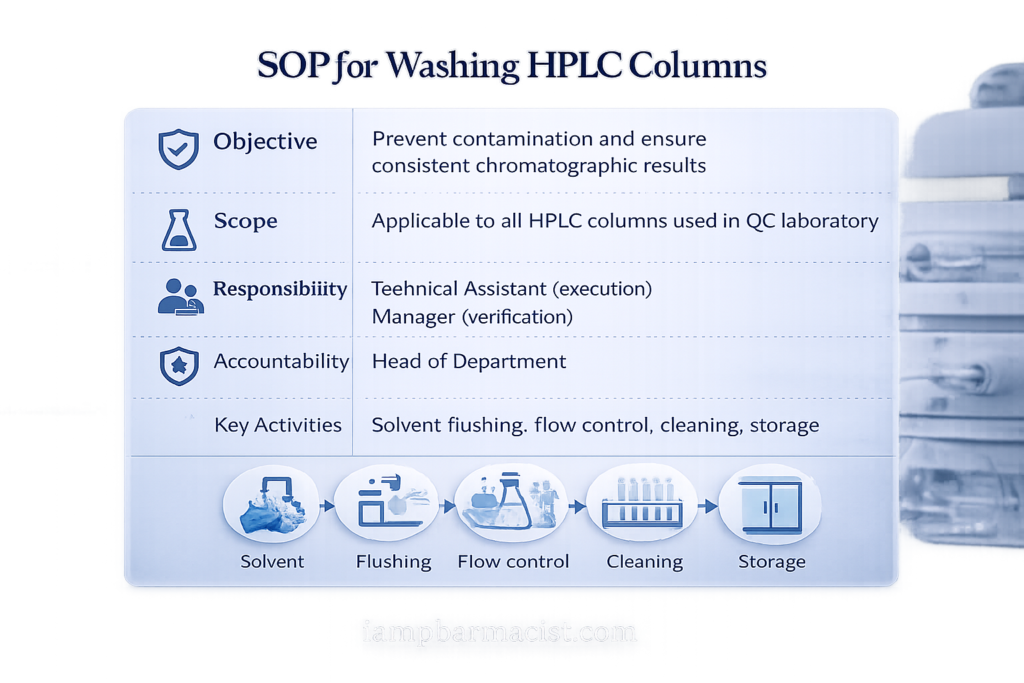
1.0 OBJECTIVE
To clean the HPLC column thoroughly after each use to avoid interference during repeated analysis.
2.0 SCOPE
Applicable to all types of HPLC columns used in Quality Control laboratories.
3.0 RESPONSIBILITY
- 3.1 Doing: Technical Assistant
- 3.2 Checking: Executive / Manager
4.0 ACCOUNTABILITY
Head of the Department
5.0 PROCEDURE
5.1 Operation (General Column Washing)
- Wash column with solvent used in mobile phase preparation
- Example: If water is used, flush with water
- Allow minimum 30 ml solvent to pass through column
- Maintain recommended flow rate
- Disconnect and store properly
5.2 Column-Specific Cleaning Procedures
5.2.1 C18, C8, C6, Phenyl, CN, Amine, Silica Columns
- Flush with mobile phase solvent
- Use minimum 30 ml washing medium
- Disconnect column after washing
- Store in designated area
5.2.2 Protein Pack Column
- Wash with minimum 30 ml of 2.5 M acetic acid
- Ensure complete flushing
- Disconnect and store properly
5.2.3 L17 Column
- Change mobile phase to:
0.01 N H₂SO₄ : ACN (85:15 v/v) - Flush at 0.6 ml/min for 2 hours
- Do not exceed flow rate limit
- Flush with water at same flow rate for 2 hours
- Disconnect and store
5.3 Calibration (Performance Assurance)
- Verify column performance after cleaning
- Check pressure, peak shape, and baseline stability
- Ensure no carryover or contamination
5.4 Cleaning & Storage Control
- Store columns in designated clean area
- Use end caps to prevent drying
- Avoid exposure to contaminants
6.0 ABBREVIATIONS
- HPLC: High Performance Liquid Chromatography
- PSI: Pound per Square Inch
- ACN: Acetonitrile
- H₂SO₄: Sulphuric Acid
- nm: Nanometer
- ml: Millilitre
- v/v: Volume by Volume
❓ FAQs
1. Why is HPLC column washing important?
It prevents contamination and ensures accurate results.
2. How much solvent is required for washing?
Minimum 30 ml is recommended.
3. Can water be used for column cleaning?
Yes, if compatible with mobile phase.
4. What is the flow rate for L17 column cleaning?
0.6 ml/min.
5. Why is flow rate control important?
To avoid column damage.
6. How are protein columns cleaned?
Using 2.5 M acetic acid.
7. What happens if column is not cleaned properly?
It leads to poor peak shape and contamination.
8. Should columns be disconnected after cleaning?
Yes, for proper storage.
9. How should columns be stored?
In a clean, designated area with end caps.
10. Who is responsible for column cleaning?
Technical Assistant performs, Manager verifies.