



Complete SOP for storage & use of reagents in QC, including labeling, shelf life, safety, and compliance practices.
📌 Definition
Storage and use of reagents and chemicals in Quality Control refers to a controlled process of labeling, storing, handling, and disposing of chemicals to ensure safety, accuracy of results, and compliance with regulatory standards.
📊 Table Snippet (Data Type)
| Section | Description |
|---|---|
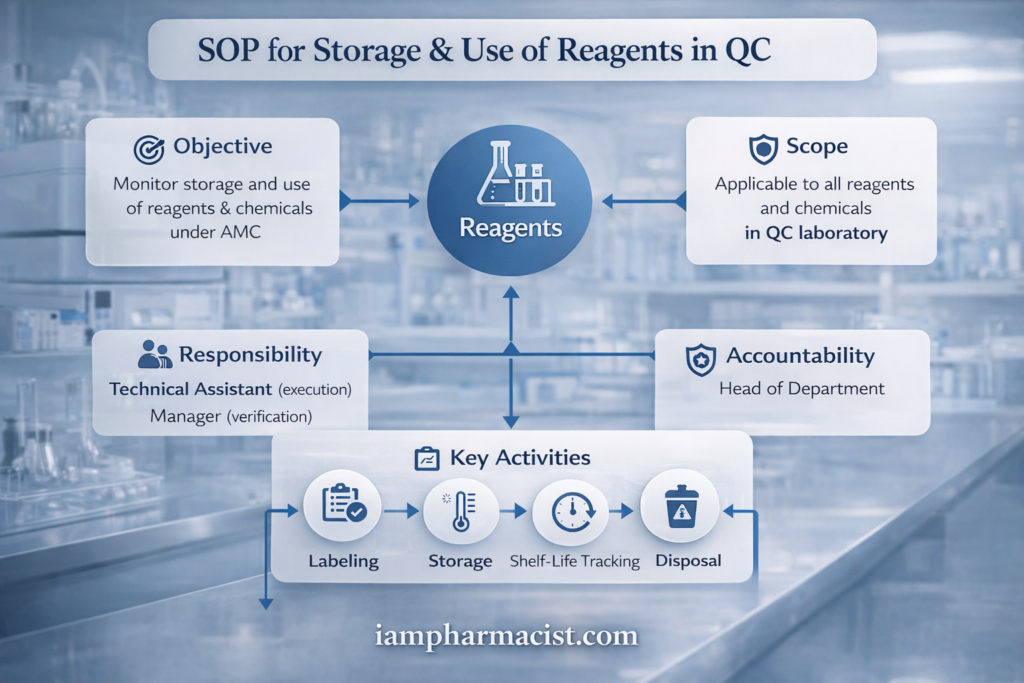
| Objective | Monitor storage and use of reagents & chemicals in QC |
| Scope | Applicable to all reagents and chemicals in QC laboratory |
| Responsibility | Technical Assistant (execution), Manager (verification) |
| Accountability | Head of Department |
| Key Activities | Labeling, storage, handling, shelf-life tracking, disposal |
🔢 Step-by-Step SOP
- Label chemicals with receipt and expiry dates
- Assign shelf life for sealed containers (5 years)
- Label date of opening and “use before” date
- Assign 2-year shelf life after opening
- Record details without hiding manufacturer label
- Store chemicals under recommended conditions
- Dispose after expiry as per SOP
- Store hazardous chemicals separately as per MSDS
🔍 Introduction
Proper storage and handling of reagents and chemicals are critical in Quality Control laboratories to ensure accurate test results, safety compliance, and regulatory adherence. A well-defined SOP minimizes risks such as contamination, degradation, and hazardous exposure while maintaining data integrity and laboratory efficiency.
🧠 Semantic Content Layer
Reagent and chemical management in QC laboratories involves systematic labeling, controlled storage conditions, defined shelf life, and safe handling practices. Adhering to SOP ensures traceability, prevents analytical errors, and aligns with Good Laboratory Practices (GLP). Integration of Material Safety Data Sheet (MSDS) guidelines further strengthens safety and compliance frameworks.
1.0 OBJECTIVE
To monitor the storage and use of reagents and chemicals in the Quality Control laboratory.
2.0 SCOPE
This procedure applies to all reagents and chemicals received and used in the QC laboratory.
3.0 RESPONSIBILITY
- 3.1 Doing: Technical Assistant
- 3.2 Checking: Executive / Manager
4.0 ACCOUNTABILITY
Head of the Department
5.0 PROCEDURE
5.1 Operation (Handling & Labeling)
- Label all reagents/chemicals with date of receipt and expiry date
- Assign shelf life of 5 years for sealed containers
- Upon opening, label with date of opening and use-before date
- Assign 2-year shelf life after opening
- Ensure labels do not obscure manufacturer’s label
- Maintain proper documentation and traceability
5.2 Calibration (Quality Assurance Context)
- Verify reagents before use in analytical testing
- Ensure chemicals meet required standards/specifications
- Cross-check expiry and integrity before calibration/testing
- Maintain records for audit and validation
5.3 Cleaning (Storage & Safety Practices)
- Store chemicals at recommended temperature and conditions
- Keep storage areas clean, dry, and contamination-free
- Segregate incompatible and poisonous chemicals
- Follow MSDS guidelines for safe storage and handling
- Dispose expired chemicals as per SOP
6.0 ABBREVIATIONS
- EXP: Expiry
- MSDS: Material Safety Data Sheet
❓ FAQs
1. What is the SOP for reagent storage in QC?
It defines labeling, storage, handling, and disposal procedures to ensure safety and accuracy.
2. Why is labeling important for chemicals?
It ensures traceability and prevents misuse or expired usage.
3. What is the shelf life of sealed reagents?
Typically 5 years unless specified otherwise.
4. What happens after opening a reagent?
It is assigned a 2-year shelf life with a “use before” label.
5. What is MSDS in QC laboratories?
It provides safety guidelines for handling hazardous chemicals.
6. How should chemicals be stored?
At recommended temperature and environmental conditions.
7. Can expired chemicals be used?
No, they must be disposed of as per SOP.
8. Who is responsible for chemical management?
Technical Assistant executes; Manager verifies.
9. Why is segregation of chemicals necessary?
To prevent reactions, contamination, and hazards.
10. How does proper storage impact QC results?
Ensures accuracy, reliability, and compliance.