



Learn a complete SOP for preventive maintenance of QC instruments, including AMC management, calibration, cleaning, and compliance-ready procedures.
📌 Definition
Preventive maintenance of Quality Control (QC) instruments refers to a systematic, scheduled process of servicing, inspection, calibration, and cleaning to ensure optimal performance, accuracy, and compliance with regulatory standards while minimizing unexpected breakdowns.
📊 Table Snippet (Data Type)
| Section | Description |
|---|---|
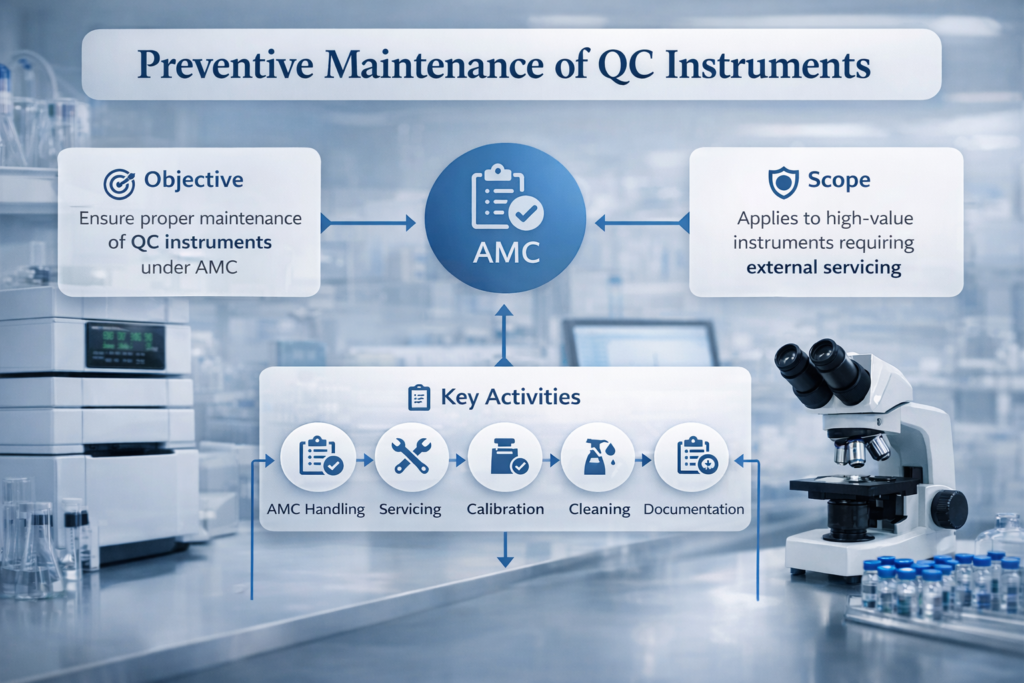
| Objective | Ensure proper maintenance of QC instruments under AMC |
| Scope | Applies to high-value instruments requiring external servicing |
| Responsibility | Service Engineer (execution), Manager (verification) |
| Accountability | Head of Department |
| Key Activities | AMC handling, servicing, calibration, cleaning, documentation |
🔢 Step-by-Step SOP
- Identify instruments under AMC coverage
- Contact supplier post-warranty for AMC proposal
- Evaluate AMC terms, cost, and service scope
- Finalize and sign annual contract
- Maintain instrument maintenance records
- Follow preventive maintenance schedulehttps://iampharmacist.com/analytical-method-validation-2/
- Perform servicing as per AMC agreement
- Renew AMC annually
🔍 Introduction
In modern Quality Control laboratories, instrument reliability directly impacts product quality, compliance, and operational efficiency. Preventive maintenance ensures that high-value QC instruments function accurately and consistently, reducing downtime and regulatory risks. This SOP provides a structured, compliant approach to managing maintenance under Annual Maintenance Contracts (AMC).
🧠 Semantic Content Layer
Preventive maintenance of laboratory instruments involves periodic inspection, calibration, cleaning, and servicing aligned with manufacturer guidelines and AMC agreements. A well-defined SOP ensures traceability, compliance with quality standards, and improved instrument lifecycle management. Proper documentation and adherence to schedules are critical for maintaining data integrity and audit readiness.
1.0 OBJECTIVE
To establish a standardized procedure for preventive maintenance of all Quality Control instruments covered under Annual Maintenance Contract (AMC).
2.0 SCOPE
Applicable to sophisticated and high-value instruments that cannot be serviced internally by routine maintenance or engineering staff and require external expert support.
3.0 RESPONSIBILITY
- 3.1 Doing: Service Engineer
- 3.2 Checking: Executive / Manager
4.0 ACCOUNTABILITY
Head of the Department
5.0 PROCEDURE
5.1 AMC Management
- List all QC instruments requiring AMC coverage
- Contact suppliers after warranty expiry for AMC proposals
- Review contract terms, service scope, and cost
5.2 Contract Finalization
- Clarify queries with the supplier
- Finalize and sign AMC agreement (typically 1 year)
- Ensure inclusion of service frequency and response time
5.3 Operation & Maintenance
- Maintain instrument maintenance cards/logbooks
- Record servicing details and parts replaced
- Follow AMC-defined maintenance schedule
5.4 Calibration
- Ensure calibration is performed as per schedule
- Verify calibration certificates and compliance standards
- Maintain calibration records for audits
5.5 Cleaning
- Perform routine cleaning as per instrument SOP
- Ensure contamination-free environment
- Document cleaning activities
5.6 Preventive Maintenance Execution
- Carry out maintenance as per AMC schedule
- Monitor instrument performance post-service
- Address deviations immediately
5.7 AMC Renewal
- Review service performance annually
- Renew contract under agreed terms
6.0 ABBREVIATIONS
- Q.C: Quality Control
- A.M.C.: Annual Maintenance Contract
❓ FAQs
1. What is preventive maintenance in QC instruments?
It is a scheduled process of servicing, calibration, and inspection to ensure accuracy and reliability.
2. Why is AMC important for QC instruments?
AMC ensures expert servicing, reduces downtime, and extends instrument life.
3. How often should QC instruments be maintained?
As per AMC schedule or manufacturer recommendations.
4. What records are required for maintenance?
Maintenance logs, calibration records, and service reports.
5. Who is responsible for preventive maintenance?
Service engineers execute, while managers verify.
6. What is included in preventive maintenance?
Inspection, calibration, cleaning, and part replacement.
7. How does maintenance impact compliance?
Ensures audit readiness and regulatory adherence.
8. What happens if maintenance is skipped?
It may lead to inaccurate results and equipment failure.
9. How are AMC contracts evaluated?
Based on cost, service scope, and response time.
10. Can preventive maintenance reduce costs?
Yes, by preventing major breakdowns and extending equipment lifespan.