


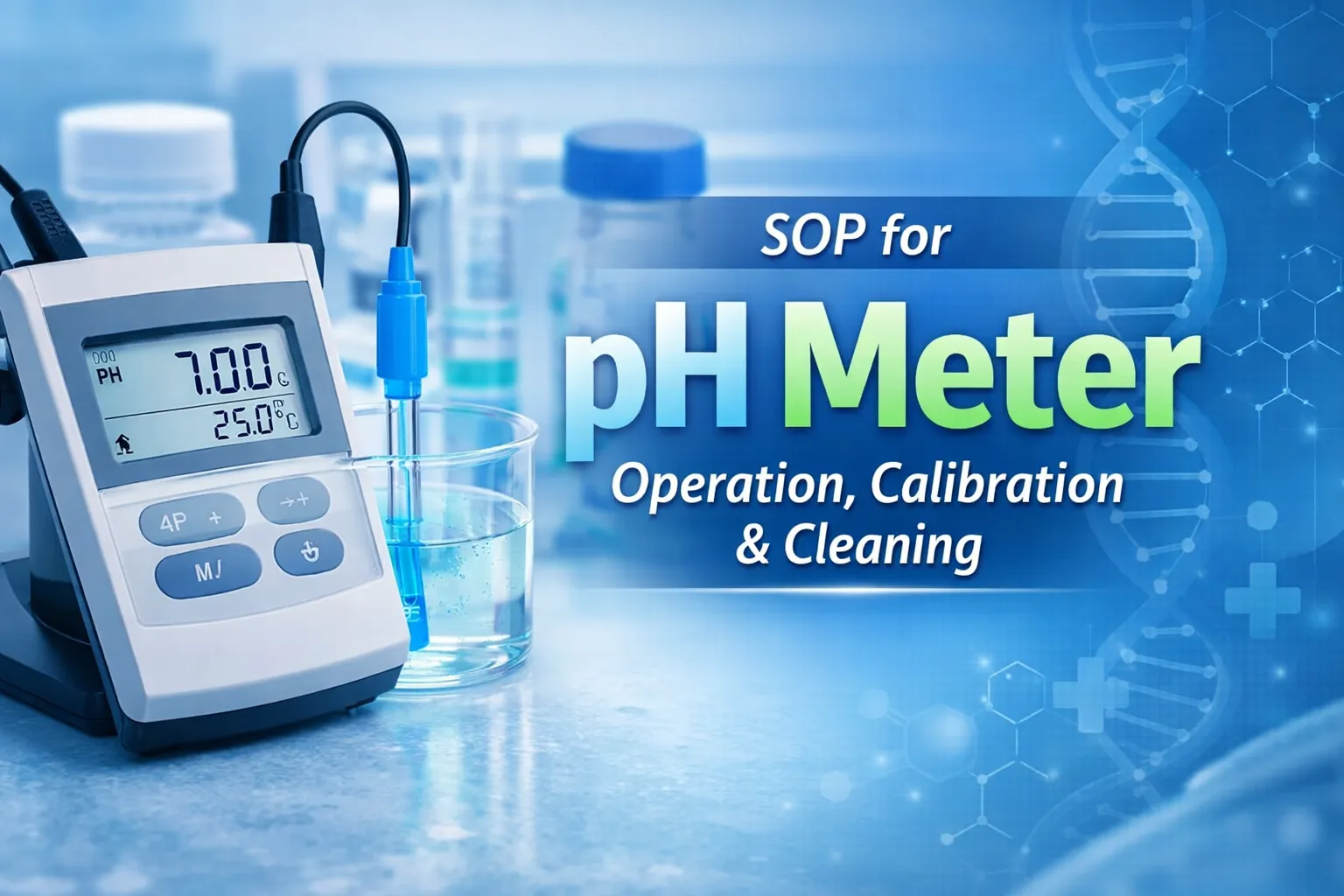

Learn SOP for pH meter operation, calibration, cleaning & electrode activation. Step-by-step guide for accurate QC results.
Introduction
Accurate pH measurement is critical in pharmaceutical Quality Control (QC), microbiology, and laboratory testing. A small error in pH reading can impact product quality, stability, and compliance. That is why following a strict SOP for pH meter operation, calibration, cleaning, and electrode activation is essential.
In this detailed guide, you will learn a step-by-step procedure to operate, calibrate, clean, and maintain a pH meter for reliable and accurate results.
1. Purpose
To define a standardized procedure for the operation, calibration, cleaning, and maintenance of the pH meter used in the QC laboratory.
2. Scope
This SOP applies to all pH meters installed and used in the Quality Control and microbiology departments.
3. Responsibility
- QC Analyst / Microbiologist: Operation and routine maintenance
- Head of Department: Overall compliance and review
4. Key Functions of pH Meter
Understanding controls is the first step in proper operation:
- ON/OFF: Switch instrument ON or OFF
- CAL/MEAS: Enter calibration or measurement mode
- HOLD/ENTER: Freeze reading or confirm calibration
- MI/▲: Store data and navigate menu upward
- MR/▼: Recall stored data and navigate downward
- SETUP: Configure system settings and calibration data
- MODE: Select measurement type (pH/temperature)
5. Procedure
5.1 Electrode Cleaning Procedure
Proper cleaning improves accuracy and extends electrode life.
5.1.1 Salt Deposits
- Immerse electrode in raw water for 10–15 minutes
- Rinse with de-ionized water
5.1.2 Oil or Grease Contamination
- Wash with mild detergent solution
- Rinse thoroughly with de-ionized water
5.1.3 Clogged Junction
- Heat KCl solution (60–80°C)
- Soak electrode for 10 minutes
- Allow cooling in fresh KCl solution
5.2 Electrode Activation Procedure
If electrode shows slow or unstable response:
- Immerse in pH 5.00/5.01 buffer solution
- Keep for 1–2 hours
- If no improvement, proceed to rejuvenation process
5.3 Operation of pH Meter
Follow these steps for accurate pH measurement:
- Turn ON the pH meter
- Rinse electrode with de-ionized water
- Maintain sample temperature at 25°C ± 2°C
- Fully immerse electrode and temperature probe
- Stir gently for uniform sample distribution
- Wait for stable reading
- Press HOLD/ENTER to lock value
- Record pH and temperature
- Rinse electrode after use
- Store properly in buffer or storage solution
5.4 pH Meter Calibration Procedure (Daily)
Calibration ensures accuracy and compliance.
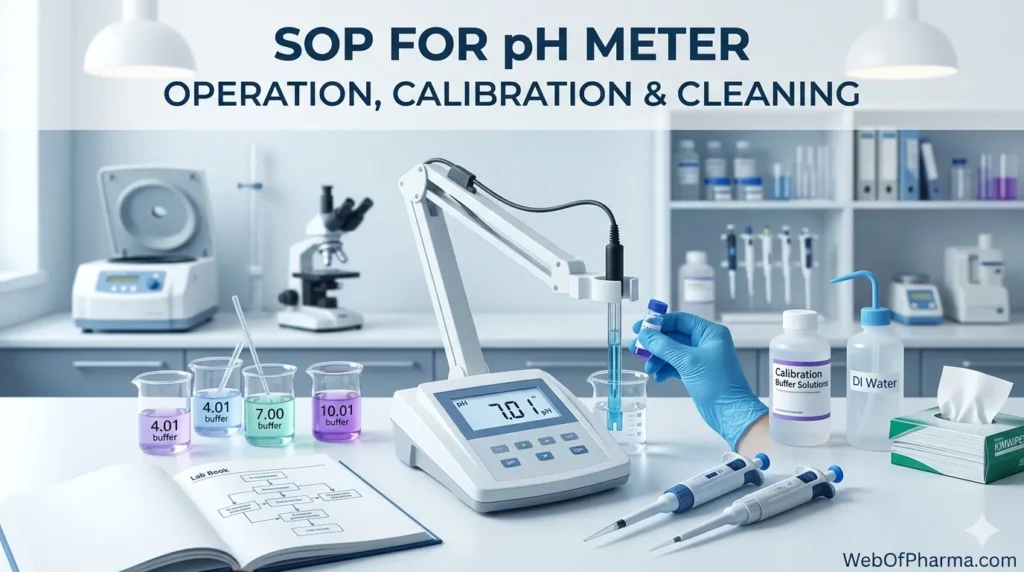
Buffers Used:
- pH 1.68
- pH 5.00/5.01
- pH 7.00/7.01
- pH 10.00/10.01
- pH 12.45
Steps:
- Select calibration mode (CAL/MEAS)
- Rinse electrode (do not wipe)
- Immerse in buffer solution
- Wait for stable reading
- Press HOLD/ENTER to confirm
- Repeat for all calibration points
- Return to measurement mode automatically
- Record calibration data
✔ Always use fresh buffer solutions weekly for accuracy.
5.5 Electrode Slope Determination
After calibration:
- Go to SETUP mode
- Navigate to parameter P3.0
- View offset value
- Proceed to slope display
- Record electrode slope (%)
✔ Normal slope ensures proper electrode performance.
5.6 Storage of pH Electrode
Proper storage prevents damage:
- Always keep bulb wet
- Store in pH 5.00/5.01 buffer solution
- Raw water can be used if buffer unavailable
- Never store in de-ionized water
- Check electrode integrity before use
5.7 Electrode Rejuvenation Procedure
If electrode fails calibration:
- Dip in ethyl alcohol (5 minutes)
- Rinse in tap water (15 minutes)
- Immerse in acid (HCl/H₂SO₄) for 5 minutes
- Rinse in tap water (15 minutes)
- Immerse in NaOH solution (5 minutes)
- Rinse in raw water (15 minutes)
- Retest using buffer solution
If still not working → replace electrode.
6. Best Practices for pH Meter Maintenance
- Calibrate daily before use
- Avoid touching glass bulb
- Do not wipe electrode dry
- Always use fresh buffers
- Store electrode properly
- Record all maintenance activities
FAQs (Frequently Asked Questions)
1. What is SOP for pH meter?
It is a documented procedure for operating, calibrating, cleaning, and maintaining a pH meter in a laboratory.
2. How often should a pH meter be calibrated?
Ideally, it should be calibrated daily before use.
3. Why should we not wipe the pH electrode?
Wiping creates static charge and affects measurement accuracy.
4. What is used to store a pH electrode?
pH 5.00/5.01 buffer solution is commonly used for storage.
5. What causes slow pH electrode response?
Dehydration, contamination, or clogged junction are common causes.
6. What is electrode slope in pH meter?
It indicates electrode performance efficiency, expressed in percentage.
7. Can distilled water be used for electrode storage?
No, it damages the electrode due to ion depletion.
8. What is the standard temperature for pH testing?
Usually 25°C ± 2°C unless otherwise specified.
9. How many buffer solutions are used in calibration?
Typically 3 to 5 buffers covering acidic, neutral, and alkaline ranges.
10. When should an electrode be replaced?
When rejuvenation fails and slope or response is no longer acceptable.