


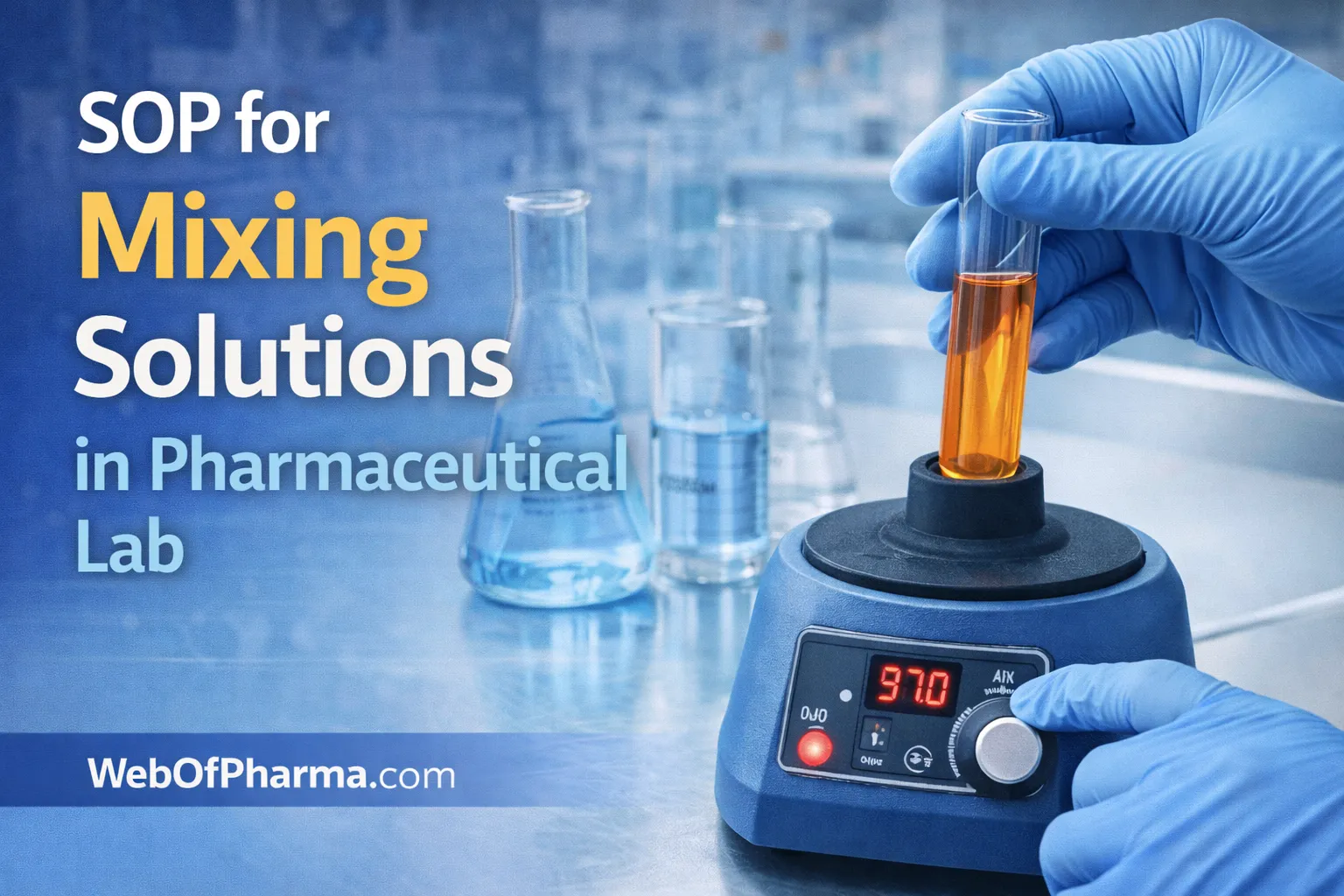

Learn SOP for mixing solutions and dissolving substances in solvents. Ensure accuracy & consistency.
In pharmaceutical laboratories, even a small mistake in solution preparation can affect the entire analysis. That’s why a proper SOP for mixing solutions in pharmaceutical laboratory is essential to ensure accuracy, consistency, and reproducibility.
This SOP provides a simple, step-by-step guide for safely mixing solutions or dissolving substances into solvents using standard lab equipment.
1. Objective of the SOP
The main objective is to:
- Ensure proper mixing of solutions
- Achieve complete dissolution of substances
- Maintain consistency in laboratory results
- Prevent operational errors
2. Scope
This SOP applies to:
- Preparation of solutions in QC laboratories
- Dissolving solid or liquid substances into solvents
- Routine laboratory mixing operations
3. Roles and Responsibilities
3.1 Responsible Personnel
- Technical Assistant / Executive: Perform mixing operations
- Executive / Manager: Verify and supervise
3.2 Accountability
- Head of Department: Ensure SOP compliance
4. Equipment Used
Common equipment for mixing includes:
- Vortex mixer
- Magnetic stirrer
- Test tubes and beakers
👉 Proper equipment selection improves efficiency and accuracy.
5. Step-by-Step Mixing Procedure
5.1 Start-Up Process
- Switch ON the mains power supply
- Switch ON the instrument
- Confirm red indicator light is glowing
👉 This indicates the instrument is ready for operation.
5.2 Mixing Operation
- Place the test tube on the rubber pad
- Adjust the speed using the control knob
- Allow the solution to mix until fully dissolved
👉 Ensure uniform mixing for accurate results.
5.3 Completion of Operation
- Turn the speed knob anticlockwise (reduce speed)
- Switch OFF the instrument
- Switch OFF the mains power supply
👉 Always follow proper shutdown procedures to avoid damage.
6. Important Safety Precautions
- Ensure equipment is clean before use
- Do not overload the instrument
- Avoid splashing or spillage
- Use appropriate containers for mixing
- Wear proper PPE (gloves, lab coat, goggles)
7. Best Practices for Solution Preparation
- Use accurate measurements for solute and solvent
- Add solute slowly to avoid clumping
- Use proper mixing speed (not too high)
- Label prepared solutions clearly
- Record preparation details in logs
8. Common Mistakes to Avoid
- Incorrect speed setting
- Incomplete dissolution
- Not checking equipment before use
- Forgetting to switch OFF the instrument
- Using contaminated containers
9. Benefits of Following This SOP
- Consistent and reproducible results
- Reduced risk of errors
- Improved laboratory efficiency
- Extended equipment lifespan
- Compliance with quality standards
10. Practical Example
👉 Example:
While preparing a buffer solution, improper mixing can lead to uneven concentration. Using the correct SOP ensures complete dissolution and accurate pH.
FAQs
1. What is the purpose of mixing solutions in a lab?
To achieve uniform distribution and complete dissolution of substances.
2. Which equipment is commonly used for mixing?
Vortex mixers, magnetic stirrers, and shakers.
3. Why is speed control important?
It prevents splashing and ensures proper mixing.
4. What does the red light indicate?
It shows the instrument is powered ON.
5. Who is responsible for mixing operations?
Technical assistants or executives perform the task.
6. Why should the instrument be turned off after use?
To ensure safety and prolong equipment life.
7. What happens if mixing is incomplete?
It can lead to inaccurate results.
8. Can any container be used for mixing?
No, use appropriate and clean lab containers.
9. What safety gear should be used?
Gloves, goggles, and lab coats.
10. How can errors in solution preparation be avoided?
By following SOP, using correct measurements, and proper mixing techniques.