


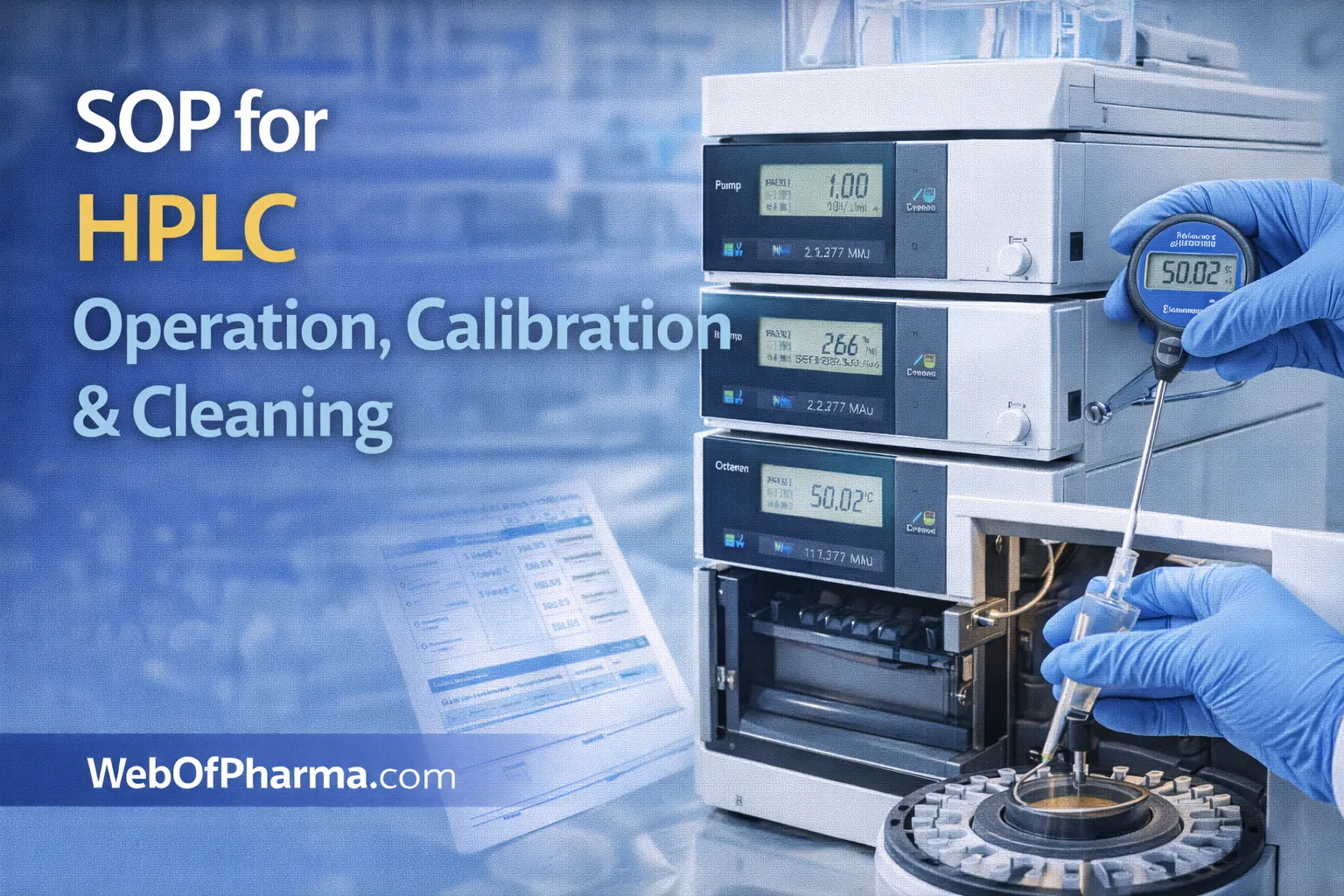

Learn SOP for HPLC operation, calibration & cleaning of pump, detector & column oven.
High-Performance Liquid Chromatography (HPLC) is one of the most critical analytical tools in pharmaceutical quality control. However, even the most advanced system can produce inaccurate results if not properly maintained. That’s why following a detailed SOP for HPLC operation calibration and cleaning is essential.
This SOP provides a complete guide covering key components like the pump, detector, column oven, and injector, ensuring accurate, reliable, and compliant results.
1. Objective of the SOP
The objective is to:
- Define procedures for HPLC calibration and operation
- Ensure accuracy and reproducibility of results
- Maintain system performance and reliability
- Comply with GMP and regulatory standards
2. Scope
This SOP applies to:
- HPLC quaternary gradient systems
- QC laboratory instruments
- Calibration and maintenance activities
3. Roles and Responsibilities
3.1 Responsible Personnel
- Technical Assistant / Executive: Perform calibration and operation
- Executive / Manager: Verify results
3.2 Accountability
- Head of Department: Ensure SOP compliance
4. Calibration Frequency
- Calibration should be performed once every 3 months
👉 Regular checks prevent analytical errors.
5. General Operation of HPLC
- Operate instrument as per standard instructions
- Ensure system is stabilized before analysis
- Use appropriate mobile phase and conditions
👉 Proper setup ensures accurate chromatographic results.
6. Calibration of HPLC Components
6.1 Pump Calibration (Flow Rate Accuracy)
Procedure:
- Set flow rate to 1.0 ml/min
- Replace column with resistor tubing
- Allow system to stabilize
- Collect water for 5 minutes
- Weigh collected volume
- Repeat for four trials
👉 Calculate flow rate accuracy based on collected volume.
6.2 Detector Wavelength Accuracy
Procedure:
- Flush detector with methanol
- Set absorbance to zero
- Inject caffeine solution (2 mg/100 ml)
- Scan wavelengths from 266–277 nm
- Identify wavelength with maximum absorbance
👉 Ensures detector precision.
6.3 Reproducibility Test
Steps:
- Prepare mobile phase (70% methanol: 30% water)
- Inject benzene & toluene mixture
- Record:
- Peak area
- Retention time
Acceptance Criteria:
- RSD ≤ 2.0%
- Relative retention time ≤ 2.0%
👉 Confirms system consistency.
6.4 Linearity Test
Procedure:
- Prepare standard solutions at different concentrations
- Inject samples and record peak area
- Plot calibration curve
👉 Ensures proportional response of detector.
6.5 Carry Over Test
- Inject blank (methanol) after high concentration sample
- Check for residual peaks
👉 Prevents contamination issues.
6.6 Gradient Accuracy Test
Procedure:
- Use acetone solution in water
- Set gradient program
- Measure signal at different concentration levels
👉 Ensures accurate solvent mixing.
6.7 Column Oven Temperature Accuracy
Steps:
- Use calibrated thermometer
- Set temperature at 40°C and 50°C
- Record readings at intervals (30, 45, 60 min)
👉 Confirms temperature stability.
6.8 Sample Cooler Temperature Accuracy
- Set cooler temperature
- Place thermometer probe
- Record readings after stabilization
👉 Ensures proper sample storage conditions.
6.9 Software Integrity Check
- Run program file check
- Verify system integrity
- Record results
👉 Ensures software reliability.
7. Cleaning Procedure
Proper cleaning prevents contamination and ensures accuracy.
Key Steps:
- Flush system with appropriate solvents (e.g., methanol)
- Clean injector and detector flow cell
- Remove residues from tubing
- Ensure no air bubbles in system
👉 Regular cleaning improves system performance.
8. Safety Precautions
- Handle solvents carefully
- Use PPE (gloves, goggles, lab coat)
- Avoid exposure to chemicals
- Ensure proper waste disposal
9. Best Practices for HPLC Maintenance
- Calibrate regularly
- Use high-purity solvents
- Filter mobile phase
- Maintain logs and records
- Train staff properly
10. Common Mistakes to Avoid
- Skipping calibration steps
- Using contaminated solvents
- Ignoring baseline stability
- Poor documentation
- Improper cleaning
FAQs
1. What is HPLC used for?
It is used for separation and analysis of compounds in pharmaceuticals.
2. Why is calibration important in HPLC?
It ensures accurate and reliable results.
3. How often should HPLC be calibrated?
Every 3 months.
4. What is pump calibration?
It checks flow rate accuracy.
5. What is detector wavelength accuracy?
It ensures correct absorbance measurement.
6. What is RSD in HPLC?
Relative Standard Deviation used for reproducibility.
7. What is carryover in HPLC?
Residual sample contamination between runs.
8. Why is cleaning important?
It prevents contamination and improves performance.
9. What is gradient accuracy test?
It checks solvent mixing precision.
10. Who is responsible for calibration?
Technical assistant performs, manager verifies.