


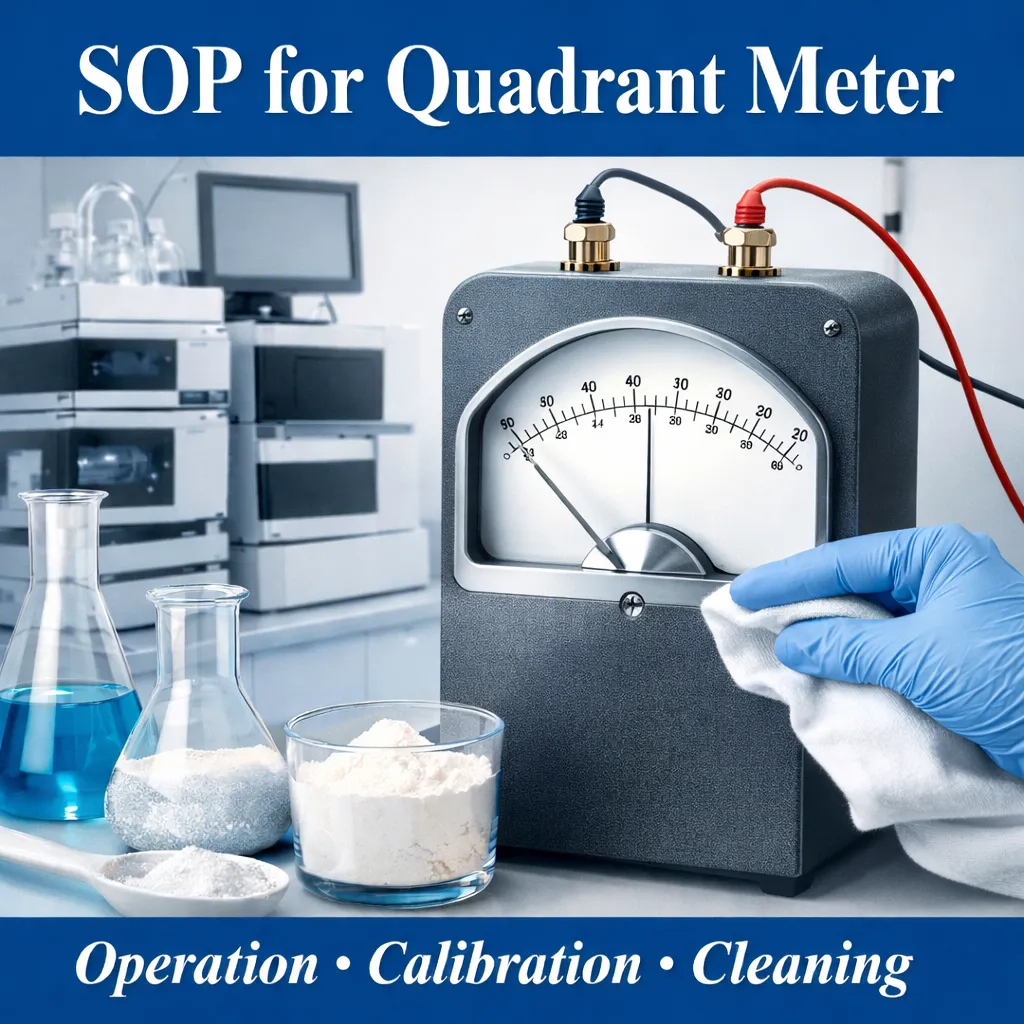

Learn SOP for quadrant meter operation, calibration & cleaning. Ensure precise measurements and compliance.
Introduction
In precision laboratories, instruments like the quadrant meter (also known as a quadrant electrometer) are essential for measuring small electrical charges and potential differences. Due to its sensitivity, even minor mishandling can lead to inaccurate readings.
A well-defined Standard Operating Procedure (SOP) ensures:
- Reliable measurements
- Instrument longevity
- Compliance with laboratory standards
This guide provides a complete SOP for operating, calibrating, and cleaning a quadrant meter, written in a clear, practical, and user-friendly format.
1.0 OBJECTIVE
To clearly lay down the procedure for operating, calibrating, and cleaning the quadrant meter.
2.0 SCOPE
This procedure is applicable to the quadrant meter installed in the Quality Control Laboratory.
3.0 RESPONSIBILITY
3.1 Doing
- Technical Assistant / Executive
3.2 Checking
- Executive / Manager
4.0 ACCOUNTABILITY
- Head of the Department
5.0 PROCEDURE
5.1 Operation of Quadrant Meter (Step-by-Step)
Quick Featured Snippet: Operation Steps
- Ensure the instrument is clean and properly calibrated
- Switch ON and allow stabilization
- Connect the sample or input terminals
- Adjust zero setting
- Record measurement readings
Detailed Procedure
- Check that the instrument is on a vibration-free surface
- Switch ON the device and allow it to stabilize
- Ensure proper grounding to avoid electrical interference
- Connect the test sample or electrical input carefully
- Adjust the zero setting before measurement
- Observe and record the readings accurately
- Disconnect the sample after testing
5.2 Calibration of Quadrant Meter
Quick Featured Snippet: Calibration Steps
- Verify zero adjustment
- Apply known reference voltage/charge
- Compare readings
- Adjust calibration controls
- Record results
Detailed Calibration Procedure
- Ensure the instrument is in zero condition
- Apply a standard known voltage or charge
- Compare the observed reading with the standard value
- Adjust calibration knobs if deviation is detected
- Repeat verification for accuracy
- Document calibration details in the logbook
- Perform calibration at defined intervals
5.3 Cleaning Procedure (As Provided SOP)
Step-by-Step Cleaning SOP
- 5.3.1 After completion of testing, remove the sample from the instrument
- 5.3.2 Clean the outer surface of the instrument and other parts using a cotton cloth
- 5.3.3 Record the cleaning activity in the specified format
- 5.3.4 Frequency: Daily
Note: Take care that the zero setting of the scale is not disturbed.
6.0 ABBREVIATION
- SOP – Standard Operating Procedure
Safety Precautions
- Ensure proper grounding of the instrument
- Avoid touching electrical terminals during operation
- Do not expose the instrument to moisture
- Handle sensitive components with care
- Switch OFF when not in use
Common Mistakes to Avoid
- ❌ Ignoring zero adjustment before measurement
- ❌ Exposure to electrical noise or interference
- ❌ Skipping routine cleaning
- ❌ Incorrect connections
- ❌ Not documenting readings
Best Practices for Accurate Results
- ✔ Perform regular calibration checks
- ✔ Maintain a clean and controlled environment
- ✔ Use stable power supply
- ✔ Keep detailed records for traceability
- ✔ Train staff on sensitive instrument handling
10 Frequently Asked Questions (FAQs)
1. What is a quadrant meter used for?
It measures very small electrical charges and potential differences.
2. How often should it be cleaned?
Cleaning should be performed daily after use.
3. Why is zero adjustment important?
It ensures baseline accuracy before measurement.
4. What affects measurement accuracy?
Electrical noise, poor grounding, and improper calibration.
5. Can moisture affect the instrument?
Yes, it can damage components and affect readings.
6. Who is responsible for operation?
Technical Assistant or Executive.
7. What should be recorded in logs?
Calibration, cleaning, and measurement data.
8. How often should calibration be done?
As per schedule or when deviations are observed.
9. What is the biggest error to avoid?
Improper zero setting and unstable connections.
10. Is grounding necessary?
Yes, it is critical for accurate measurements.