


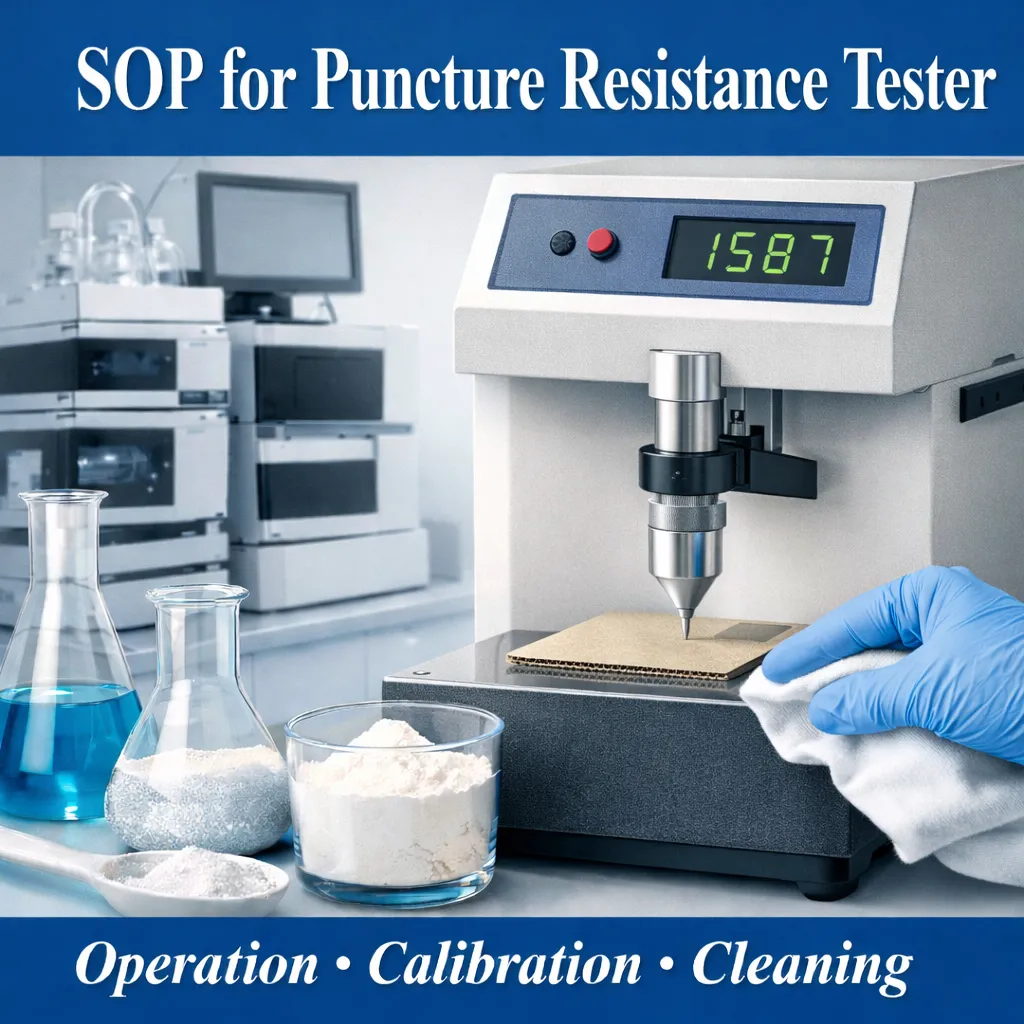

Learn SOP for puncture resistance tester operation, calibration & cleaning. Ensure accurate QC testing.
Introduction
In packaging and material testing laboratories, the puncture resistance tester is a critical instrument used to evaluate the durability and strength of materials such as corrugated boards, films, and packaging sheets.
To maintain consistent results and prolong instrument life, a well-defined Standard Operating Procedure (SOP) is essential. This guide provides a complete SOP covering operation, calibration, and cleaning, designed for easy implementation in quality control labs.
1.0 OBJECTIVE
To clearly lay down the procedure for operating, calibrating, and cleaning the puncture resistance tester.
2.0 SCOPE
This procedure is applicable to the puncture resistance tester installed in the Quality Control Laboratory.
3.0 RESPONSIBILITY
3.1 Doing
- Technical Assistant / Executive
3.2 Checking
- Executive / Manager
4.0 ACCOUNTABILITY
- Head of the Department
5.0 PROCEDURE
5.1 Operation of Puncture Resistance Tester (Step-by-Step)
Quick Featured Snippet: Operation Steps
- Switch ON the instrument and allow stabilization
- Place the sample securely in the holder
- Set the required test parameters
- Release the pendulum/weight
- Record puncture resistance value
Detailed Procedure
- Ensure the instrument is clean and calibrated before use
- Switch ON the tester and check readiness
- Place the sample (e.g., paperboard or packaging material) properly
- Secure the specimen to prevent movement
- Set the appropriate test parameters if applicable
- Release the pendulum or apply force as per method
- Observe and record the puncture resistance value
- Remove the tested sample after completion
5.2 Calibration of Puncture Resistance Tester
Quick Featured Snippet: Calibration Steps
- Check zero setting of the scale
- Use standard calibration weights
- Verify instrument readings
- Adjust calibration if needed
- Record calibration results
Detailed Calibration Procedure
- Verify the zero position of the instrument before testing
- Use certified standard weights or calibration tools
- Perform test cycles and compare readings
- Adjust the calibration mechanism if deviations are observed
- Repeat checks to ensure consistency
- Document all calibration activities in the logbook
- Follow scheduled calibration intervals
5.3 Cleaning Procedure (As Provided SOP)
Step-by-Step Cleaning SOP
- 5.3.1 After completion of testing, remove the samples from the instrument
- 5.3.2 Remove the plastic flap from the top side of the instrument and clean with a cotton cloth
- 5.3.3 Remove the weight and clean the outer surface and remaining parts of the instrument using a cotton cloth
- 5.3.4 Record the cleaning activity in the instrument log card
- 5.3.5 Frequency: Daily
Note: Take care that the instrument setting of the scale does not get disturbed.
6.0 ABBREVIATION
- SOP – Standard Operating Procedure
Safety Precautions
- Always ensure the instrument is stable before operation
- Keep hands away from moving parts during testing
- Handle weights and pendulum carefully
- Switch OFF the instrument before cleaning
- Use proper PPE if required
Common Mistakes to Avoid
- ❌ Improper sample placement
- ❌ Ignoring zero calibration
- ❌ Handling weights carelessly
- ❌ Skipping daily cleaning
- ❌ Not recording test data
Best Practices for Accurate Results
- ✔ Perform routine calibration checks
- ✔ Maintain a clean instrument environment
- ✔ Use standardized sample sizes
- ✔ Train personnel regularly
- ✔ Maintain detailed logs for audits
10 Frequently Asked Questions (FAQs)
1. What is a puncture resistance tester used for?
It measures the force required to puncture packaging materials.
2. How often should the tester be cleaned?
Cleaning should be performed daily after use.
3. Why is calibration important?
It ensures accurate and reliable measurement results.
4. What materials can be tested?
Corrugated boards, paper, films, and packaging materials.
5. What is the role of the pendulum/weight?
It applies force to determine puncture resistance.
6. Who performs the SOP?
Technical Assistant or Executive.
7. What should be recorded in the log card?
Cleaning, calibration, and testing data.
8. What is the biggest error to avoid?
Incorrect sample positioning.
9. Can improper cleaning affect results?
Yes, dust and debris can impact accuracy.
10. How often should calibration be done?
As per schedule or when deviations occur.