


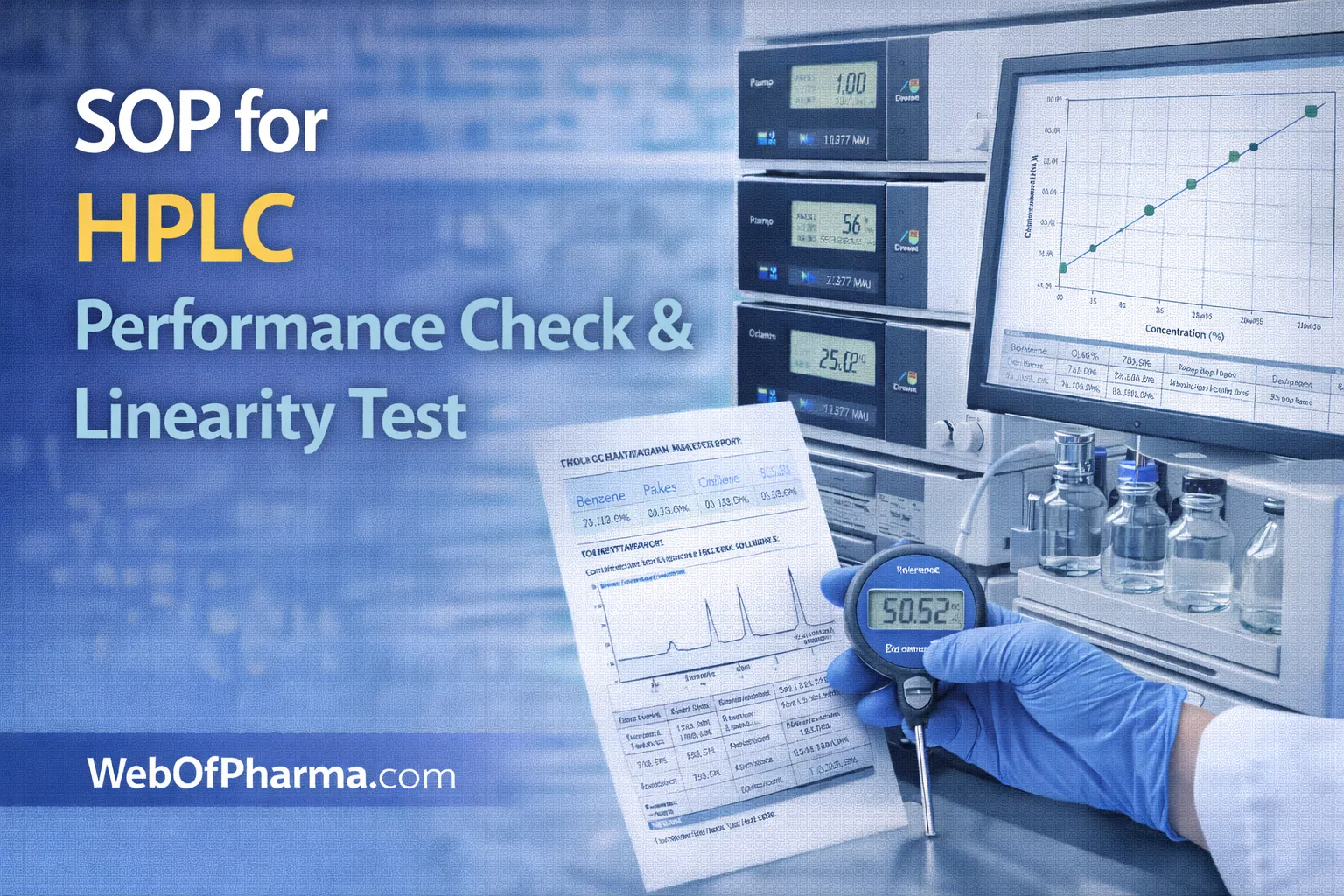

Learn SOP for HPLC performance check & linearity testing. Ensure accurate results & compliance.
High-Performance Liquid Chromatography (HPLC) is a backbone of pharmaceutical analysis. However, even a well-maintained system can drift from accuracy over time. That’s why a structured SOP for HPLC performance check is essential to ensure reliable and reproducible results.
This SOP focuses on evaluating linearity of results, which is a key indicator of system performance.
1. Objective of the SOP
The objective is to:
- Verify the performance of HPLC systems
- Ensure accuracy and reliability of analytical results
- Detect deviations in system response
- Maintain compliance with quality standards
2. Scope
This SOP applies to:
- Performance verification of HPLC systems
- QC laboratory operations
- Routine system suitability checks
3. Roles and Responsibilities
3.1 Responsible Personnel
- Technical Assistant / Executive: Perform testing
- Executive / Manager: Review and verify results
3.2 Accountability
- Head of Department: Ensure SOP compliance
4. Frequency of Performance Check
- Perform every 2 months
👉 Regular checks help maintain system accuracy.
5. Principle of HPLC Performance Check
The performance is evaluated by:
- Checking linearity of detector response
- Measuring relationship between concentration and peak area
👉 A linear response confirms system reliability.
6. Materials and Reagents Required
- Methanol
- Purified water
- Benzene
- Toluene
- Volumetric flasks and pipettes
7. Step-by-Step Performance Check Procedure
7.1 Preparation of Mobile Phase
- Prepare mixture:
- 70% Methanol : 30% Water
7.2 Preparation of Stock Solution
- Prepare:
- 0.2% Benzene + 0.2% Toluene in Methanol
7.3 Preparation of Calibration Solutions
Prepare different concentrations:
- 5 ml stock → dilute to 25 ml (0.04%)
- 10 ml stock → dilute to 25 ml (0.08%)
- 15 ml stock → dilute to 25 ml (0.12%)
- 20 ml stock → dilute to 25 ml (0.16%)
- Stock solution (0.20%)
👉 These different concentrations are used to evaluate linearity.
7.4 Instrument Setup
- Column: ODS (25 cm × 4.6 mm, 5 µ)
- Flow rate: 1.0 ml/min
- Wavelength: 254 nm
7.5 System Equilibration
- Allow system to stabilize with mobile phase for 15 minutes
7.6 Injection and Data Recording
- Inject each solution
- Record:
- Peak area of benzene
- Peak area of toluene
- Retention time
👉 Perform duplicate injections for accuracy.
8. Calculation of Linearity
- Plot concentration vs peak area
- Calculate correlation coefficient
Acceptance Criteria:
- Linearity ≥ 99.95%
👉 Results below this indicate poor system performance.
9. Documentation
Record the following:
- Instrument details
- Date of performance check
- Observed peak areas
- Retention times
- Linearity results
- Analyst and reviewer signatures
10. Safety Precautions
- Handle solvents carefully
- Use PPE (gloves, goggles, lab coat)
- Avoid inhalation of benzene vapors
- Work in a well-ventilated area
11. Best Practices for Accurate Results
- Use high-purity solvents
- Ensure proper column conditioning
- Filter mobile phase before use
- Avoid air bubbles in system
- Calibrate instrument regularly
12. Common Mistakes to Avoid
- Incorrect dilution preparation
- Skipping system equilibration
- Ignoring duplicate injections
- Poor documentation
- Using contaminated solvents
FAQs
1. What is HPLC performance check?
It verifies the accuracy and reliability of the HPLC system.
2. Why is linearity important in HPLC?
It ensures detector response is proportional to concentration.
3. What is the frequency of performance check?
Every 2 months.
4. What solvents are used?
Methanol and water.
5. What compounds are used for testing?
Benzene and toluene.
6. What is acceptable linearity?
Not less than 99.95%.
7. Why is system equilibration required?
To stabilize baseline and ensure consistent results.
8. What happens if linearity fails?
Instrument needs maintenance or recalibration.
9. Who performs the test?
Technical assistant or executive.
10. Why is documentation important?
For traceability and audit compliance.