


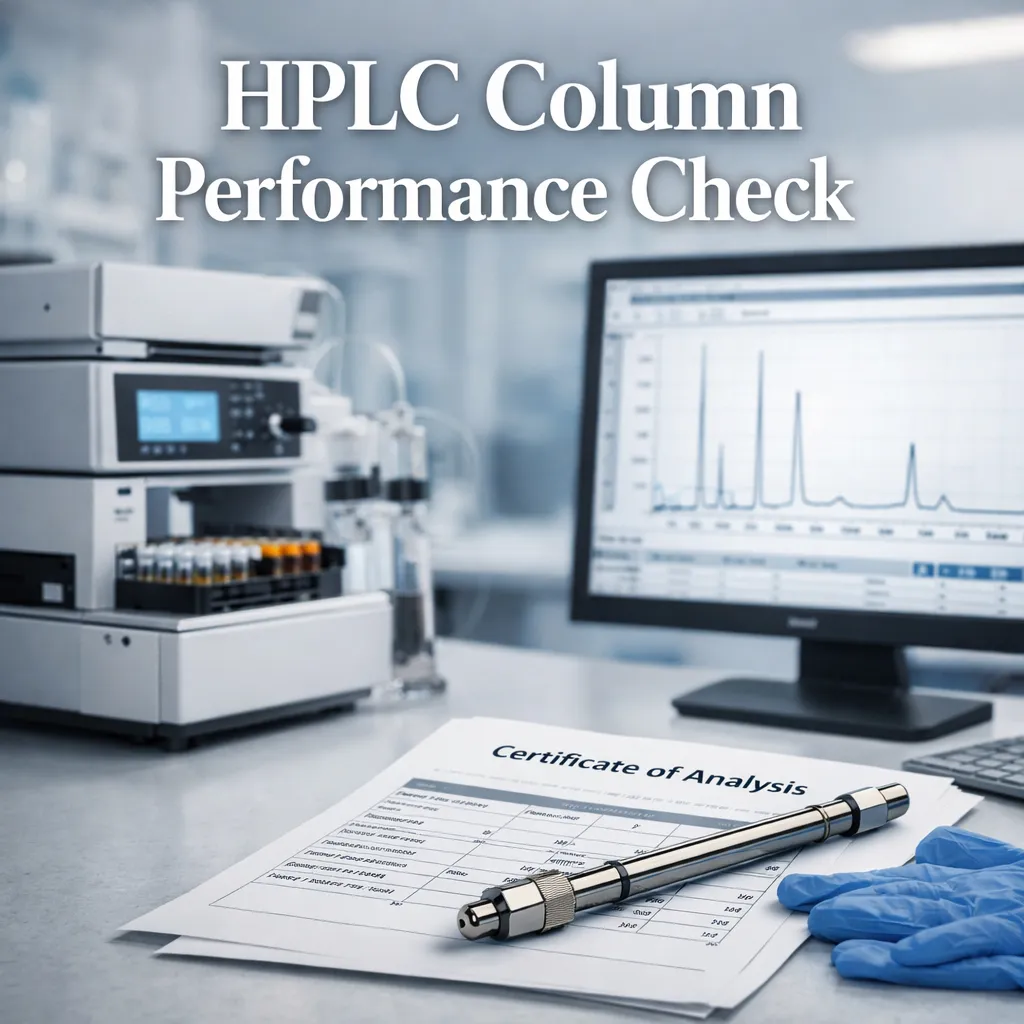

Step-by-step SOP to evaluate HPLC column performance vs vendor certificate, including calibration, cleaning, and regeneration procedures.
Introduction
High-performance liquid chromatography (HPLC) columns are the backbone of analytical accuracy. Yet, many laboratories overlook a critical step—verifying column performance against the vendor’s certificate of analysis (COA).
This SOP ensures that every column delivers reliable results by standardizing performance checks, calibration, and regeneration. If you want reproducible chromatography data and compliance-ready documentation, this guide provides a complete, practical framework.
Definition
HPLC column performance SOP is a standardized procedure used to verify a chromatography column’s efficiency, retention time, theoretical plates, and back pressure against vendor-provided specifications before routine use.
Semantic Content Layer
HPLC column validation involves systematic evaluation of chromatographic parameters such as theoretical plates, tailing factor, resolution, and system back pressure. Both reverse phase (C8, C18, cyano, phenyl) and normal phase (silica) columns require conditioning, calibration, and periodic regeneration to maintain analytical integrity. Comparing observed values with the certificate of analysis ensures method reproducibility, regulatory compliance, and instrument reliability.
Step-by-Step SOP
1. Operation – New Column Performance Check
- Condition column with methanol at 0.5 ml/min
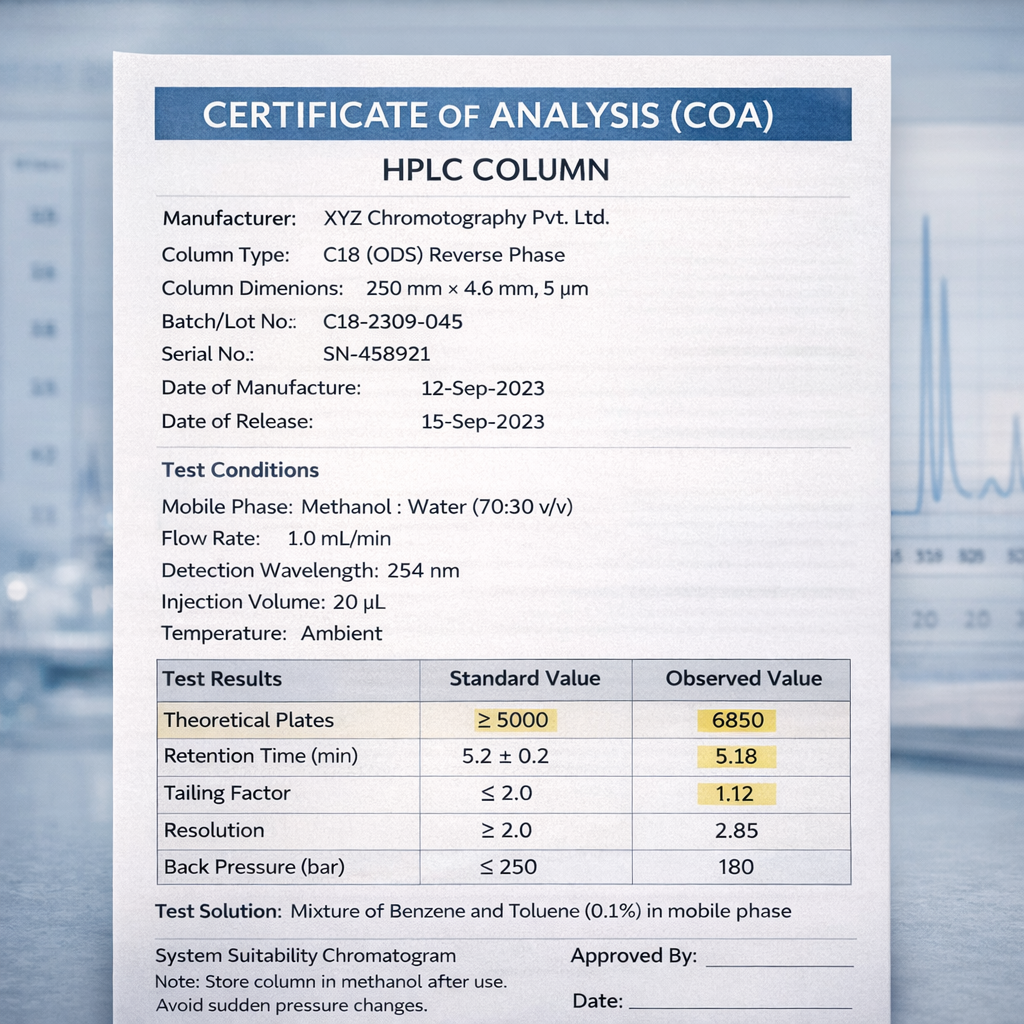
- Compare results with vendor COA (plates, RT, pressure)
- Perform system suitability test
- Record results in Annexure-I
- Flush and store column properly
Detailed Procedure
5.1 Checking of New HPLC Column
- Condition column using methanol (0.5 ml/min)
- Verify:
- Back pressure
- Retention time (RT)
- Theoretical plates
- Use vendor-provided method and materials
- Record results in Annexure-I
Reverse Phase Column Testing
- Mobile Phase: Methanol:Water (70:30 v/v)
- Flow Rate: 1.0 ml/min
- Wavelength: 254 nm
- Injection Volume: 20 µl
Test Solutions:
- C8/C18: Benzene + Toluene (0.1%)
- Cyano/Phenyl: Benzene + Naphthalene
Normal Phase Column Testing
- Mobile Phase: IPA:Hexane (40:60 v/v)
- Flow Rate: 1.0 ml/min
Test Solution:
- Toluene + Diethyl phthalate
Table Snippet (Data Type)
| Parameter | Acceptance Criteria (Typical) |
|---|---|
| Theoretical Plates | As per COA |
| Retention Time | ±5% of COA |
| Tailing Factor | ≤ 2.0 |
| Resolution | ≥ 2.0 |
| Back Pressure | Within system limits |
2. Calibration of Column
- Perform system suitability using standard mixtures
- Verify:
- Plate count
- Resolution
- Tailing factor
- Compare against COA values
- Record deviations and investigate
3. Cleaning & Storage
Reverse Phase:
- Flush with methanol (20 min, 1.0 ml/min)
- Store in methanol
Normal Phase:
- Flush with hexane
- Store in hexane
4. Column Regeneration Procedure
Reverse Phase:
- Warm water (55°C, 10 min)
- Inject DMSO (4 times)
- Flush with:
- Methanol (70 min, reverse flow)
- Chloroform (70 min)
- Final methanol wash
Normal Phase:
- Hexane (60 min)
- Methylene chloride (60 min)
- IPA (60 min)
- Methanol (60 min)
Responsibilities & Accountability
- Execution: Technical Assistant / Executive
- Verification: Manager
- Accountability: Head of Department
FAQs
1. What is HPLC column performance testing?
It verifies column efficiency using parameters like plates, RT, and resolution.
2. Why compare with COA?
To ensure vendor specifications match actual performance.
3. What is acceptable tailing factor?
Typically ≤ 2.0.
4. When should a column be regenerated?
Only when system suitability fails.
5. What solvent is used for reverse phase storage?
Methanol.
6. What is theoretical plate count?
A measure of column efficiency.
7. What causes high back pressure?
Blockage, contamination, or column degradation.
8. How often should testing be done?
At installation and periodically during use.
9. What is resolution in HPLC?
Separation quality between peaks.
10. Can columns be reused after regeneration?
Yes, if performance meets acceptance criteria.
{ “@context”: “https://schema.org”, “@type”: “Article”, “headline”: “Standard Operating Procedure for HPLC Column Check”, “description”: “Step-by-step SOP for HPLC column performance verification and regeneration.”, “author”: { “@type”: “Organization”, “name”: “Analytical Experts” }, “mainEntityOfPage”: { “@type”: “WebPage”, “@id”: “https://example.com/hplc-column-performance-sop” }, “publisher”: { “@type”: “Organization”, “name”: “Lab QA Hub” } } { “@context”: “https://schema.org”, “@type”: “FAQPage”, “mainEntity”: [ { “@type”: “Question”, “name”: “What is HPLC column performance testing?”, “acceptedAnswer”: { “@type”: “Answer”, “text”: “It evaluates efficiency, retention time, and resolution.” } } ] } { “@context”: “https://schema.org”, “@type”: “HowTo”, “name”: “Check HPLC Column Performance”, “step”: [ {“@type”: “HowToStep”,”text”: “Condition column with methanol”}, {“@type”: “HowToStep”,”text”: “Compare results with COA”}, {“@type”: “HowToStep”,”text”: “Perform system suitability test”} ] }