


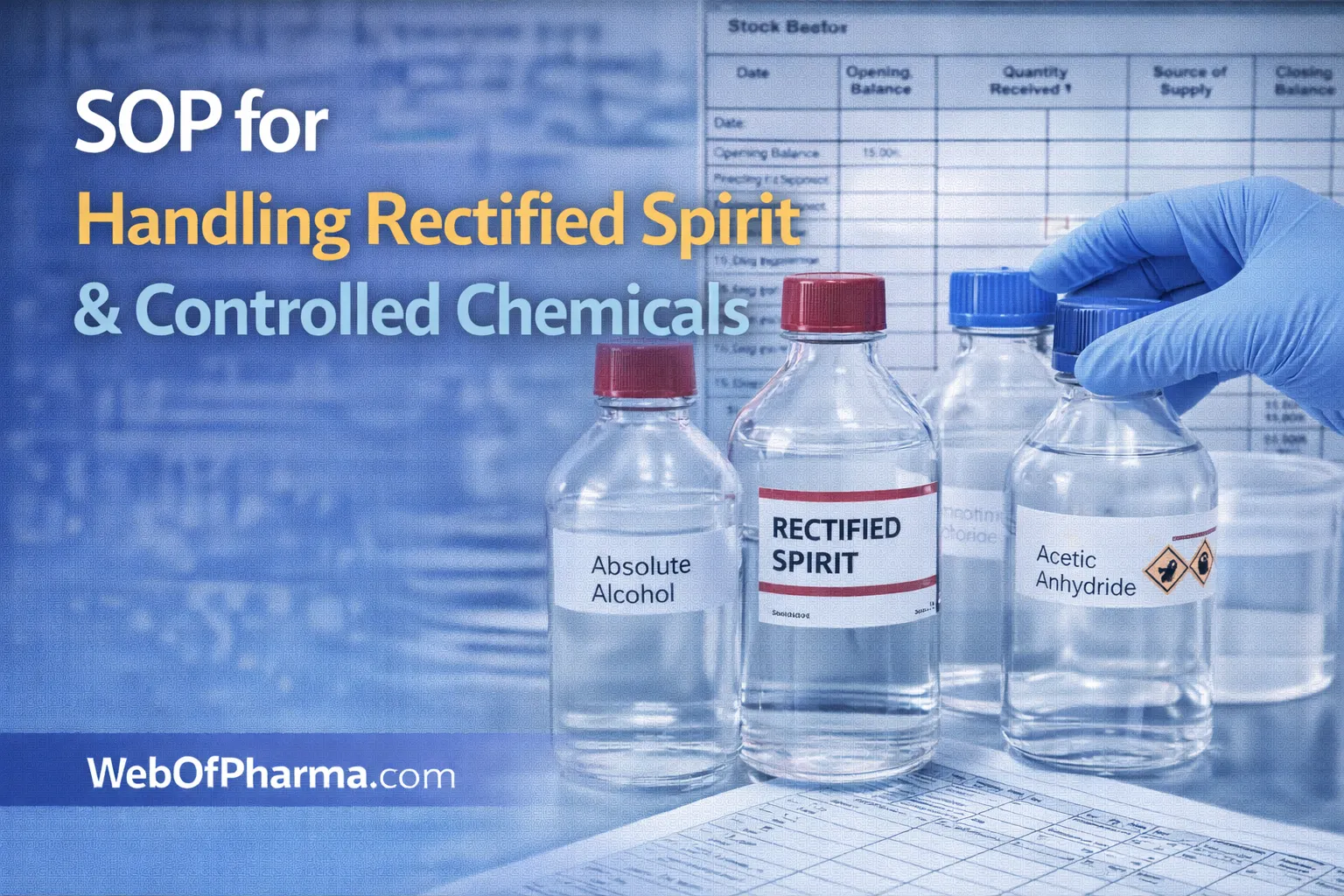

Learn SOP for handling rectified spirit, alcohol & controlled chemicals safely.
In pharmaceutical laboratories, certain chemicals require strict control due to their regulatory status and potential misuse. Substances like rectified spirit, absolute alcohol, acetic anhydride, and ammonium chloride must be handled with precision and accountability.
This detailed SOP for handling controlled chemicals in pharmaceutical laboratory ensures proper indenting, receiving, storage, and usage—while maintaining compliance with regulatory authorities.
1. Objective of the SOP
The objective is to:
- Establish a controlled system for handling restricted chemicals
- Ensure compliance with excise and regulatory guidelines
- Maintain proper inventory and documentation
- Prevent misuse or unauthorized access
2. Scope
This SOP applies to:
- Indenting, receiving, storage, and issuance of:
- Rectified Spirit
- Absolute Alcohol
- Acetic Anhydride
- Ammonium Chloride
- Quality Control laboratory operations
3. Roles and Responsibilities
3.1 Responsible Personnel
- Technical Assistant / Executive: Handle chemical operations
- Executive / Manager: Verify and approve processes
3.2 Accountability
- Head of Department: Ensure SOP compliance
4. Procedure for Rectified Spirit & Absolute Alcohol
These are regulated substances and require strict documentation.
4.1 Indenting Process
- Verify existing stock levels
- Raise indent based on monthly requirement
- Fill R.S. III Form (Requisition for Rectified Spirit/Absolute Alcohol)
- Get approval from authorized manager
- Submit to administration department
4.2 Receiving Procedure
- Receive material with supplier challan
- Verify quantity and documentation
- Send signed challan copy to accounts with GRN (Goods Receipt Note)
- Maintain one copy for records
4.3 Storage & Control
- Store in designated secure area
- Maintain stock register approved by excise authority
- Ensure restricted access
👉 Proper documentation is mandatory for audit compliance.
5. Procedure for Acetic Anhydride & Ammonium Chloride
5.1 Indenting Process
- Use general indent format
- Mention:
- Manufacturer name
- Grade
- Quantity required
- Send indent to purchase department
5.2 Receiving Procedure
- Receive materials with supplier challan
- Prepare Consignment Received Note
- Get it signed by manager
- Send copy to supplier and accounts (with GRN)
5.3 Storage & Record Keeping
- Maintain separate stock register
- Store under appropriate conditions
- Label containers clearly
6. Issuance of Chemicals
- Issue chemicals only as per requirement
- Record every transaction in stock register
- Ensure authorized usage
7. Stock Register Details
The stock register must include:
- Date
- Opening balance
- Quantity received
- Source of supply
- Transport number & date
- Challan number & date
- Total quantity
- Quantity issued
- Closing balance
- Signature
- Remarks
👉 Proper record-keeping ensures traceability.
8. Safety Precautions
- Store chemicals in well-ventilated areas
- Avoid exposure to heat or flame
- Use PPE (gloves, goggles, lab coat)
- Handle chemicals carefully to prevent spills
- Follow MSDS guidelines
9. Best Practices for Chemical Control
- Maintain updated inventory records
- Perform regular stock audits
- Restrict access to authorized personnel
- Label all containers properly
- Train staff on handling procedures
10. Common Mistakes to Avoid
- Improper documentation
- Unauthorized issuance
- Incorrect storage conditions
- Ignoring stock updates
- Lack of regulatory compliance
FAQs
1. Why are rectified spirit and alcohol controlled?
They are regulated due to potential misuse and legal restrictions.
2. What is the R.S. III form?
It is a requisition form for procuring rectified spirit or absolute alcohol.
3. What is GRN?
Goods Receipt Note used for recording received materials.
4. Why maintain a stock register?
To track inventory and ensure traceability.
5. Who approves chemical indent?
Authorized manager or department head.
6. How should acetic anhydride be stored?
In a secure, labeled, and controlled environment.
7. What details are required in stock register?
Date, quantity, source, issue, balance, and signatures.
8. Who handles chemical issuance?
Authorized personnel only.
9. What happens if records are not maintained?
It may lead to compliance issues and audit failures.
10. Why is documentation important?
For regulatory compliance and accountability.