


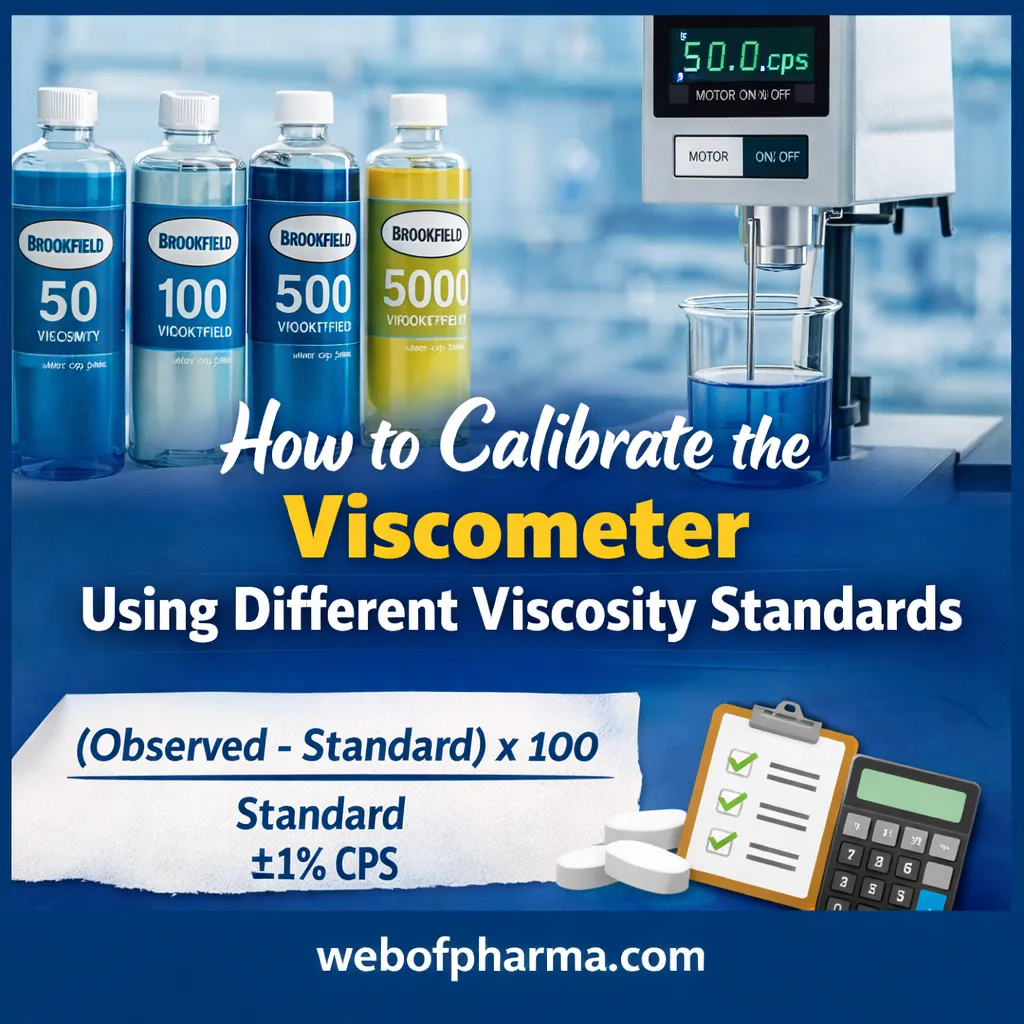

Learn how to calibrate the viscometer using different viscosity standards such as 50, 500, 1000, and 5000 cps. Step-by-step calibration procedure, documentation requirements, and GMP compliance explained.
Calibration of a viscometer is a critical activity in pharmaceutical quality control laboratories to ensure accurate viscosity measurement of liquids, suspensions, syrups, gels, and emulsions. A properly calibrated instrument guarantees reliable analytical results, product consistency, and compliance with Good Manufacturing Practices (GMP).
This article explains the standard procedure to calibrate the viscometer using different viscosity standards, including recommended calibration fluids, operational steps, documentation requirements, and acceptance criteria.
Objective
To establish a standard procedure to calibrate the viscometer using different viscosity standards and verify the accuracy and reliability of viscosity measurements.
Scope
This procedure applies to the calibration of rotational viscometers used in:
- Pharmaceutical Quality Control laboratories
- Research and Development laboratories
- Production departments
- Stability testing laboratories
Principle of Viscometer Calibration
Viscosity is the resistance of a fluid to flow. Calibration verifies that the viscometer measures viscosity accurately when compared with certified reference standards of known viscosity.
During calibration:
- Standard viscosity fluids are used
- Spindle and speed settings are selected
- Temperature is controlled
- Measured viscosity is compared to the reference value
Calibration ensures:
- Accuracy of viscosity measurement
- Instrument reliability
- Regulatory compliance
- Product quality consistency
Calibration Standards Used
Viscometer calibration is typically performed using certified viscosity standards such as:
- 50 cps
- 100 cps
- 500 cps
- 1000 cps
- 5000 cps
Recommended calibration fluid:
Brookfield Calibration Fluid
These standards provide traceability and ensure reliable measurement performance across different viscosity ranges.
Step-by-Step Procedure to Calibrate the Viscometer Using Different Viscosity Standards
1. Instrument Preparation
- Ensure the instrument is clean and ready for use.
- Verify that the viscometer is properly leveled.
- Switch ON the instrument and allow stabilization.
2. Selection of Calibration Standards
Calibrate the instrument using different viscosity standards such as:
- 50 cps
- 500 cps
- 1000 cps
- 5000 cps
Use certified calibration fluids for accurate results.
3. Spindle Selection
- Select the spindle by pressing the SELECT SPINDLE key.
- The display “S” line will blink for four seconds.
- Press the UP or DOWN (↑↓) arrow key to change the spindle number.
- Release the arrow key to stop scrolling.
- Press SELECT SPINDLE again to confirm selection.
4. Speed Selection
- Press the SET SPEED key.
- The display will blink.
- Use the UP or DOWN (↑↓) arrow keys to select the required RPM.
- Press SET SPEED again to confirm.
5. Spindle Installation
- Attach the selected spindle to the lower shaft.
- Hold the shaft firmly while screwing the spindle securely.
6. Sample Preparation
- Place the test solution beaker below the spindle center.
- Insert the spindle into the fluid until the liquid level reaches the immersion groove.
- Ensure no air bubbles are attached to the spindle surface.
7. Running the Calibration Test
- Press the MOTOR ON/OFF key to start the test.
- Allow sufficient time for the reading to stabilize.
Stabilization time depends on:
- Fluid viscosity
- Spindle type
- Rotation speed
8. Recording Results
- Record the stabilized reading in centipoise (cps) in the calibration logbook.
- Compare observed viscosity with the standard value.
9. Completion of Calibration
- Press the MOTOR ON/OFF key to stop the test.
- Switch OFF the instrument.
- Clean the spindle and instrument.
- Affix the calibration label on the viscometer.
Acceptance Criteria for Viscometer Calibration
The observed viscosity value should fall within:
Label Claim ± 1.0 % CPS
This tolerance ensures measurement accuracy and compliance with quality standards.
Typical Viscometer Calibration Log Format
| Sr. No. | Viscosity Standard | Lot No. | Spindle No. | RPM | Temperature | Observed Viscosity (cps) | Acceptance Limit (±1.0%) |
|---|---|---|---|---|---|---|---|
| 1 | 50 cps | — | — | — | — | — | Pass/Fail |
| 2 | 100 cps | — | — | — | — | — | Pass/Fail |
| 3 | 500 cps | — | — | — | — | — | Pass/Fail |
| 4 | 1000 cps | — | — | — | — | — | Pass/Fail |
| 5 | 5000 cps | — | — | — | — | — | Pass/Fail |
Calibration Frequency
Viscometer calibration should be performed:
- Monthly
- Before critical testing
- After maintenance
- After relocation
- After repair
- As per GMP schedule
Common Sources of Calibration Errors
- Incorrect spindle selection
- Air bubbles on spindle
- Improper immersion depth
- Temperature variation
- Unclean spindle
- Worn mechanical parts
Routine calibration helps prevent inaccurate viscosity measurements.
Importance of Viscometer Calibration in Pharmaceuticals
Calibration of viscometers is essential to:
- Ensure product consistency
- Maintain batch uniformity
- Meet regulatory requirements
- Support stability studies
- Validate manufacturing processes
- Maintain data integrity
This is especially critical for products such as:
- Syrups
- Suspensions
- Creams
- Gels
- Emulsions
- Injectable solutions
Documentation Requirements
After calibration, record:
- Instrument identification
- Calibration standards used
- Spindle number
- RPM setting
- Temperature
- Observed viscosity value
- Acceptance decision
- Date and signature
Proper documentation ensures:
- GMP compliance
- Audit readiness
- Traceability
- Data reliability
Conclusion
Following a standardized procedure to calibrate the viscometer using different viscosity standards ensures accurate viscosity measurements, reliable analytical results, and compliance with pharmaceutical regulatory requirements. Regular calibration, proper documentation, and routine maintenance are essential for maintaining instrument performance and ensuring consistent product quality.
10 Frequently Asked Questions (FAQs)
1. Why is viscometer calibration important?
It ensures accurate viscosity measurement and reliable product quality testing.
2. What viscosity standards are used for calibration?
Common standards include 50, 100, 500, 1000, and 5000 cps.
3. What is the acceptable tolerance for viscometer calibration?
Typically ±1.0 % CPS from the standard value.
4. How often should a viscometer be calibrated?
Usually monthly or after maintenance or relocation.
5. What unit is used to measure viscosity?
Viscosity is commonly measured in centipoise (cps).
6. What happens if air bubbles are present during testing?
They can cause inaccurate viscosity readings.
7. Why is temperature important during calibration?
Viscosity changes with temperature, affecting measurement accuracy.
8. What should be done after calibration?
Clean the spindle, record results, and affix a calibration label.
9. What types of products require viscosity testing?
Syrups, suspensions, gels, creams, and emulsions.
10. What is the most common viscometer used in pharmaceutical labs?
The rotational viscometer, especially Brookfield-type instruments.