


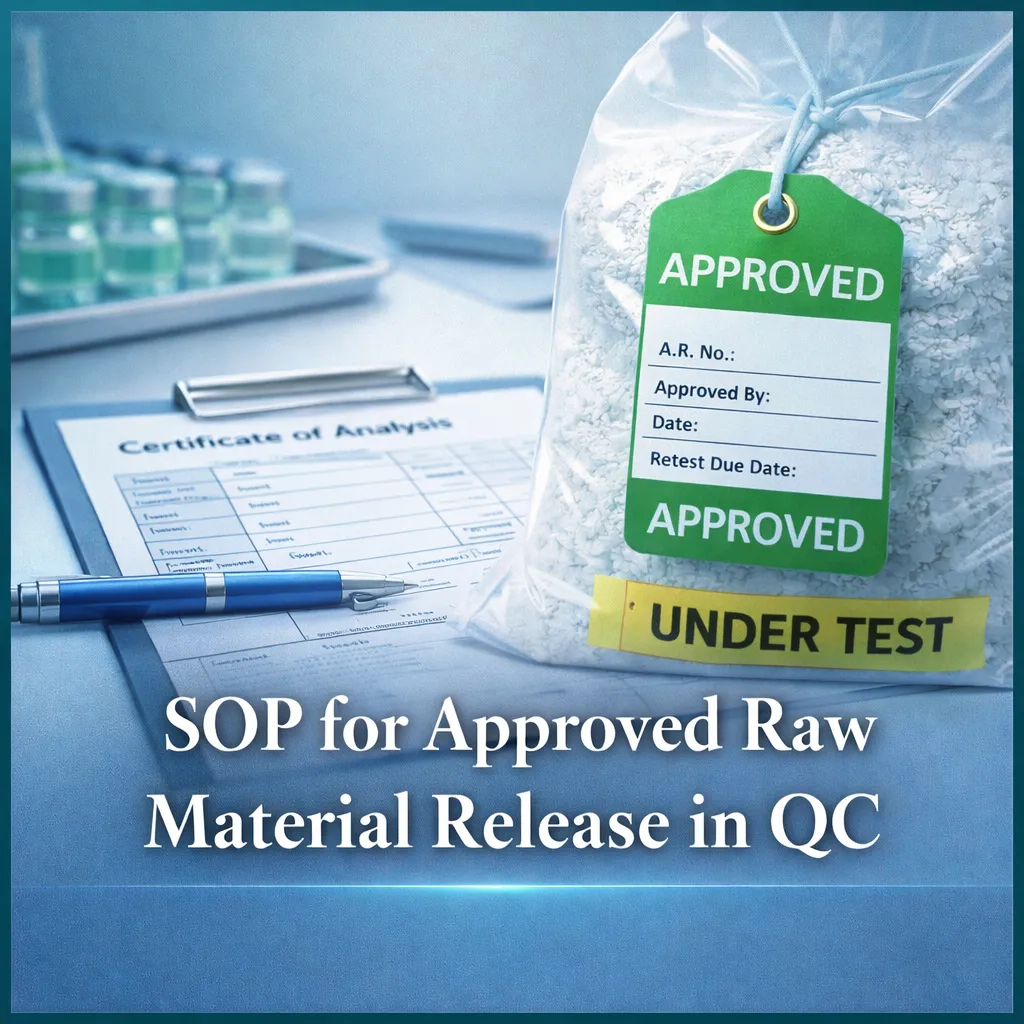

Learn SOP for releasing approved raw materials in QC labs with testing, documentation, and compliance steps for accurate batch control.
Introduction
In pharmaceutical manufacturing, raw materials are the foundation of product quality. Ensuring that only approved materials are used in production is critical for compliance, safety, and efficacy. The Quality Control (QC) department plays a vital role in testing, evaluating, and approving raw materials before release.
This SOP provides a structured approach for testing, documentation, and release of raw materials, ensuring traceability, regulatory compliance, and consistent product quality.
1.0 Objective
To define a standardized procedure for the release of approved raw materials after completion of quality control testing.
2.0 Scope
This SOP applies to all raw materials including active and inactive ingredients received in the QC laboratory.
3.0 Responsibility
- Doing: Technical Assistant / Executive
- Checking: Executive / Manager
4.0 Accountability
- Head of the Department
5.0 Step-by-Step SOP for Raw Material Release
5.1 Sample Receipt & Registration
- Receive raw material sample from store
- Place in “UNDER TEST SAMPLE” tray
- Enter details in raw material register
5.2 Sample Distribution
- Distribute samples for:
- Chemical analysis
- Instrumental analysis
- Microbiological testing
5.3 Documentation & Protocol Issue
- Issue:
- Photocopy of testing protocol
- COA format from controlled system
- Sign and date all documents
5.4 Testing of Raw Materials
5.4.1 Active Raw Materials (API)
- Perform identification test for each container
- Conduct remaining tests on composite sample
- Perform assay on composite samples (every 10 containers)
- Report average value in COA
5.4.2 Inactive Raw Materials (Excipients)
- Perform complete testing on composite sample
5.5 Recording of Results
- Record results in protocol and COA
- Mention instrument identification numbers used
5.6 Final Reporting
- Enter details in Material Receiving Report (MRR):
- Approved/Rejected quantity
- Assay values (for active materials)
- Release/Rejection date
- Final status
5.7 Review & Approval
- Submit reports to QC Incharge for verification
- QC Incharge checks and signs reports
- File QC copy with sampling report
5.8 System Entry & Status Update
- Enter assay and results in system
- Update status to Approved/Rejected
- Authorized personnel must verify
5.9 Labeling of Materials
Approved Label (Green):
- A.R. No.
- Approved By
- Date
- Retest Due Date
Rejected Label (Red):
- A.R. No.
- Rejected By
- Date
- Reason
- Replace “UNDER TEST” label with final status label
5.10 Communication & Distribution
- Send MRR copies to Raw Material Store
- Share status report with production team
- Maintain daily assay status printouts
6.0 Abbreviations
- QC: Quality Control
- A.R. No.: Analytical Report Number
- R.M.: Raw Material
- MRR: Material Receiving Report
- COA: Certificate of Analysis
Safety & Compliance Precautions
- Ensure correct sampling and labeling
- Use calibrated instruments
- Follow GMP/GLP guidelines
- Maintain traceability of all records
- Avoid mix-ups between materials
Common Mistakes to Avoid
- Skipping identification tests
- Incorrect composite sampling
- Missing documentation
- Wrong labeling of materials
- Delayed system updates
Best Practices
- Maintain proper documentation flow
- Perform cross-verification of results
- Use validated methods and instruments
- Conduct periodic audits
- Train staff regularly
FAQs (Frequently Asked Questions)
1. What is raw material release SOP?
A procedure to approve materials after QC testing.
2. What is an API?
Active Pharmaceutical Ingredient responsible for therapeutic effect.
3. What is a COA?
Certificate of Analysis confirming material quality.
4. Why is identification testing important?
To confirm material identity before use.
5. What is composite sampling?
Combining samples from multiple containers for testing.
6. Who approves raw materials?
QC Incharge/Executive after verification.
7. What happens if material fails testing?
It is labeled as rejected and not used.
8. What is MRR?
Material Receiving Report documenting material status.
9. Why is labeling important?
To prevent mix-ups and ensure traceability.
10. How is status updated?
Through authorized system entry (e.g., SAP).