



Learn SOP for manual cleaning of glassware in QC with proper washing, nitric acid cleaning, drying, and contamination control procedures.
📌 Definition
Manual cleaning of laboratory glassware in Quality Control refers to a structured process of washing, rinsing, and drying glassware using detergent, purified water, and specialized cleaning agents to eliminate residues and prevent analytical interference.
📊 Table Snippet (Data Type)
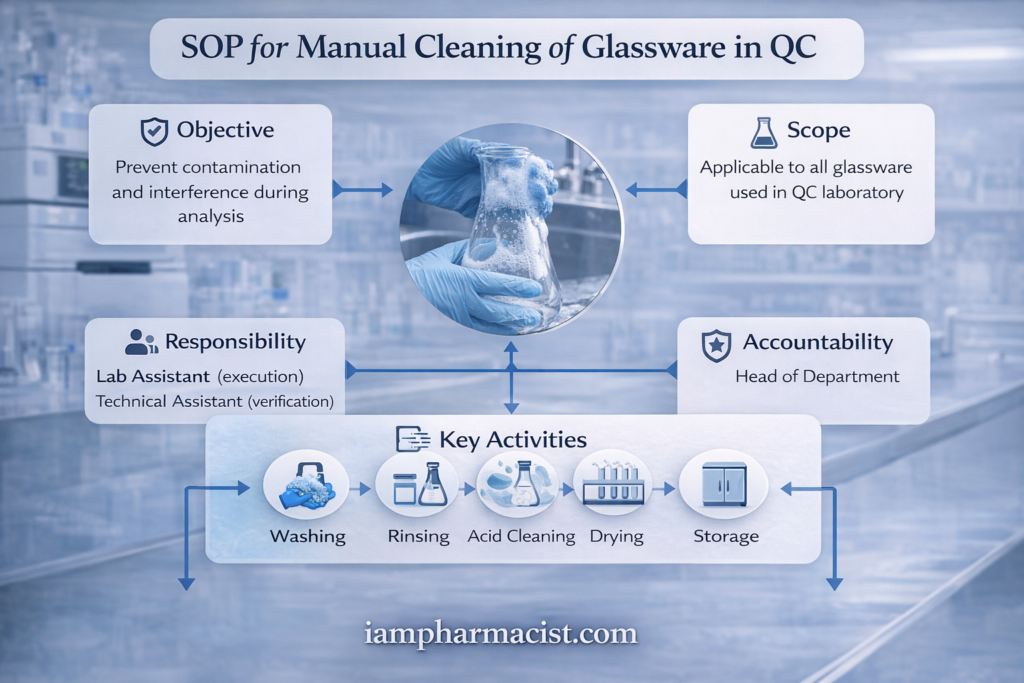
| Section | Description |
|---|---|
| Objective | Prevent contamination and interference during analysis |
| Scope | Applicable to all glassware used in QC laboratory |
| Responsibility | Lab Assistant (execution), Technical Assistant (verification) |
| Accountability | Head of Department |
| Key Activities | Washing, rinsing, acid cleaning, drying, storage |
🔢 Step-by-Step SOP
- Drain leftover solutions safely
- Wash with raw water
- Clean with 0.1% detergent solution
- Rinse with raw water
- Rinse 3–4 times with purified water
- Dry glassware in dryer
- Apply nitric acid cleaning (if required)
- Store clean, dry glassware properly
🔍 Introduction
In Quality Control laboratories, even trace contamination in glassware can significantly affect analytical results. Proper manual cleaning ensures accuracy, reproducibility, and compliance with Good Laboratory Practices (GLP). This SOP provides a systematic and validated approach to cleaning different types of glassware used in QC analysis.
🧠 Semantic Content Layer
Glassware cleaning in QC laboratories involves multi-step washing using raw water, detergent solution, purified water, and chemical cleaning agents such as nitric acid. Proper drying and storage eliminate contamination risks and ensure reliable analytical outcomes. Following a standardized SOP enhances laboratory efficiency, compliance, and data integrity.
1.0 OBJECTIVE
To clean glassware effectively to avoid interference during analysis.
2.0 SCOPE
Applicable to all laboratory glassware used in Quality Control analysis.
3.0 RESPONSIBILITY
- 3.1 Doing: Laboratory Assistant / Workman
- 3.2 Checking: Technical Assistant / Executive
4.0 ACCOUNTABILITY
Head of the Department
5.0 PROCEDURE
5.1 Operation (General Cleaning)
- Wear safety goggles and gloves
- Drain leftover solutions into sink
- Wash glassware (flasks, beakers, pipettes, burettes, bottles, crucibles) with raw water
- Scrub using 0.1% detergent solution (1 ml Teepol in 1000 ml purified water)
- Rinse thoroughly with raw water
- Rinse 3–4 times with purified water
- Drain and place in dryer
5.2 Nitric Acid Cleaning (When Required)
- Heat laboratory-grade nitric acid under fume hood
- Rinse glassware with hot nitric acid
- Allow to stand overnight
- Rinse with raw water
- Final rinse with purified water
- Dry in dryer
5.3 Specialized Glassware Cleaning
5.3.1 Gooch Crucible / Sintered Glass Funnel
- Fill with hot nitric acid
- Keep overnight
- Rinse with raw water
- Apply vacuum and wash
- Rinse 3–4 times with purified water
- Dry properly
5.3.2 Silica Crucible
- Fill with nitric acid and heat under fume hood
- Wash with raw water
- Rinse with purified water
- Ignite at 700°C in muffle furnace
- Cool and store properly
5.4 Calibration (Quality Assurance Context)
- Ensure glassware cleanliness before analytical use
- Verify absence of residues or stains
- Use only clean, dry glassware for calibrated instruments
5.5 Drying & Storage (Cleaning Control)
- Dry glassware in controlled dryer
- Store in dust-free environment
- Avoid contamination before use
6.0 ABBREVIATIONS
- °C: Degree Centigrade
- ml: Millilitre
❓ FAQs
1. Why is glassware cleaning important in QC?
It prevents contamination and ensures accurate analytical results.
2. What detergent is used for cleaning?
Typically 0.1% detergent solution like Teepol.
3. Why use purified water for rinsing?
To remove impurities and avoid residue.
4. When is nitric acid cleaning required?
For stubborn residues or high-precision analysis.
5. How many times should glassware be rinsed?
3–4 times with purified water.
6. What PPE is required during cleaning?
Goggles and gloves.
7. How is silica crucible cleaned?
Using nitric acid followed by ignition at 700°C.
8. Can wet glassware be used for analysis?
No, it must be completely dry.
9. What is the role of drying?
To eliminate moisture contamination.
10. Who is responsible for cleaning verification?
Technical Assistant or Executive.