


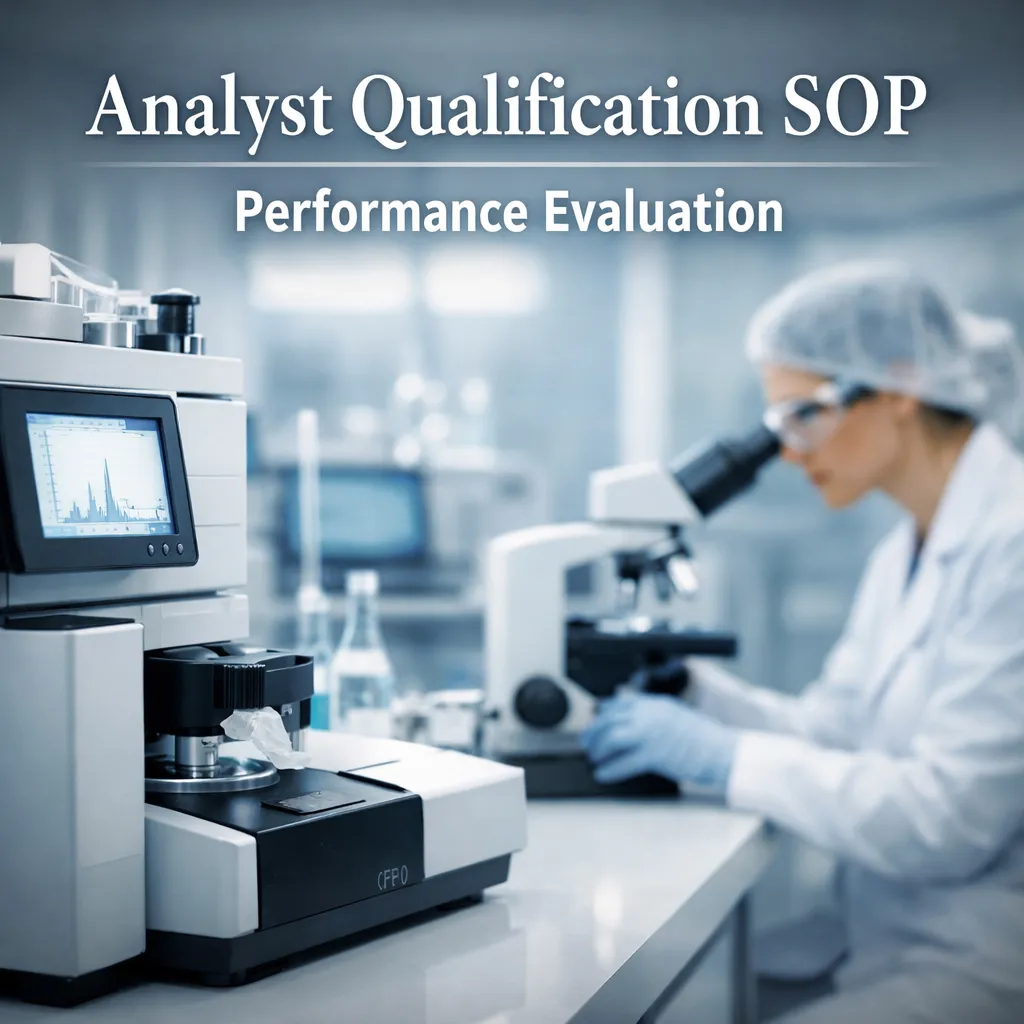

Learn a complete SOP for analyst qualification and performance evaluation with step-by-step procedures, methods, and compliance guidelines.
Introduction
Ensuring the accuracy and reliability of laboratory results begins with one critical factor: analyst competency. In regulated industries—especially pharmaceuticals—analyst qualification is not optional; it’s a compliance requirement tied to product quality and patient safety.
This guide provides a complete, SEO-optimized Standard Operating Procedure (SOP) to evaluate analyst performance, ensuring adherence to Good Laboratory Practices (GLP) and regulatory expectations. Whether you’re onboarding new analysts or requalifying existing staff, this SOP delivers a structured, audit-ready approach.
Definition
Analyst qualification is a structured process used to evaluate the competency, accuracy, and compliance of laboratory personnel by assessing their ability to perform analytical tests, follow procedures, and produce reliable results within defined acceptance criteria.
Semantic Content Layer
Analyst qualification in quality control laboratories involves systematic evaluation of analytical skills, method execution, instrument handling, data integrity, and compliance with GLP standards. The process includes testing across multiple analytical techniques such as HPLC, UV spectroscopy, titration, and microbiological analysis. Performance is validated through precision, accuracy, and documentation practices, ensuring that results meet predefined acceptance limits and regulatory expectations.
1. OBJECTIVE
To establish a standardized procedure for evaluating the performance and competency of analysts in a quality control environment.
2. SCOPE
Applicable to all analysts undergoing qualification in the Quality Control (QC) Department.
3. RESPONSIBILITY
- Doing: Executive / Manager
- Checking: Manager
4. ACCOUNTABILITY
Head of the Department
5. PROCEDURE
5.1 Preparation Phase
- Identify approved raw materials and finished products.
- Prepare a comprehensive list for evaluation.
5.2 Sample Documentation
Maintain records including:
| Parameter | Description |
|---|---|
| Material/Product Name | Sample identity |
| B.No. | Batch Number |
| A.R. No. | Analytical Reference Number |
| Code No. | Assigned unique code |
| Analytical Value | Expected result |
| Acceptance Limit | Permissible range |
5.3 Sample Coding
- Assign a unique code number to each sample for blind analysis.
5.4 Sample Distribution
- Provide coded samples in:
- Poly bags
- Glass vials
5.5 Method Assignment
- Supply detailed analytical methods to the analyst.
5.6 Performance Evaluation Areas
Evaluate analysts in one or more of the following:
- Assay (triplicate analysis required)
- Dissolution
- Identification via IR Spectrophotometer (triplicate)
- Microbiological testing
5.7 Analytical Techniques Assessment
Assess competency in:
- HPLC
- UV Spectrophotometer
- Titration
- IR Spectrophotometer
5.8 Performance Criteria
An analyst is considered qualified if:
- Results fall within acceptable limits
- GLP compliance is maintained
- Documentation is accurate and complete
5.9 Qualification Timeline
- New analysts must be qualified within 3 months of assignment.
5.10 Documentation & Record Keeping
Maintain:
- Calculations
- Chromatograms
- Strip charts
- Department head comments
All records must be stored in individual training files.
5.11 Non-Qualification Handling
- Retrain the analyst
- Restrict task allocation until qualification is achieved
5.12 Training Records
- Maintain logs for:
- Training
- Retraining
- Requalification
5.13 Final Report
- Prepare and document a final qualification report.
Step-by-Step SOP
Step-by-Step Analyst Qualification Process
- Identify materials and prepare sample list
- Record sample details with acceptance criteria
- Assign coded identifiers to samples
- Distribute samples to analysts
- Provide analytical methods
- Conduct tests (assay, dissolution, IR, microbiology)
- Evaluate performance across techniques
- Verify results against acceptance limits
- Check GLP compliance and documentation
- Approve or retrain analyst
- Maintain records and finalize report
SOP Sections: Operational Excellence
Operation
- Ensure proper sample handling and coding
- Follow validated analytical methods
- Execute tests in triplicate where required
Calibration
- Verify instrument calibration before analysis
- Use certified reference standards
- Maintain calibration logs for audit readiness
Cleaning
- Clean instruments and glassware before use
- Prevent cross-contamination
- Follow laboratory cleaning SOPs strictly
6. ABBREVIATIONS
- B.No. – Batch Number
- I.R. – Infrared Spectrophotometer
- U.V. – Ultraviolet
- GLP – Good Laboratory Practice
Table Snippet (Quick Evaluation Criteria)
| Criteria | Requirement | Outcome |
|---|---|---|
| Accuracy | Within limits | Pass/Fail |
| Precision | Triplicate consistency | Pass/Fail |
| GLP Compliance | Full adherence | Pass/Fail |
| Documentation | Complete & traceable | Pass/Fail |
FAQs
1. What is analyst qualification?
Analyst qualification ensures a laboratory professional can perform tests accurately and comply with GLP standards.
2. Why is analyst qualification important?
It ensures data integrity, regulatory compliance, and product quality.
3. How long does analyst qualification take?
Typically within 3 months of assignment.
4. What tests are included in analyst evaluation?
Assay, dissolution, IR identification, and microbiological analysis.
5. What happens if an analyst fails qualification?
They undergo retraining and reassessment before being reassigned.
6. What is GLP in analyst qualification?
Good Laboratory Practice ensures standardized, reliable, and compliant lab operations.
7. Which instruments are used in evaluation?
HPLC, UV spectrophotometer, IR spectrophotometer, and titration setups.
8. How is analyst precision evaluated?
Through repeated (triplicate) testing and consistency of results.
9. What records are required for qualification?
Calculations, chromatograms, reports, and training records.
10. Can experienced analysts skip qualification?
No, all analysts must be qualified for assigned tasks.
{ “@context”: “https://schema.org”, “@type”: “Article”, “headline”: “Analyst Qualification SOP for Performance Evaluation”, “description”: “Comprehensive SOP for evaluating analyst performance in QC labs with GLP compliance.”, “author”: { “@type”: “Person”, “name”: “SEO Content Strategist” }, “publisher”: { “@type”: “Organization”, “name”: “Quality Control Insights” }, “mainEntityOfPage”: { “@type”: “WebPage”, “@id”: “https://example.com/analyst-qualification-performance-evaluation-sop” }, “mainEntity”: [ { “@type”: “FAQPage”, “mainEntity”: [ { “@type”: “Question”, “name”: “What is analyst qualification?”, “acceptedAnswer”: { “@type”: “Answer”, “text”: “Analyst qualification ensures competency in performing analytical tests with accuracy and compliance.” } } ] }, { “@type”: “HowTo”, “name”: “Analyst Qualification Procedure”, “step”: [ { “@type”: “HowToStep”, “text”: “Prepare sample list” }, { “@type”: “HowToStep”, “text”: “Assign coded samples” }, { “@type”: “HowToStep”, “text”: “Conduct analysis” }, { “@type”: “HowToStep”, “text”: “Evaluate results” } ] } ] }