


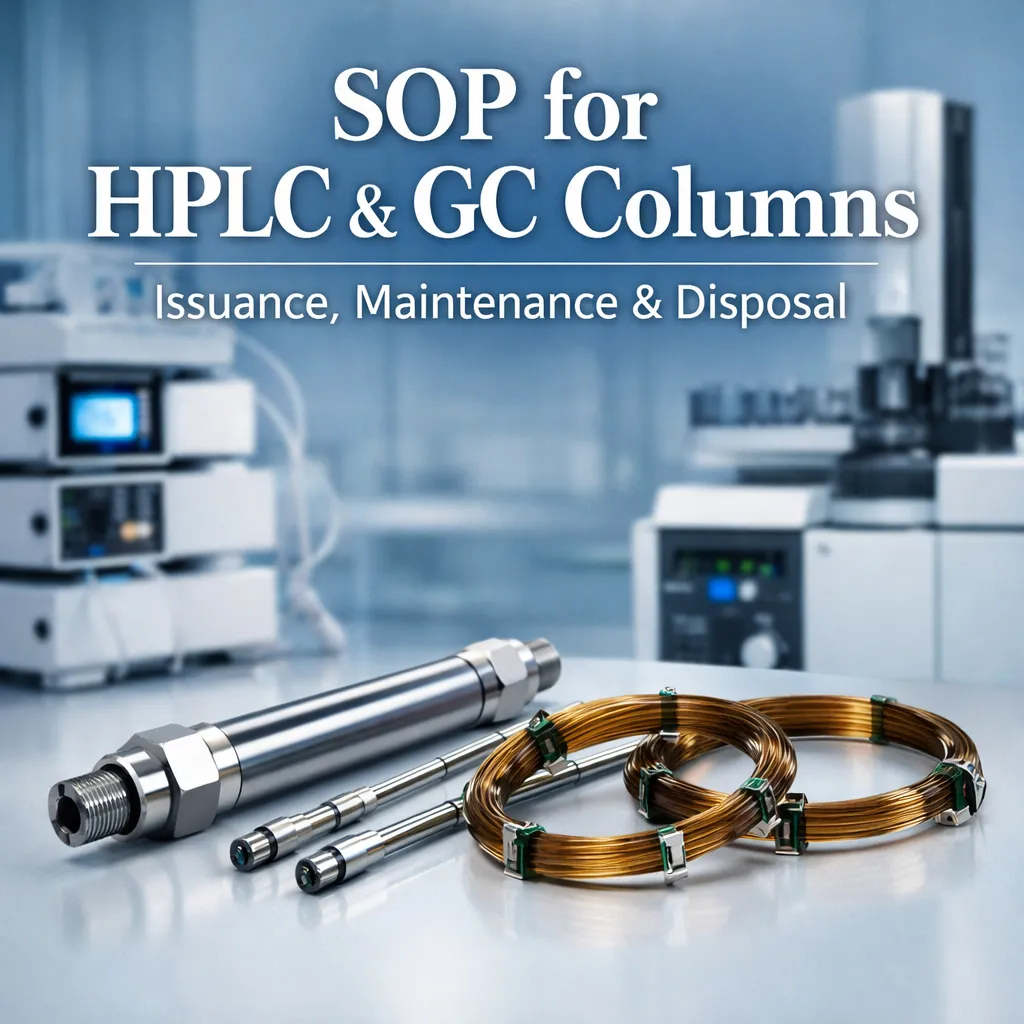

Comprehensive SOP for HPLC and GC Column Issuance, Maintenance & Disposal in QC labs with compliance and best practices.
🧠 Definition
HPLC and GC column SOP defines the standardized procedure for issuing, conditioning, maintaining, regenerating, and disposing chromatographic columns to ensure analytical accuracy, system suitability, and compliance with pharmaceutical quality standards.
📊 Column Lifecycle Overview
| Stage | Key Activity |
|---|---|
| Issuance | Procurement & ID assignment |
| Conditioning | Solvent washing & performance check |
| Maintenance | Cleaning & regeneration |
| Disposal | Rejection & documentation |
📋 Quick SOP Steps
Steps for Column Handling:
- Indent and procure column
- Verify and condition column
- Perform system suitability test
- Assign ID and record entry
- Maintain and regenerate column
- Monitor performance
- Dispose if criteria not met
Introduction
Chromatographic columns are critical components in analytical testing. Improper handling can lead to inaccurate results and compliance failures. This SOP ensures systematic issuance, maintenance, and disposal of HPLC and GC columns, maintaining analytical integrity and extending column life.
🧬 Semantic Content Layer
Chromatographic column management involves conditioning, performance verification, regeneration, and disposal based on system suitability parameters such as tailing factor, resolution, and theoretical plates. Proper solvent usage, degassing, and cleaning ensure analytical precision, data integrity, and GMP compliance.
1. Objective
To lay down the procedure for issuance, maintenance, and disposal of HPLC/GC columns.
2. Scope
Applicable for new column usage, maintenance, and disposal of old columns in QC laboratories.
3. Responsibility
- QC Executive/Officer: Indent and retrieval of columns
4. Accountability
- HOD QC / Head QA/QC
⚙️ 5. SOP Procedure
5.1 Operation (Issuance & Conditioning)
Step-by-Step Procedure
- QC executive indents required column and sends for approval.
- Receive and verify column against purchase documents.
- Condition column:
- Flush with methanol/acetonitrile (30 min)
- Wash with water (30 min)
- Wash with 60:40 water:solvent (30 min)
- Perform system suitability test.
- Assign ID if performance meets criteria.
- Record entry in issuance register.
👉 If performance fails → inform QC Head & supplier.
5.2 Calibration & Performance Check
- Verify system suitability:
- Tailing factor
- Resolution
- Theoretical plates
- Compare with method specifications
- Ensure reproducibility
5.3 Maintenance & Regeneration
- Wash with water (1 hour)
- Wash with 60:40 solvent mixture (1–2 hours)
- Regenerate using:
- Methanol / Acetonitrile / THF / IPA
- For protein columns:
- Use Water:IPA:Ethanol (50:25:25)
- For chiral columns:
- Use ethanol/hexane
5.4 GC Column Procedure
- Follow same issuance process
- Condition at 220°C for 4–5 hours
- Verify theoretical plates & resolution
5.5 Cleaning Procedure
- Wash column after analysis
- Use water + solvent mixture
- Remove buffer residues using hot water
- Store in appropriate solvent
5.6 Disposal Procedure
- Discard column if:
- Poor resolution
- High tailing
- Low theoretical plates
- Record in destruction register
- Label as “Discarded – Do Not Use”
- Store separately
⚠️ Precautions
- Use degassed solvents
- Filter samples before injection
- Avoid mechanical damage
- Store at room temperature
❌ Common Mistakes
- Improper conditioning
- Using non-degassed solvents
- Skipping regeneration
- Reusing failed columns
✅ Best Practices
- Maintain column logbook
- Perform routine cleaning
- Follow manufacturer guidelines
- Monitor system suitability
📘 Abbreviations
- QA – Quality Assurance
- QC – Quality Control
- HPLC – High Performance Liquid Chromatography
- GC – Gas Chromatography
- SOP – Standard Operating Procedure
❓ FAQs
- What is HPLC column SOP?
Procedure for handling chromatography columns. - Why is conditioning important?
Ensures column performance. - What solvents are used?
Methanol, acetonitrile, water. - When to discard column?
When system suitability fails. - What is regeneration?
Cleaning column to restore performance. - How to store column?
In solvent at room temperature. - What is tailing factor?
Peak symmetry indicator. - How often to clean column?
After each analysis. - What affects column life?
Improper solvent use and contamination. - Is SOP GMP compliant?
Yes.