


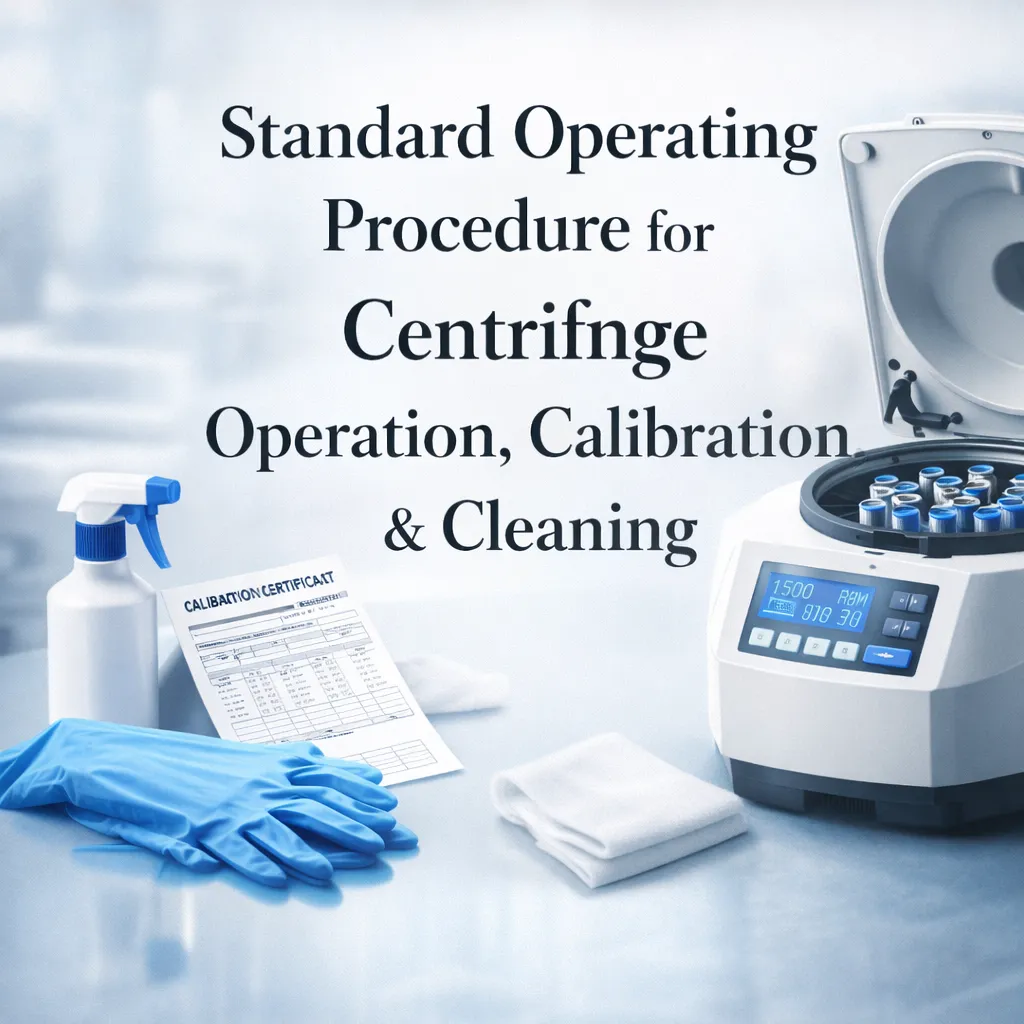

Learn a complete SOP for Centrifuge Operation, Calibration and Cleaning in pharma labs.
🧫 Introduction
Centrifuges are essential instruments in pharmaceutical quality control (QC) laboratories, used for separating components based on density. However, improper operation or poor maintenance can lead to inaccurate results, contamination, and safety hazards.
A well-defined Standard Operating Procedure (SOP) ensures consistent performance, accurate results, and compliance with regulatory standards.
This guide provides a complete SOP for operating, calibrating, and cleaning centrifuges in pharmaceutical environments.
📌 1.0 OBJECTIVE
To establish a standardized procedure for the operation, calibration, and cleaning of centrifuge equipment in pharmaceutical laboratories.
📍 2.0 SCOPE
This SOP applies to centrifuges installed in the Quality Control (QC) department for routine analysis and sample processing.
👨🔬 3.0 RESPONSIBILITY
- Execution: Technical Assistant / Executive
- Verification: Executive / Manager
🏢 4.0 ACCOUNTABILITY
Head of the Department (HOD)
⚙️ 5.0 PROCEDURE (Step-by-Step SOP)
▶️ 5.1 Operation of Centrifuge
🔹 Step 1: Pre-Operational Checks
- Ensure the instrument is clean and dry
- Verify rotor condition (no cracks or corrosion)
- Check calibration status label
🔹 Step 2: Sample Preparation
- Use balanced tubes (equal volume & weight)
- Ensure proper sealing of centrifuge tubes
🔹 Step 3: Loading the Centrifuge
- Place tubes symmetrically in the rotor
- Avoid overloading
🔹 Step 4: Setting Parameters
- Set required:
- Speed (RPM)
- Time
- Temperature (if applicable)
🔹 Step 5: Start Operation
- Close lid securely
- Start centrifuge
- Do not open during operation
🔹 Step 6: Post-Run Procedure
- Wait until rotor stops completely
- Remove samples carefully
- Inspect for spills or leaks
⚖️ 5.2 Calibration of Centrifuge
🔹 Frequency:
- As per calibration schedule or regulatory requirement
🔹 Steps:
- Verify RPM using a calibrated tachometer
- Check timer accuracy
- Validate temperature (if refrigerated centrifuge)
- Record calibration data
- Label instrument with calibration status
👉 Calibration ensures accuracy and reproducibility of results.
🧼 5.3 Cleaning of Centrifuge
🔹 Routine Cleaning Procedure:
- Switch OFF the instrument
- Switch OFF the mains
- Clean outer surface with dry cotton cloth
- Clean centrifuge disc/rotor using cotton cloth
- Remove any residue or spills
🔹 Post-Analysis Cleaning:
- Wash centrifuge tubes as per glassware cleaning SOP
- Dry thoroughly before reuse
🧪 6.0 ABBREVIATIONS
- SOP: Standard Operating Procedure
⚠️ Safety Tips for Centrifuge Use
- Always balance tubes before operation
- Never exceed recommended speed limits
- Do not open lid while running
- Use appropriate tubes for chemicals
- Wear PPE (gloves, goggles, lab coat)
❌ Common Mistakes to Avoid
- ❌ Unbalanced loading of samples
- ❌ Ignoring calibration schedule
- ❌ Cleaning while power is ON
- ❌ Using damaged rotors
- ❌ Skipping documentation
🌟 Best Practices
- Maintain a centrifuge logbook
- Perform routine preventive maintenance
- Train staff regularly
- Use manufacturer-recommended accessories
- Conduct periodic audits
❓ Frequently Asked Questions (FAQs)
1. What is the purpose of a centrifuge in pharma labs?
To separate components based on density for analysis.
2. Why is calibration important?
It ensures accurate and reproducible results.
3. How often should centrifuge be cleaned?
After each use and as per SOP schedule.
4. What happens if tubes are unbalanced?
It can damage the rotor and cause safety hazards.
5. Can centrifuge be opened during operation?
No, it is strictly prohibited.
6. What PPE is required?
Gloves, goggles, and lab coat.
7. How to verify centrifuge speed?
Using a calibrated tachometer.
8. What is the role of QC department?
To ensure accuracy and compliance in testing.
9. What should be done after spills?
Clean immediately and disinfect properly.
10. Who is responsible for SOP compliance?
Technical staff, verified by management.