


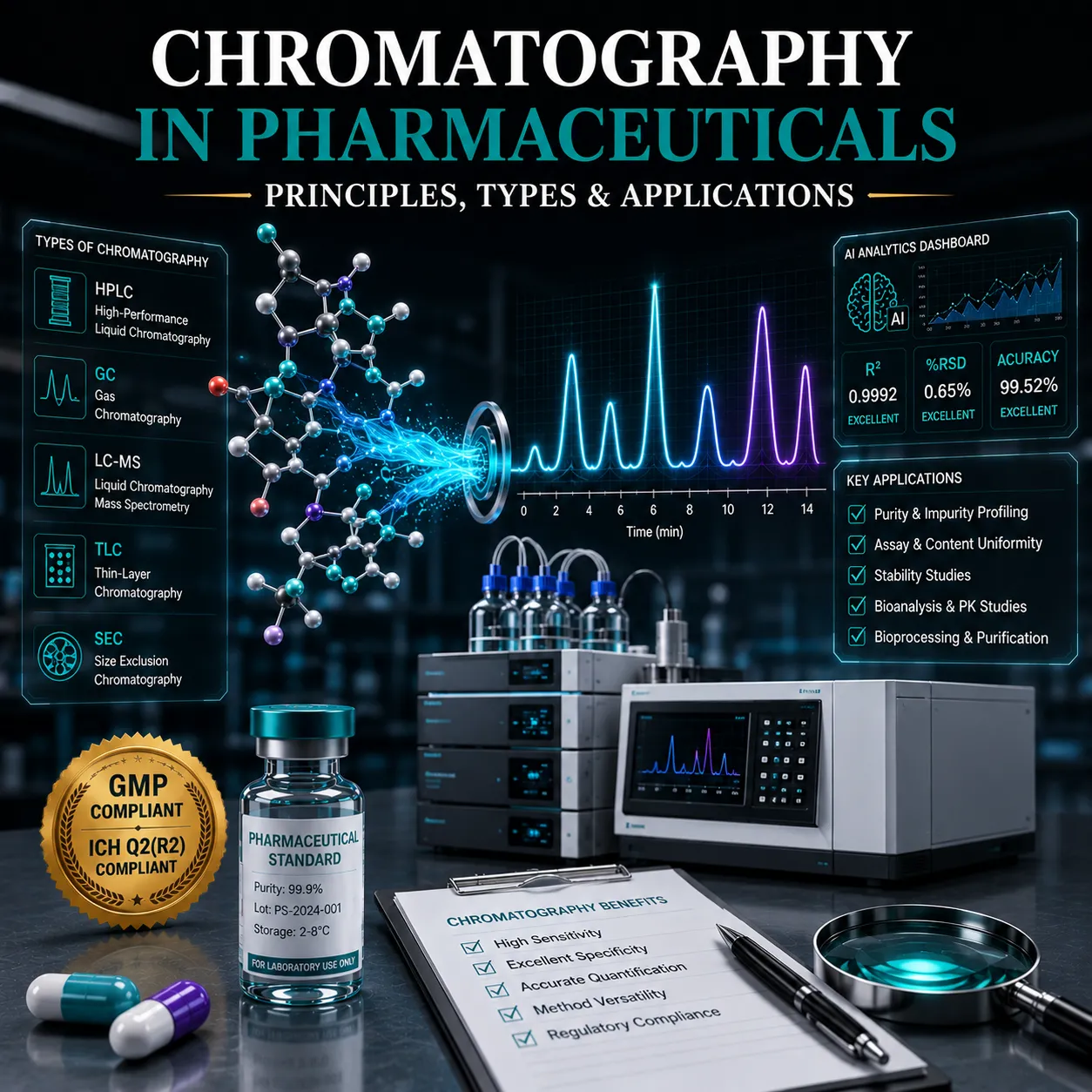

Learn chromatography in pharmaceuticals, including principles, types, applications, HPLC, GC, LC-MS, GMP requirements, and quality control uses.
Definition
Chromatography in pharmaceuticals is an analytical and purification technique used to separate, identify, quantify, and purify compounds based on their interaction with a stationary phase and a mobile phase. It plays a critical role in drug development, quality control, impurity profiling, stability testing, and regulatory compliance.
Chromatography is one of the most important analytical technologies in the pharmaceutical industry. From discovering new drug molecules to ensuring the quality and safety of finished products, chromatography provides the accuracy, sensitivity, and reliability required for modern pharmaceutical analysis.
Today, pharmaceutical laboratories depend on chromatographic techniques for routine quality control testing, impurity analysis, stability studies, residual solvent determination, and biopharmaceutical characterization. Regulatory agencies including the FDA, EMA, USP, and ICH recognize chromatography as a cornerstone of pharmaceutical quality systems.
This comprehensive guide explains the principles, major types, and real-world pharmaceutical applications of chromatography.
What Is Chromatography?
Chromatography is a separation technique that divides a mixture into its individual components based on their differing interactions with two phases:
Stationary Phase
A fixed phase that remains immobile.
Examples:
- Silica particles
- C18 bonded phases
- Polymer resins
- Gel matrices
Mobile Phase
A moving phase that carries analytes through the system.
Examples:
- Water
- Methanol
- Acetonitrile
- Helium
- Nitrogen
Compounds interact differently with each phase, causing them to move at different rates and separate from one another.
Core Principle of Chromatography
The fundamental principle of chromatography is differential partitioning.
As molecules travel through the chromatographic system:
- Stronger interaction with stationary phase → slower movement
- Stronger interaction with mobile phase → faster movement
This difference creates separation.
Simplified Process
Sample Injection ↓ Mobile Phase Flow ↓ Interaction with Stationary Phase ↓ Differential Migration ↓ Peak Separation ↓ Detection & QuantificationComponents of a Chromatographic System
| Component | Function |
|---|---|
| Mobile Phase | Carries analytes |
| Stationary Phase | Facilitates separation |
| Injector | Introduces sample |
| Column | Site of separation |
| Detector | Measures analytes |
| Data System | Records chromatogram |
Types of Chromatography Used in Pharmaceuticals
Several chromatographic techniques are used depending on the physicochemical properties of the analyte.
1. High-Performance Liquid Chromatography (HPLC)
HPLC is the most widely used chromatographic technique in pharmaceutical laboratories.
Principle
A liquid mobile phase is pumped at high pressure through a packed column.
Advantages
✅ High precision
✅ Excellent sensitivity
✅ Suitable for non-volatile compounds
✅ Widely accepted by regulators
Applications
- Assay testing
- Related substances
- Dissolution testing
- Stability studies
- Cleaning validation
Example
Paracetamol assay by reverse-phase HPLC using a C18 column.
2. Gas Chromatography (GC)
GC separates volatile and semi-volatile compounds.
Principle
An inert gas acts as the mobile phase while compounds are separated within a capillary column.
Applications
- Residual solvent analysis
- Volatile impurity testing
- Environmental monitoring
Example
Residual solvent testing according to ICH Q3C and USP <467>.
3. Thin-Layer Chromatography (TLC)
TLC is a simple and cost-effective chromatographic method.
Principle
Sample components travel across a coated plate through capillary action.
Applications
- Identity testing
- Preliminary purity evaluation
- Reaction monitoring
Advantages
- Low cost
- Fast analysis
- Minimal instrumentation
4. Liquid Chromatography–Mass Spectrometry (LC-MS)
LC-MS combines chromatographic separation with mass spectrometric detection.
Benefits
- Structural identification
- Trace-level impurity detection
- High sensitivity
Applications
- Genotoxic impurities
- Metabolite identification
- Pharmacokinetic studies
Example
Identification of unknown degradation products during forced degradation studies.
5. Size Exclusion Chromatography (SEC)
SEC separates molecules according to molecular size.
Principle
Large molecules elute first while smaller molecules enter pores and elute later.
Applications
- Protein characterization
- Monoclonal antibodies
- Vaccine analysis
- Aggregate determination
Common in Biopharmaceuticals
SEC is frequently used for therapeutic protein quality assessment.
Comparison of Major Chromatographic Techniques
| Technique | Mobile Phase | Best For |
|---|---|---|
| HPLC | Liquid | APIs, impurities |
| GC | Gas | Volatile solvents |
| TLC | Solvent mixture | Screening tests |
| LC-MS | Liquid + MS | Trace impurities |
| SEC | Liquid | Biologics & proteins |
Key Pharmaceutical Applications of Chromatography
1. Purity and Impurity Profiling
One of the most critical uses of chromatography.
Objectives
- Identify impurities
- Quantify degradation products
- Assess API purity
Regulatory Importance
ICH Q3A and Q3B require impurity monitoring and control.
2. Assay and Content Uniformity
Chromatography confirms that drug products contain the correct amount of active ingredient.
Example
Tablet assay testing using HPLC.
Benefits
- Dose accuracy
- Product consistency
- Patient safety
3. Stability Studies
Chromatography helps determine how pharmaceutical products change over time.
Evaluates
- Degradation pathways
- Shelf-life
- Storage conditions
Regulatory Basis
ICH Q1 Stability Guidelines.
4. Residual Solvent Analysis
GC is commonly used to monitor residual solvents remaining from manufacturing.
Guidelines
- ICH Q3C
- USP <467>
Example
Detection of methanol, benzene, and toluene.
5. Bioanalysis
Chromatographic methods support clinical research.
Applications
- Plasma drug concentrations
- Pharmacokinetic studies
- Bioequivalence studies
Common Technique
LC-MS/MS.
6. Bioprocessing and Purification
Preparative chromatography is used to purify biomolecules.
Examples
- Monoclonal antibodies
- Recombinant proteins
- Vaccines
Importance
Ensures product purity and therapeutic effectiveness.
Step-by-Step Guide: How Chromatographic Analysis Works
Step 1: Sample Preparation
Prepare sample according to method requirements.
Activities
- Dilution
- Extraction
- Filtration
Step 2: Sample Injection
Introduce sample into the chromatographic system.
Step 3: Separation
Analytes interact differently with stationary and mobile phases.
Step 4: Detection
Detector generates signals corresponding to analyte concentration.
Common detectors:
- UV
- PDA
- FID
- MS
Step 5: Data Processing
Software generates chromatograms and calculates results.
Step 6: Result Evaluation
Assess:
- Retention time
- Peak area
- Resolution
- System suitability
Practical Example: HPLC Assay of a Tablet
Scenario
A QC laboratory analyzes a tablet formulation.
Method
- Column: C18
- Mobile Phase: Water:Acetonitrile
- Detector: UV 254 nm
Results
| Peak | Retention Time | Area |
|---|---|---|
| API | 6.8 min | 1,250,000 |
| Impurity A | 3.5 min | 2,150 |
Interpretation
- API identified correctly
- Impurity level within specification
- System suitability passed
Batch accepted.
Chromatography and GMP Compliance
Chromatographic systems are heavily scrutinized during regulatory inspections.
Relevant Regulations
- USP <621>
- USP <467>
- ICH Q2(R2)
- ICH Q3A
- ICH Q3B
- ICH Q3C
- EU GMP Annex 11
- FDA 21 CFR Part 11
Common GMP Deficiencies
❌ Inadequate system suitability
❌ Poor chromatographic integration practices
❌ Missing audit trails
❌ Unsupported method changes
❌ Incomplete validation records
Best Practices
✅ Validate analytical methods
✅ Review chromatograms thoroughly
✅ Maintain instrument calibration
✅ Document all changes
✅ Preserve electronic records
Future Trends in Pharmaceutical Chromatography
Emerging technologies are transforming pharmaceutical laboratories.
Key Innovations
- AI-assisted chromatogram interpretation
- Automated method development
- Digital quality control laboratories
- Real-time release testing
- Advanced LC-MS workflows
These technologies improve efficiency while strengthening data integrity and regulatory compliance.
FAQs
1. What is chromatography in pharmaceuticals?
Chromatography is a separation technique used to identify, quantify, and purify pharmaceutical compounds.
2. Why is HPLC important in pharmaceutical analysis?
HPLC provides accurate, precise, and reliable analysis of APIs, impurities, and finished products.
3. What is the difference between HPLC and GC?
HPLC uses a liquid mobile phase, while GC uses a gas mobile phase and is best for volatile compounds.
4. What is LC-MS used for?
LC-MS is used for impurity identification, metabolite analysis, and trace-level detection.
5. What is the stationary phase?
The stationary phase is the immobile material responsible for chromatographic separation.
6. What is the mobile phase?
The mobile phase transports analytes through the chromatographic system.
7. What is retention time?
Retention time is the time taken for a compound to reach the detector after injection.
8. Why is chromatography important for impurity profiling?
It enables detection and quantification of impurities that may affect safety and efficacy.
9. Which chromatography technique is used for residual solvents?
Gas chromatography (GC) is commonly used for residual solvent analysis.
10. How does chromatography support GMP compliance?
It provides validated analytical data used to demonstrate product quality and regulatory compliance.