


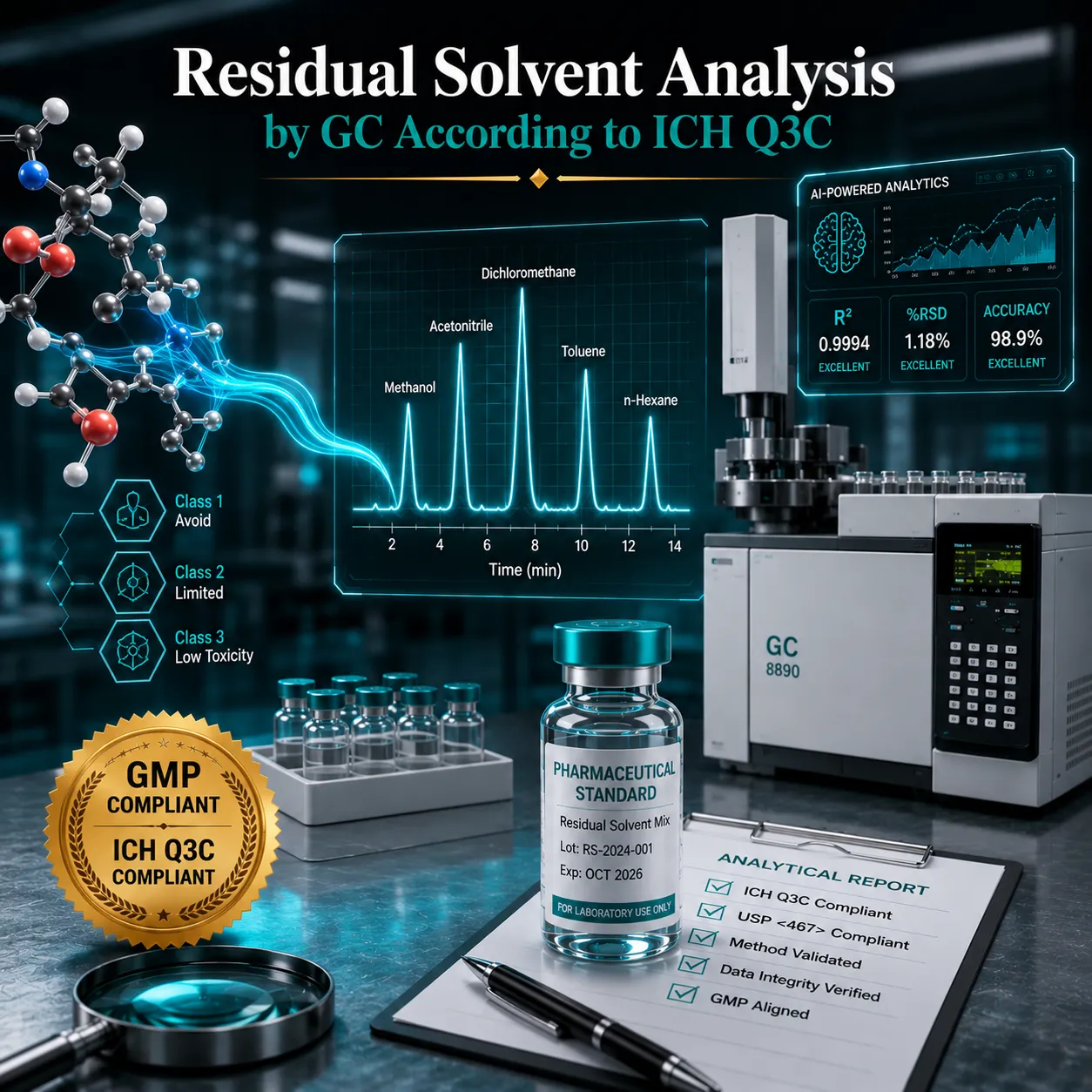

Learn residual solvent analysis by gas chromatography per ICH Q3C and USP <467>, including solvent limits, HS-GC methods, validation, and GMP compliance.
Definition
Residual solvent analysis by gas chromatography (GC) is a pharmaceutical quality control test used to identify and quantify volatile organic solvents remaining in drug substances and drug products. According to ICH Q3C and USP <467>, residual solvents are classified based on toxicity and must remain below specified limits to ensure patient safety and regulatory compliance.
Residual solvents are among the most closely monitored impurities in pharmaceutical manufacturing. Although solvents play a vital role in synthesis, purification, extraction, and formulation processes, trace amounts may remain in the final product. If not properly controlled, these residues can impact patient safety and lead to regulatory non-compliance.
To address this risk, the International Council for Harmonisation (ICH) developed ICH Q3C: Impurities—Guideline for Residual Solvents, which establishes toxicological limits and solvent classifications. Today, pharmaceutical laboratories worldwide use Headspace Gas Chromatography (HS-GC) in conjunction with USP General Chapter <467> Residual Solvents to monitor these volatile impurities.
This guide explains the principles, regulatory requirements, analytical procedures, validation expectations, and practical applications of residual solvent testing in pharmaceutical quality control.
What Are Residual Solvents?
Residual solvents are organic volatile chemicals used during:
- Drug substance synthesis
- Crystallization processes
- Extraction procedures
- Purification steps
- Formulation manufacturing
Although manufacturing processes are designed to remove these solvents, trace levels may remain in the final product.
Why Control Residual Solvents?
Potential risks include:
- Toxicity
- Carcinogenicity
- Neurotoxicity
- Organ damage
- Environmental concerns
Therefore, regulatory agencies require manufacturers to demonstrate compliance with established solvent limits.
Understanding ICH Q3C Solvent Classification
ICH Q3C categorizes residual solvents according to their toxicological risk.
Table 1: ICH Q3C Solvent Classes
| Solvent Class | Description | Examples |
|---|---|---|
| Class 1 | Solvents to be avoided | Benzene, Carbon Tetrachloride |
| Class 2 | Solvents with limited use | Methanol, Toluene, Acetonitrile |
| Class 3 | Solvents with low toxic potential | Ethanol, Acetone, Isopropanol |
Class 1 Solvents: Avoid Whenever Possible
Class 1 solvents are known human carcinogens or environmentally hazardous substances.
Examples
| Solvent | Typical Limit (ppm) |
|---|---|
| Benzene | 2 ppm |
| Carbon Tetrachloride | 4 ppm |
| 1,2-Dichloroethane | 5 ppm |
| 1,1-Dichloroethene | 8 ppm |
Regulatory Expectation
Manufacturers should avoid using these solvents whenever technically feasible.
Class 2 Solvents: Controlled by PDE
Class 2 solvents possess significant toxicity risks but may be used when justified.
Examples
| Solvent | PDE-Based Control |
|---|---|
| Methanol | Limited |
| Acetonitrile | Limited |
| Toluene | Limited |
| Hexane | Limited |
Acceptance limits are based on Permitted Daily Exposure (PDE) calculations.
Class 3 Solvents: Low Toxic Potential
Class 3 solvents present minimal toxicological concern.
Common Examples
| Solvent | Typical Use |
|---|---|
| Ethanol | Extraction |
| Acetone | Cleaning |
| Isopropanol | Manufacturing |
| Ethyl Acetate | Purification |
Limit
Class 3 solvents are generally acceptable up to:
50 mg/day or 5000 ppm
without additional toxicological justification.
Why Gas Chromatography Is Used for Residual Solvent Testing
Residual solvents are volatile compounds, making Gas Chromatography (GC) the preferred analytical technique.
Advantages
✅ High sensitivity
✅ Excellent selectivity
✅ Simultaneous multi-solvent analysis
✅ Regulatory acceptance
✅ Trace-level detection capability
Headspace Gas Chromatography (HS-GC): The Industry Standard
Modern pharmaceutical laboratories predominantly use Headspace Gas Chromatography (HS-GC) because it minimizes matrix interference while improving sensitivity.
Principle of HS-GC
The sample is placed in a sealed vial and heated.
As temperature increases:
- Volatile solvents migrate into the gas phase.
- Equilibrium is established.
- Headspace vapor is sampled.
- Vapor is injected into the GC system.
Only volatile compounds enter the column, resulting in cleaner chromatograms.
Analytical Procedure Breakdown
Step 1: Sample Preparation
The sample is dissolved in a suitable diluent such as:
| Solvent | Common Use |
|---|---|
| Water | Water-soluble products |
| DMSO | Poorly soluble compounds |
| DMA | Difficult matrices |
The solution is transferred into a sealed headspace vial.
Step 2: Headspace Equilibration
The vial is heated at a controlled temperature.
Purpose
- Release trapped solvents
- Achieve thermodynamic equilibrium
- Improve analytical reproducibility
Step 3: Vapor Injection
The autosampler withdraws a precise volume of vapor from the vial headspace and transfers it into the GC inlet.
Step 4: Chromatographic Separation
Residual solvents are separated on a capillary GC column.
Common Column Types
| Column Type | Application |
|---|---|
| Polar | Alcohols and ketones |
| Non-Polar | Hydrocarbons |
| Intermediate Polarity | Multi-solvent methods |
Step 5: Detection
Flame Ionization Detector (FID)
Advantages:
- Cost-effective
- High sensitivity
- Excellent linearity
Mass Spectrometry (GC-MS)
Advantages:
- Structural confirmation
- Trace-level identification
- Unknown solvent detection
Typical Residual Solvent Workflow
Sample ↓ Dissolution ↓ Headspace Vial ↓ Heating & Equilibration ↓ Headspace Injection ↓ GC Separation ↓ FID/MS Detection ↓ Quantification ↓ ICH Q3C Compliance AssessmentPractical Example
Example: Residual Solvent Testing for an API
Manufacturing process uses:
- Methanol
- Toluene
- Acetone
Analytical Results
| Solvent | Result (ppm) | Limit (ppm) | Status |
|---|---|---|---|
| Methanol | 1200 | 3000 | Pass |
| Toluene | 350 | 890 | Pass |
| Acetone | 1800 | 5000 | Pass |
Conclusion:
The batch complies with ICH Q3C requirements.
USP <467> and ICH Q3C Harmonization
USP General Chapter <467> Residual Solvents incorporates ICH Q3C requirements and provides validated analytical procedures.
Benefits
- Global consistency
- Regulatory acceptance
- Standardized methodology
- Reduced validation burden
Today, most pharmaceutical laboratories align residual solvent testing with USP <467> requirements.
Method Validation Requirements
Residual solvent methods must comply with ICH Q2(R2).
Critical Validation Parameters
| Parameter | Purpose |
|---|---|
| Specificity | Solvent identification |
| Linearity | Concentration-response relationship |
| Accuracy | Recovery assessment |
| Precision | Repeatability |
| LOQ | Trace-level quantification |
| Robustness | Method reliability |
Common Causes of Method Failure
Poor Headspace Equilibration
Can cause inconsistent recoveries.
Incorrect Diluent Selection
May suppress solvent release.
Column Bleeding
Interferes with trace-level detection.
Improper Temperature Programming
Leads to co-elution and poor resolution.
Carryover
Can generate false-positive results.
GMP and Regulatory Insights
Regulators frequently review residual solvent programs during inspections.
Common GMP Observations
❌ Inadequate solvent risk assessment
❌ Missing PDE justification
❌ Poor method validation
❌ Unverified headspace conditions
❌ Incomplete chromatographic integration records
GMP Best Practices
✅ Maintain solvent inventories
✅ Establish risk-based testing strategies
✅ Validate HS-GC methods
✅ Monitor system suitability
✅ Ensure data integrity compliance
✅ Retain chromatographic audit trails
Data Integrity Considerations
Residual solvent data should comply with:
- FDA Data Integrity Guidance
- EU GMP Annex 11
- ALCOA+ Principles
- PIC/S Data Integrity Guidance
Ensure:
- Electronic audit trails remain active
- Integration changes are documented
- Chromatograms are archived
- Raw data remains retrievable
FAQs
1. What is residual solvent analysis in pharmaceuticals?
Residual solvent analysis measures volatile organic solvents remaining in drug substances and products after manufacturing.
2. Why is gas chromatography used for residual solvent testing?
GC provides excellent sensitivity and selectivity for volatile compounds at trace levels.
3. What is ICH Q3C?
ICH Q3C is the international guideline that establishes toxicological limits for residual solvents.
4. What are Class 1 solvents?
Class 1 solvents are known carcinogens or environmentally hazardous solvents that should generally be avoided.
5. What is the benzene limit according to ICH Q3C?
Benzene is typically limited to 2 ppm due to its carcinogenic potential.
6. What is USP <467>?
USP <467> is the pharmacopeial chapter describing procedures for residual solvent testing.
7. Why is headspace GC preferred?
Headspace GC reduces matrix interference and improves detection of volatile solvents.
8. What detector is commonly used in residual solvent analysis?
Flame Ionization Detection (FID) is the most commonly used detector, although GC-MS is also utilized.
9. What are Class 3 solvents?
Class 3 solvents have low toxic potential and are generally acceptable up to 5000 ppm.
10. How is compliance with ICH Q3C demonstrated?
By validating the analytical method and showing solvent concentrations remain below established limits.