


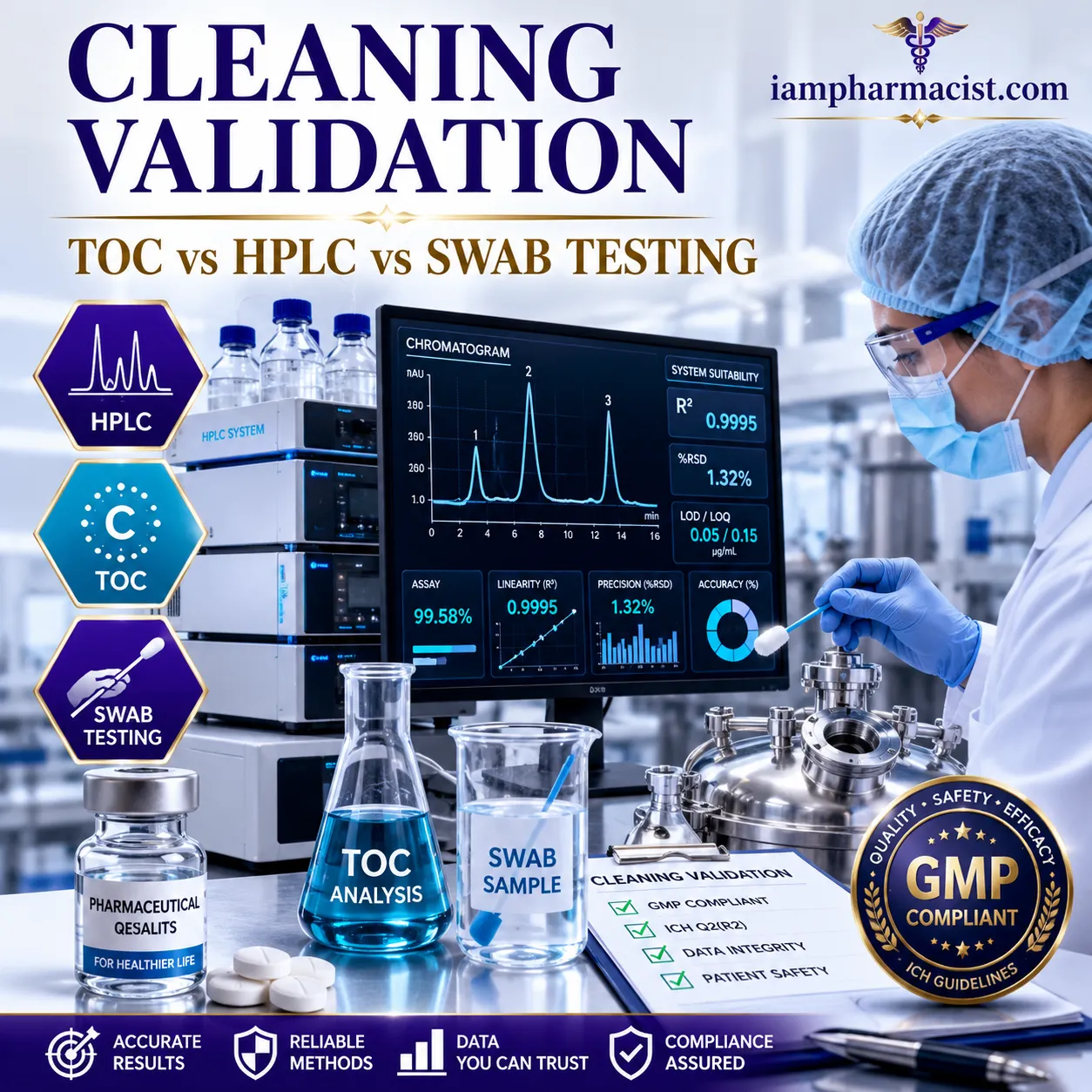

Compare TOC, HPLC, and swab testing for cleaning validation. Learn regulatory requirements, MAC calculations, method validation, and GMP best practices.
Definition
Cleaning validation analytical methods are laboratory techniques used to detect and quantify product, excipient, and cleaning agent residues remaining on pharmaceutical equipment after cleaning. The most commonly used methods are HPLC (specific residue analysis), TOC (non-specific organic residue detection), and swab testing (surface sampling technique). Method selection depends on residue type, detection limits, regulatory expectations, and cleaning validation objectives.
Introduction
Cleaning validation is a critical GMP requirement that demonstrates pharmaceutical manufacturing equipment is consistently cleaned to prevent cross-contamination, product mix-ups, and patient safety risks.
As regulatory expectations evolve from traditional Maximum Allowable Carryover (MAC) calculations toward toxicological limits such as PDE (Permitted Daily Exposure), analytical methods must become increasingly sensitive, scientifically justified, and validated.
Among the most widely used cleaning validation approaches are:
- High Performance Liquid Chromatography (HPLC)
- Total Organic Carbon (TOC) Analysis
- Swab Testing
- Rinse Sampling
- Conductivity Testing
- Total Protein Analysis
- Visual Inspection
This guide compares TOC, HPLC, and swab testing, explains regulatory expectations, and provides a practical roadmap for analytical method development and validation.
Why Analytical Methods Matter in Cleaning Validation
The success of a cleaning validation program depends on the ability to accurately detect trace residues left after cleaning.
These residues may include:
| Residue Type | Examples |
|---|---|
| Active Pharmaceutical Ingredients (APIs) | Potent compounds, hormones, cytotoxics |
| Excipients | Lactose, starch, cellulose |
| Cleaning Agents | Detergents, surfactants |
| Degradation Products | Oxidized or hydrolyzed impurities |
| Bioburden | Microbial contamination |
| Proteins | Biotech manufacturing residues |
An inappropriate analytical method can lead to:
- False pass results
- Undetected contamination
- Regulatory observations
- Product recalls
- Data integrity concerns
Regulatory Expectations for Cleaning Validation
Key Guidelines
| Regulatory Authority | Relevant Guidance |
|---|---|
| FDA | Guidance for Industry: Process Validation |
| EMA | Health-Based Exposure Limits (HBEL) |
| PIC/S | PI 006 Recommendations |
| WHO | GMP Cleaning Validation Guidance |
| APIC | Cleaning Validation Guidance |
| ICH | Q14 and Q2(R2) Analytical Procedure Development |
Modern regulators expect:
✅ Scientific rationale
✅ Toxicological risk assessment
✅ PDE-based residue limits
✅ Validated analytical methods
✅ Recovery studies
✅ Lifecycle management
Cleaning Validation Calculator
1. MAC Calculator (PDE Method)
2. MAC Calculator (1/1000 Dose Criterion)
3. Swab Residue Limit Calculator
4. Rinse Sample Limit Calculator
5. Recovery Percentage Calculator
6. Recovery Corrected Result Calculator
Understanding Maximum Allowable Carryover (MAC)
MAC represents the maximum acceptable amount of residue from a previous product that can carry over into the next product.
Traditional MAC Approaches
FDA 1/1000 Dose Criterion
MAC=1000MinimumDailyDose×BatchSize
10 ppm Criterion
MAC=10 ppm
PDE-Based Approach (EMA Preferred)
MAC=MaximumDailyDosePDE×NextProductBatchSize
The PDE approach is currently considered the most scientifically justified method.
What Is Swab Testing?
Swab testing is a sampling technique used to recover residues from equipment surfaces for laboratory analysis.
Swab Sampling Process
- Select sampling location
- Mark defined surface area
- Swab using validated technique
- Extract residue from swab
- Analyze extract using HPLC, TOC, or another method
Advantages
- Direct surface assessment
- Detects worst-case locations
- Regulatory preference
- Suitable for difficult-to-clean areas
Limitations
- Recovery variability
- Operator dependence
- Limited area coverage
What Is HPLC in Cleaning Validation?
High Performance Liquid Chromatography (HPLC) is a specific analytical technique used to quantify targeted residues.
How HPLC Works
The method separates chemical components and measures the concentration of a specific residue using chromatographic detection.
Typical Applications
- API residues
- Degradation products
- Detergent components
- Potent compounds
HPLC Strengths and Limitations
| Strengths | Limitations |
|---|---|
| Highly specific | Longer analysis time |
| Excellent sensitivity | Higher operating cost |
| Quantitative results | Requires method development |
| Regulatory acceptance | Cannot detect unknown residues |
| Suitable for PDE limits | Solvent consumption |
Best Used When
- Target residue is known
- Low carryover limits exist
- Potent compounds are manufactured
- Regulatory scrutiny is high
What Is TOC Analysis?
Total Organic Carbon (TOC) measures the total amount of organic carbon present in a sample.
Rather than identifying specific compounds, TOC measures total carbon content.
TOC Principle
Organic compounds are oxidized into carbon dioxide.
The analyzer measures generated CO₂ and converts it into carbon concentration.
TOC Strengths and Limitations
| Strengths | Limitations |
|---|---|
| Detects multiple residues simultaneously | Non-specific |
| Rapid analysis | Cannot identify residue source |
| High sensitivity | Unsuitable for inorganic residues |
| Low cost per sample | Carbon response varies |
| Excellent for detergents and excipients | Requires carbon correlation |
Particularly Effective For
- Cleaning agents
- Detergents
- Excipients
- Multiple product facilities
- Routine monitoring
TOC vs HPLC Comparison
| Parameter | TOC | HPLC |
|---|---|---|
| Specificity | Non-specific | Highly specific |
| Quantification | Total carbon | Target compound |
| Method Development | Minimal | Extensive |
| Cost | Lower | Higher |
| Analysis Time | Fast | Moderate |
| Detects Unknown Residues | Yes | No |
| API Quantification | Limited | Excellent |
| Detergent Detection | Excellent | Variable |
| Routine Monitoring | Excellent | Moderate |
| Regulatory Acceptance | High | Very High |
TOC vs HPLC vs Swab Testing
| Feature | TOC | HPLC | Swab Testing |
|---|---|---|---|
| Method Type | Analytical | Analytical | Sampling |
| Detects Specific Residue | No | Yes | Depends on analysis |
| Surface Assessment | Via sample | Via sample | Direct |
| Quantitative | Yes | Yes | Yes |
| Recovery Studies Required | Yes | Yes | Yes |
| Routine Monitoring | Excellent | Good | Excellent |
| Cleaning Validation | Excellent | Excellent | Essential |
Sampling Techniques for Cleaning Residues
1. Swab Sampling
Best for:
- Worst-case locations
- Equipment surfaces
- Validation studies
2. Rinse Sampling
Best for:
- Large equipment
- CIP systems
- Inaccessible surfaces
Advantages:
- Covers entire system
- Simple execution
Limitations:
- Dilution effects
- Lower sensitivity
3. Solvent Sampling
Common for:
- Hoses
- Transfer lines
- Narrow process paths
4. Placebo Sampling
Used to assess residue transfer during manufacturing.
5. Visual Inspection
Regulators consider visual inspection a mandatory but insufficient stand-alone tool.
Method Development Roadmap
Step 1: Identify Residues
Determine:
- API
- Excipient
- Cleaning agent
- Degradation products
Step 2: Calculate Acceptance Limits
Use:
- PDE
- HBEL
- MAC
Step 3: Select Analytical Method
| Scenario | Recommended Method |
|---|---|
| Potent API | HPLC |
| Multiple residues | TOC |
| Detergent residue | TOC |
| Protein residue | Total Protein Assay |
| Surface verification | Swab Testing |
Step 4: Develop Sampling Strategy
Define:
- Locations
- Swab type
- Solvent
- Sample handling
Step 5: Validate Method
According to ICH Q2(R2).
Validation Parameters for Cleaning Validation Methods
Specificity
Evaluate interference from:
- Excipients
- Degradation products
- Cleaning agents
- Swab extractables
Accuracy
Measured through recovery studies.
Typical acceptance:
70–120% recovery
Precision
Includes:
- Repeatability
- Intermediate precision
Target:
RSD ≤ 15%
Linearity
Typical target:
R² ≥ 0.99
Detection Limit (LOD)
Lowest detectable residue concentration.
Quantitation Limit (LOQ)
Lowest concentration quantified with acceptable accuracy.
Robustness
Evaluate effects of:
- Extraction time
- Solvent composition
- Analyst
- Instrument variation
Practical Example
Scenario
A multiproduct facility manufactures:
- Product A (high-potency API)
- Product B (tablet formulation)
Risk Assessment
Product A has a low PDE.
Selected Strategy
| Activity | Method |
|---|---|
| Surface sampling | Swab |
| API residue analysis | HPLC |
| Detergent verification | TOC |
| Routine monitoring | TOC |
| Investigation testing | HPLC |
This hybrid approach satisfies both sensitivity and operational efficiency.
GMP Best Practices
Use Worst-Case Product Selection
Consider:
- Toxicity
- Solubility
- Cleanability
- Potency
Validate Sampling Recovery
Swab recovery should be scientifically justified.
Establish Lifecycle Monitoring
Cleaning validation is not a one-time exercise.
Trend Analytical Data
Monitor:
- OOS results
- OOT trends
- Recovery shifts
Integrate ICH Q14 Principles
Apply analytical procedure lifecycle concepts throughout method development and maintenance.
Common Mistakes to Avoid
| Mistake | Impact |
|---|---|
| Using only visual inspection | Hidden residues missed |
| No recovery studies | Invalid results |
| Inadequate LOD/LOQ | False acceptance |
| Ignoring detergent residues | Cross-contamination risk |
| No PDE assessment | Regulatory findings |
| Poor sampling locations | False negatives |
Conclusion
No single analytical method is universally superior for cleaning validation. The optimal strategy combines scientifically justified sampling techniques with validated analytical methods.
- HPLC provides highly specific quantification of known residues and remains the gold standard for potent APIs.
- TOC offers rapid, sensitive, and cost-effective monitoring of organic residues, detergents, and excipients.
- Swab testing remains the preferred surface sampling technique for demonstrating equipment cleanliness.
A risk-based combination of TOC, HPLC, rinse sampling, and validated swab recovery studies aligned with FDA, EMA, PIC/S, WHO, and ICH expectations provides the strongest cleaning validation program.
FAQs
1. What is the best analytical method for cleaning validation?
HPLC is best for specific residue quantification, while TOC is ideal for rapid detection of total organic residues. Most facilities use both.
2. What is the difference between TOC and HPLC?
TOC measures total organic carbon non-specifically, whereas HPLC identifies and quantifies specific compounds.
3. Is swab testing mandatory for cleaning validation?
Swab testing is not always mandatory but is strongly recommended and widely accepted by regulators for direct surface assessment.
4. When should TOC be used in cleaning validation?
TOC is particularly useful for detergents, excipients, and routine cleaning monitoring programs.
5. Why is HPLC considered the gold standard?
HPLC offers superior specificity, sensitivity, and quantitative accuracy for known residues.
6. What are MAC limits in cleaning validation?
MAC limits define the maximum residue amount allowed to carry over into the next manufactured product.
7. What is PDE in cleaning validation?
PDE (Permitted Daily Exposure) is a toxicology-based limit used to establish scientifically justified residue acceptance criteria.
8. How are swab recovery studies performed?
Known residue amounts are applied to coupons, recovered using validated swabbing procedures, and analyzed to determine recovery efficiency.
9. What validation parameters are required?
Specificity, accuracy, precision, linearity, LOD, LOQ, range, robustness, and recovery must typically be evaluated.
10. Which regulations govern cleaning validation?
Key guidance documents include FDA, EMA, PIC/S, WHO, APIC, ICH Q14, and ICH Q2(R2).