


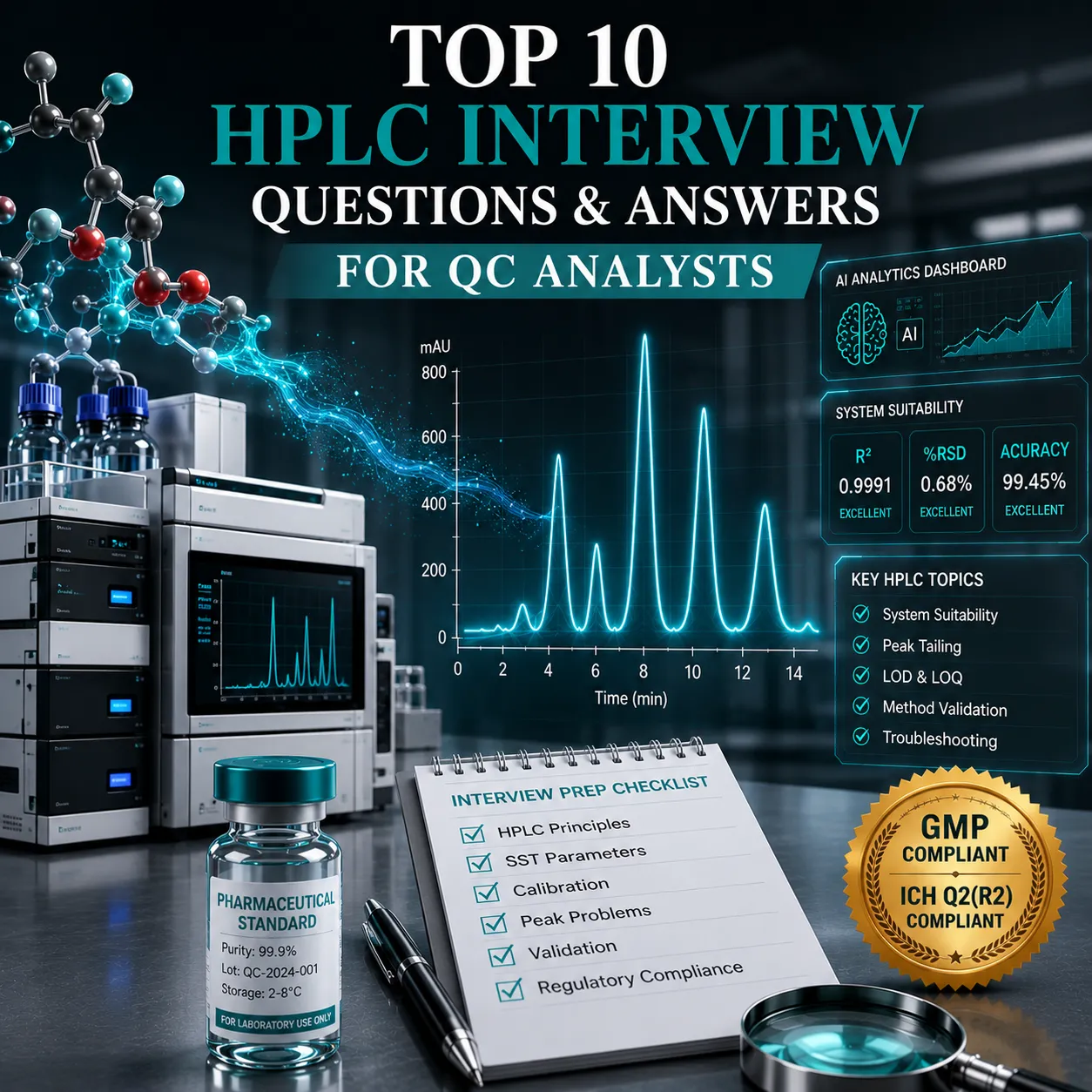

Prepare for pharmaceutical QC interviews with the top 10 HPLC interview questions and answers covering SST, validation, troubleshooting, LOD, LOQ, and GMP.
Definition
HPLC interview questions for QC analysts typically focus on chromatographic principles, system suitability testing, method validation, troubleshooting, calibration, and GMP compliance. Understanding concepts such as retention time, resolution, tailing factor, LOD, LOQ, and mobile phase selection is essential for success in pharmaceutical quality control interviews.
High-Performance Liquid Chromatography (HPLC) is one of the most important analytical techniques used in pharmaceutical quality control laboratories. Whether you’re applying for a QC Analyst, Senior QC Analyst, Analytical Chemist, or Stability Analyst position, interviewers frequently assess your understanding of HPLC fundamentals, troubleshooting, validation, and regulatory compliance.
This guide covers the Top 10 HPLC Interview Questions and Answers that are commonly asked during pharmaceutical interviews and provides practical explanations to help candidates confidently demonstrate technical expertise.
Why HPLC Knowledge Matters in Pharmaceutical QC
HPLC is routinely used for:
- Assay testing
- Related substances analysis
- Dissolution testing
- Stability studies
- Cleaning validation
- Residual impurity analysis
- Method validation
A strong understanding of HPLC is often a key hiring requirement for pharmaceutical quality control professionals.
Question 1: What Is the Fundamental Principle of HPLC?
Answer
HPLC separates, identifies, and quantifies components within a mixture based on their interactions with a stationary phase and a mobile phase.
The sample is injected into a high-pressure liquid stream and passes through a chromatographic column. Different compounds interact differently with the stationary phase, causing them to elute at distinct retention times.
Interview Tip
Mention:
- Mobile phase
- Stationary phase
- Retention time
- Separation based on chemical properties
Practical Example
In a paracetamol assay, impurities and the active ingredient separate into different chromatographic peaks based on their affinity for the stationary phase.
Question 2: What Is the Difference Between Normal Phase and Reversed-Phase HPLC?
Answer
| Parameter | Normal Phase | Reversed Phase |
|---|---|---|
| Stationary Phase | Polar | Non-polar |
| Mobile Phase | Non-polar | Polar |
| Common Column | Silica | C18/C8 |
| Pharmaceutical Use | Limited | Most common |
Examples
Normal Phase
- Silica column
- Hexane mobile phase
Reversed Phase
- C18 column
- Water + Acetonitrile
Most pharmaceutical methods use Reversed-Phase Chromatography (RPC).
Question 3: What Is System Suitability Testing (SST)?
Answer
System Suitability Testing verifies that the chromatographic system performs correctly before sample analysis begins.
Common SST Parameters
| Parameter | Purpose |
|---|---|
| Resolution (Rs) | Peak separation |
| Tailing Factor | Peak symmetry |
| Theoretical Plates (N) | Column efficiency |
| Retention Time | System consistency |
| %RSD | Injection precision |
Why It’s Important
USP <621> states that no sample analysis is acceptable unless system suitability requirements are met.
Question 4: Why Is Mobile Phase pH Important?
Answer
Mobile phase pH affects the ionization state of acidic and basic analytes.
Proper pH control improves:
- Retention
- Resolution
- Peak shape
- Method reproducibility
Example
A basic compound analyzed at inappropriate pH may exhibit severe peak tailing due to silanol interactions.
Interview Tip
Explain how pH influences analyte ionization and chromatographic behavior.
Question 5: What Parameters Are Checked During HPLC Calibration?
Answer
Calibration ensures that critical system components operate accurately.
Key Calibration Parameters
| Parameter | Purpose |
|---|---|
| Flow Rate Accuracy | Pump performance |
| Gradient Accuracy | Mobile phase mixing |
| Injection Volume Accuracy | Sample delivery |
| Detector Wavelength Accuracy | Detection reliability |
| Oven Temperature Accuracy | Method reproducibility |
| Detector Linearity | Quantitative accuracy |
GMP Importance
Calibration records are frequently reviewed during audits and inspections.
Question 6: What Is the Difference Between LOD and LOQ?
Answer
LOD (Limit of Detection)
Lowest concentration that can be detected but not necessarily quantified.
LOQ (Limit of Quantification)
Lowest concentration that can be quantified with acceptable accuracy and precision.
Typical Signal-to-Noise Ratios
| Parameter | Typical S/N Ratio |
|---|---|
| LOD | 3:1 |
| LOQ | 10:1 |
Example
A method may detect an impurity at 0.01%, but accurately quantify it only at 0.03%.
Question 7: How Do You Troubleshoot Peak Tailing?
Answer
Peak tailing is a common chromatographic problem.
Possible Causes
| Cause | Corrective Action |
|---|---|
| Column contamination | Flush column |
| Active silanol interactions | Adjust pH |
| Column damage | Replace column |
| Dead volume | Tighten fittings |
| Buffer incompatibility | Optimize mobile phase |
Practical Approach
- Check mobile phase pH
- Flush column
- Replace guard column
- Evaluate analytical column condition
Question 8: Explain Isocratic and Gradient Elution
Answer
Isocratic Elution
Mobile phase composition remains constant throughout the run.
Gradient Elution
Mobile phase composition changes during the run.
Comparison
| Feature | Isocratic | Gradient |
|---|---|---|
| Mobile Phase | Constant | Changes |
| Simplicity | Higher | Lower |
| Complex Samples | Limited | Excellent |
| Run Time | Longer | Shorter |
Example
Gradient methods are commonly used for impurity profiling where analytes vary significantly in polarity.
Question 9: What Causes High System Back Pressure?
Answer
High back pressure usually indicates flow restrictions within the system.
Common Causes
| Cause | Solution |
|---|---|
| Blocked inlet frit | Replace frit |
| Dirty column | Flush column |
| Sample particulates | Improve filtration |
| Buffer precipitation | Prepare fresh mobile phase |
| Viscous solvent | Optimize mobile phase |
GMP Best Practice
Always filter samples and mobile phases using validated filtration procedures.
Question 10: What Is the Purpose of a Degasser in HPLC?
Answer
A degasser removes dissolved gases from the mobile phase.
Benefits
- Stable baseline
- Consistent flow rate
- Reduced noise
- Improved detector response
Problems Without Degassing
- Air bubbles
- Pump cavitation
- Baseline fluctuations
- Detector instability
Interview Tip
Explain how dissolved gases affect chromatographic performance.
Quick Revision Table
| Question | Key Concept |
|---|---|
| HPLC Principle | Separation mechanism |
| Normal vs RP-HPLC | Stationary/mobile phases |
| SST | System performance |
| Mobile Phase pH | Peak shape and retention |
| Calibration | Instrument accuracy |
| LOD vs LOQ | Sensitivity |
| Peak Tailing | Troubleshooting |
| Isocratic vs Gradient | Elution strategies |
| High Pressure | System maintenance |
| Degasser | Mobile phase preparation |
Step-by-Step Interview Preparation Guide
Step 1: Review HPLC Fundamentals
Understand:
- Retention time
- Resolution
- Theoretical plates
- Tailing factor
Step 2: Study Common SST Parameters
Focus on:
- Rs
- %RSD
- Tailing
- Plate count
Step 3: Learn Troubleshooting
Practice diagnosing:
- Peak tailing
- Peak splitting
- Baseline noise
- High pressure
Step 4: Understand Validation Concepts
Review:
- Accuracy
- Precision
- Linearity
- LOD
- LOQ
Step 5: Review GMP Requirements
Know:
- Data integrity
- Audit trails
- Calibration
- Documentation
GMP and Regulatory Insights
Interviewers increasingly evaluate GMP awareness.
Key Regulations
- USP <621>
- ICH Q2(R2)
- 21 CFR Part 11
- EU GMP Annex 11
- ALCOA+ Principles
Common GMP Interview Questions
- What is data integrity?
- What is an OOS result?
- How do you document chromatographic changes?
- What actions would you take if SST fails?
Practical Scenario Question
Scenario
System suitability fails due to tailing factor exceeding specification.
Expected Interview Response
- Stop sample analysis.
- Investigate root cause.
- Check mobile phase preparation.
- Evaluate guard column.
- Flush analytical column.
- Repeat SST.
- Document investigation according to SOP.
This demonstrates both technical competence and GMP compliance.
FAQs
1. What are the most common HPLC interview questions?
Questions on HPLC principles, system suitability, LOD, LOQ, troubleshooting, and validation are commonly asked.
2. What is SST in HPLC?
System Suitability Testing verifies chromatographic system performance before sample analysis.
3. What is the difference between LOD and LOQ?
LOD detects an analyte, while LOQ quantifies it accurately and precisely.
4. Why is pH important in HPLC?
pH affects analyte ionization, retention, and peak shape.
5. What causes peak tailing?
Column contamination, pH issues, dead volume, and column damage are common causes.
6. What is the purpose of a degasser?
A degasser removes dissolved gases to prevent bubbles and baseline instability.
7. What is reversed-phase HPLC?
A chromatographic technique using a non-polar stationary phase and a polar mobile phase.
8. What causes high HPLC pressure?
Blockages, dirty columns, precipitated buffers, and particulate contamination.
9. Why is system suitability important?
It ensures analytical reliability and regulatory compliance.
10. Which guideline governs HPLC validation?
ICH Q2(R2) provides validation requirements for analytical procedures.