


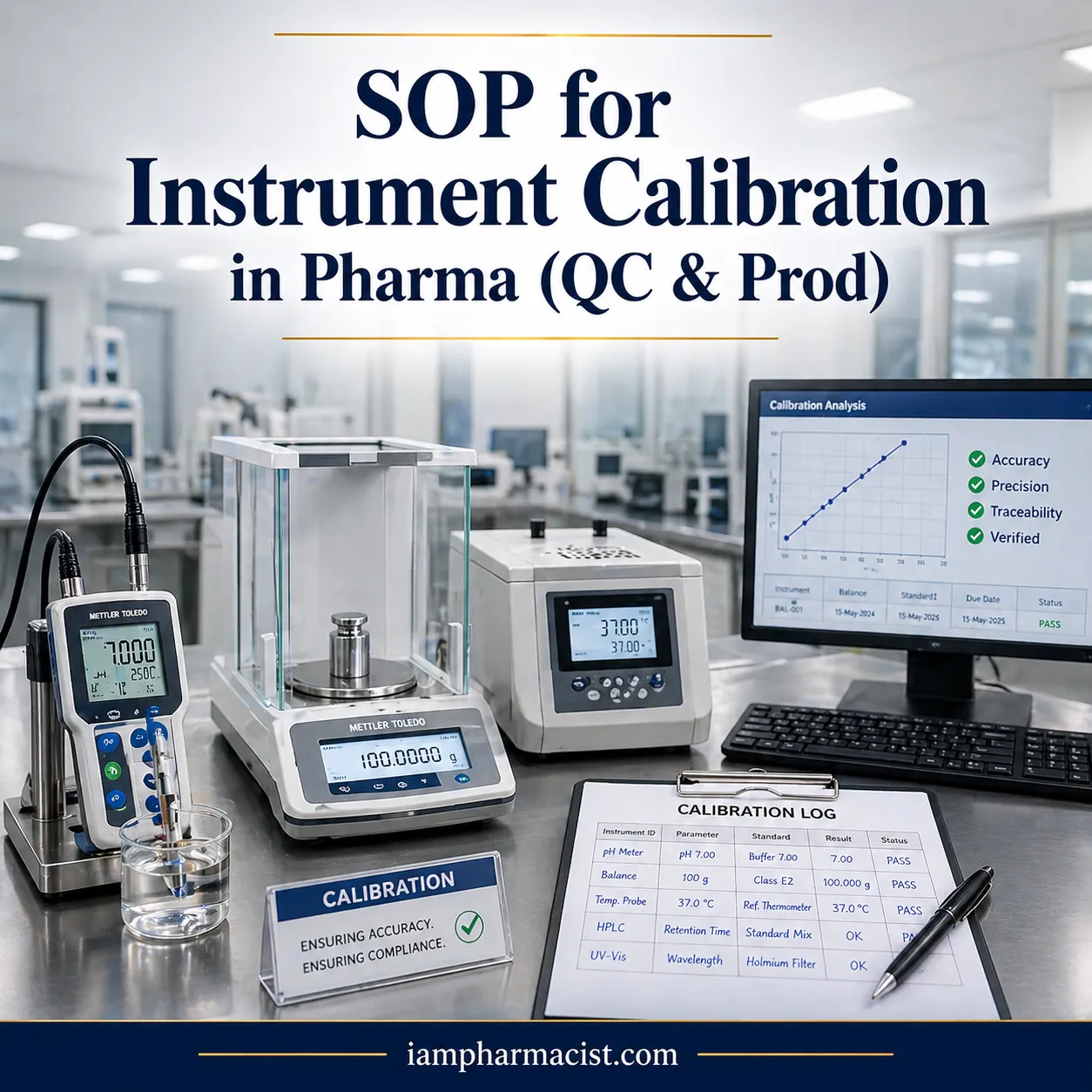

Learn SOP for Instrument Calibration of QC and production, including planning, frequency, documentation, and compliance with GMP standards.
Definition
A Standard Operating Procedure (SOP) for instrument calibration defines the systematic process of verifying and adjusting instruments to ensure accuracy, reliability, and compliance with regulatory standards in pharmaceutical manufacturing and quality control.
| Instrument Type | Calibration Method | Frequency |
|---|---|---|
| Critical | External/Internal | 6 months |
| Non-Critical | Internal/External | 1 year |
| AHU Pressure Gauges | External | 3 years |
| New Equipment | Scheduled | As per plan |
Introduction
Calibration of instruments is a critical component of pharmaceutical quality systems. Accurate instruments ensure reliable test results, consistent manufacturing processes, and compliance with GMP regulations.
This SOP outlines a comprehensive procedure for calibration of production and QC instruments, including planning, execution, documentation, and handling of calibration failures. https://www.webofpharma.com/2022/05/sop-for-preventive-maintenance-for.html
1.0 Objective
To establish a procedure for calibration of instruments used in production and quality control.
2.0 Scope
Applicable to:
- Critical instruments
- Non-critical instruments
3.0 Responsibility
- Officer / Executive / Assistant Manager
4.0 Accountability
- Head of Department
5.0 Procedure
5.1 Identification of Instruments
- Engineering department identifies instruments as:
- Critical
- Non-critical
5.2 Calibration Frequency
- Based on instrument criticality
- Typical frequency:
- Critical: every 6 months
- Non-critical: annually
- AHU gauges: every 3 years
5.3 Calibration Categories
- In-house calibration
- External agency calibration
5.4 In-House Calibration
- Performed using certified standards
- Standards must be traceable to national/international standards
- Responsibility: Engineering / QA / QC / Production
5.5 External Calibration
- Annual calibration plan prepared by Engineering
- Monthly schedule shared in advance
- External agency must follow approved procedures
5.6 Calibration Planning
Annual Plan
- Covers all instruments for the year
Monthly Schedule
- Updated for:
- New instruments
- Qualified equipment
5.7 Execution of Calibration
- Perform calibration within 15 days of due date
- Tag instrument as “UNDER CALIBRATION”
- Cover full range:
- Minimum
- Maximum
- Operational
5.8 Documentation
Calibration records must include:
- Instrument name, ID, make
- Range, least count, accuracy
- Calibration standards used
- Traceability details
- Validity of calibration
5.9 Verification & Labeling
- Data verified by concerned department
- If passed:
- Attach calibration label
- Update plan using symbols:
- O = Scheduled
- ● = Calibrated
- ●/ = Rescheduled
5.10 Handling Calibration Failure
- Stop using instrument immediately
- Label as “UNDER MAINTENANCE”
Critical Instrument Failure
- Report to QA Head
- Conduct investigation
Investigation Includes
- Root cause
- Impact on product quality
- Review of past data
5.11 Corrective Actions
- Repair or replace instrument
- Recalibrate before use
- If irreparable:
- Dispose in scrap yard
5.12 Record Management
- Maintain calibration certificates
- Maintain calibration files
- Ensure audit readiness
SOP Sections
Operation
- Identify and classify instruments
- Follow calibration schedule
- Ensure compliance and documentation
Calibration
- Use certified reference standards
- Ensure traceability
- Cover full instrument range
Cleaning
- Clean instruments before calibration
- Avoid contamination
- Maintain environmental control
Step-by-Step Calibration Process
- Identify instrument and classification
- Prepare annual calibration plan
- Schedule monthly calibration activities
- Perform calibration (in-house/external)
- Record calibration data
- Verify results
- Label instrument
- Handle failures and investigate https://iampharmacist.com/deviation-management-in-pharmaceuticals/
- Update calibration records
Abbreviations
- SOP: Standard Operating Procedure
FAQs
1. What is instrument calibration in pharma?
It ensures instruments provide accurate and reliable results. https://www.fda.gov/media/185615/download
2. Why is calibration important?
To maintain product quality and regulatory compliance.
3. What is calibration frequency?
Depends on instrument criticality.
4. What happens if calibration fails?
Instrument use is stopped and investigation begins.
5. What is a calibration plan?
A schedule of calibration activities for all instruments.
6. What are certified standards?
Reference standards traceable to national/international bodies.
7. Who performs calibration?
Internal teams or approved external agencies.
8. What is calibration labeling?
Tagging instruments with calibration status.
9. What records are required?
Calibration data, certificates, and traceability details.
10. Can calibration schedules change?
Only in specific justified conditions.
{ “@context”: “https://schema.org”, “@type”: “Article”, “headline”: “SOP for Instrument Calibration in Pharma”, “description”: “Complete SOP for calibration of QC and production instruments.”, “author”: { “@type”: “Organization”, “name”: “iampharmacist.com” } } { “@context”: “https://schema.org”, “@type”: “FAQPage”, “mainEntity”: [ { “@type”: “Question”, “name”: “What is calibration?”, “acceptedAnswer”: { “@type”: “Answer”, “text”: “It ensures measurement accuracy of instruments.” } } ] } { “@context”: “https://schema.org”, “@type”: “HowTo”, “name”: “Instrument Calibration Process”, “step”: [ {“@type”: “HowToStep”,”text”: “Identify instruments”}, {“@type”: “HowToStep”,”text”: “Plan calibration”}, {“@type”: “HowToStep”,”text”: “Perform calibration”}, {“@type”: “HowToStep”,”text”: “Record and verify”} ] }