


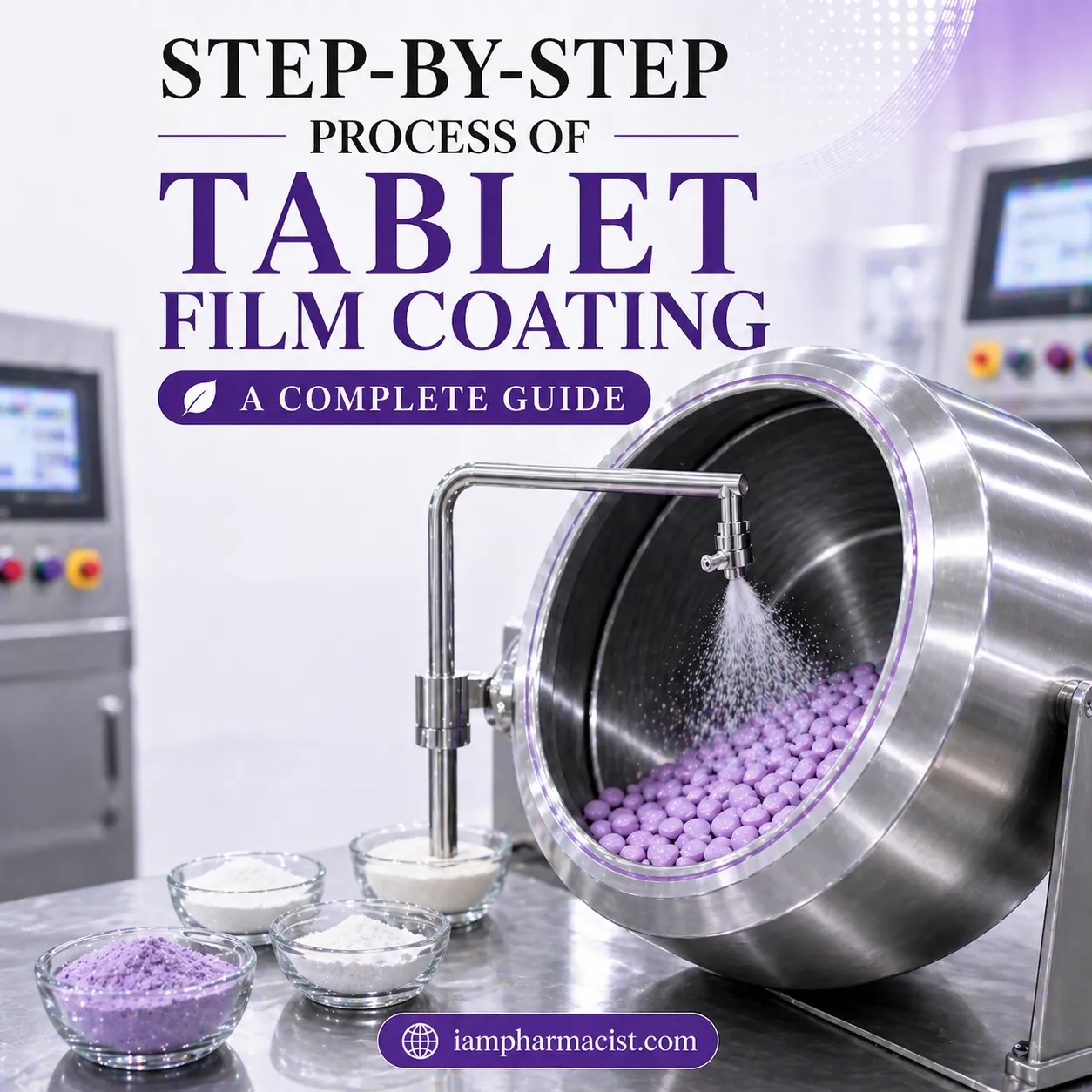

Learn the tablet film coating process step by step. Discover materials, equipment, parameters, and tips for achieving uniform coating quality.
Definition
Tablet film coating is a controlled pharmaceutical process where a thin polymer-based layer is applied to tablets to improve appearance, stability, and drug delivery performance.
💡 Introduction
Film-coated tablets are everywhere—from supplements to prescription medicines—because coating improves handling, appearance, and patient experience.
However, film coating sits at a critical intersection of:
- Core tablet quality
- Coating formulation
- Equipment performance
If any of these factors drift, defects like roughness, sticking, or uneven color quickly appear. That’s why understanding the process step by step is essential for consistent, high-quality production.
🎯 Why Film Coating Is Used
Manufacturers apply film coating to achieve:
- Improved tablet appearance and identification
- Reduced dusting and abrasion
- Better swallowability and taste masking
- Protection from moisture, light, and oxidation
- Functional performance like controlled or delayed release
A key principle: coating enhances quality—it does not fix poor tablet cores.
📊 Components of a Film Coating System
| Component | Function | Issue if Incorrect |
|---|---|---|
| Polymer | Forms film layer | Cracking, weak coating |
| Plasticizer | Adds flexibility | Brittle or peeling film |
| Pigment/Opacifier | Color & protection | Uneven color |
| Anti-adherent | Prevents sticking | Picking, rough surface |
| Solvent (water/organic) | Carries materials | Overwetting, slow drying |
⚙️ Step-by-Step Tablet Film Coating Process (HowTo)
Step 1: Prepare Coating Solution
Proper mixing ensures uniform dispersion. Poor preparation leads to:
- Nozzle clogging
- Spray instability
- Surface defects
Step 2: Load Tablets & Stabilize Bed
Before spraying:
- Ensure smooth tablet movement
- Stabilize temperature and airflow
Spraying onto an unstable bed often causes sticking issues.
Step 3: Spray and Dry (Core Process Loop)
This is the most critical stage.
Balance is key:
- Too wet → sticking, picking, twinning
- Too dry → rough surface, poor film formation
- Poor mixing → uneven coating
Step 4: Drying & Film Formation
Controlled airflow removes solvent, allowing:
- Uniform film formation
- Proper adhesion
Step 5: Cooling and Discharge
Cooling prevents:
- Surface damage
- Scuffing during transfer
Skipping this step can ruin otherwise good batches.
Step 6: In-Process Monitoring
Key checks include:
- Weight gain consistency
- Surface appearance
- Spray and airflow stability
Modern systems use Process Analytical Technology (PAT) for real-time monitoring.
🏭 Coating Equipment Overview
1. Perforated Pan Coater
- Best for tablets
- High efficiency and uniformity
2. Conventional Pan Coater
- Simpler but less precise
3. Fluid Bed Coater
- Used for pellets and granules
Equipment design directly affects repeatability and coating quality.
🔬 Critical Process Parameters
Spray Parameters
- Spray rate
- Atomization quality
- Gun position
Drying Parameters
- Inlet air temperature
- Airflow rate
- Exhaust conditions
Mechanical Factors
- Pan speed
- Tablet load
👉 Most defects result from overwetting or over-drying imbalance.
⚠️ Common Coating Defects & Fixes
| Defect | Cause | Solution |
|---|---|---|
| Twinning | Overwetting | Reduce spray rate |
| Peeling | Poor adhesion | Improve formulation |
| Roughness | Drying too fast | Adjust airflow |
| Picking | Local overwet | Balance spray/drying |
| Logo bridging | High viscosity | Reduce solids |
✅ Quality Control in Film Coating
Good coating quality includes:
- Uniform color and finish
- Minimal defects
- Consistent weight gain (typically 1–3%)
- Stable performance during handling
❓ FAQs
1. What is tablet film coating?
A process that applies a thin polymer layer to improve tablet quality.
2. What is the most critical step in coating?
The spray-drying balance stage.
3. Why do tablets stick during coating?
Usually due to overwetting.
4. What causes rough coating?
Droplets drying before reaching the tablet.
5. Can coating fix poor tablets?
No, it highlights defects.
6. What is weight gain in coating?
Increase in tablet weight due to coating layer.
7. What equipment is used?
Pan coaters and fluid bed systems.
8. What is PAT in coating?
Real-time monitoring technology.
9. What is twinning?
Tablets sticking together during coating.
10. Why is drying important?
It ensures proper film formation.
{ “@context”: “https://schema.org”, “@type”: “Article”, “headline”: “Step-by-Step Tablet Film Coating Process Guide”, “description”: “Detailed guide on tablet film coating process, materials, and parameters.”, “author”: { “@type”: “Person”, “name”: “Pharma Technical Expert” } } { “@context”: “https://schema.org”, “@type”: “FAQPage”, “mainEntity”: [] } { “@context”: “https://schema.org”, “@type”: “HowTo”, “name”: “Tablet Film Coating Process”, “step”: [ {“@type”: “HowToStep”,”name”: “Prepare coating solution”}, {“@type”: “HowToStep”,”name”: “Load tablets”}, {“@type”: “HowToStep”,”name”: “Spray coating”}, {“@type”: “HowToStep”,”name”: “Dry and form film”}, {“@type”: “HowToStep”,”name”: “Inspect quality”} ] }