


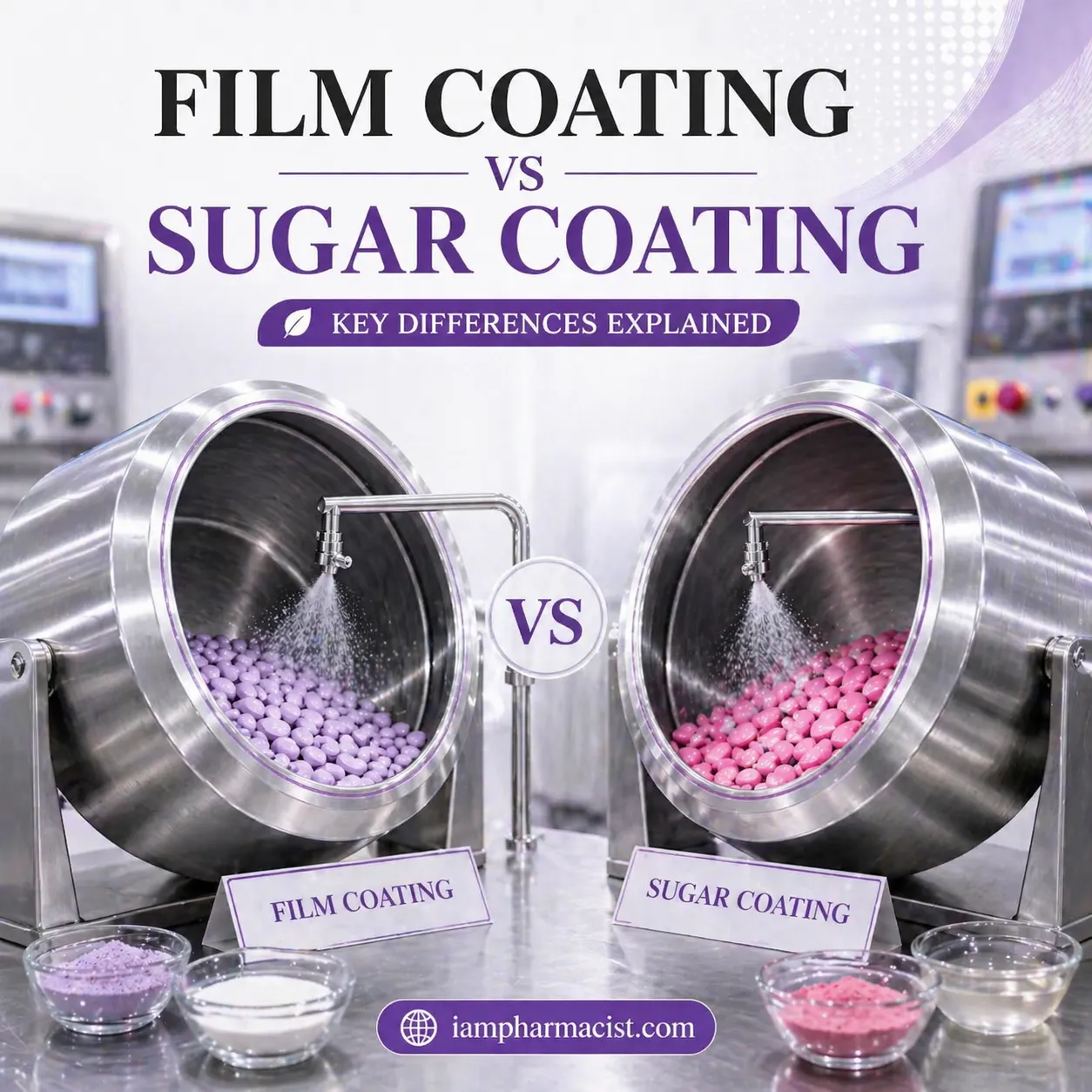

Compare film coating vs sugar coating in tablets. Learn key differences, benefits, process, and which coating is best for pharma applications.
📌 Definition
Film coating and sugar coating are two pharmaceutical tablet coating techniques where a protective layer is applied to improve stability, appearance, taste, and drug performance.
💡 Introduction
Tablet coating plays a vital role in the pharmaceutical industry, not only enhancing the appearance of tablets but also improving drug stability, patient compliance, and functionality.
Choosing between film coating and sugar coating is a strategic decision. It influences:
- Manufacturing efficiency
- Drug release behavior
- Patient experience
While sugar coating represents a traditional, aesthetic-focused method, film coating reflects modern pharmaceutical innovation with functional benefits.
🎯 Why Choosing the Right Coating Matters
The selection of coating directly impacts:
- Drug protection from moisture and light
- Ease of swallowing
- Taste masking
- Controlled drug release
For example, pediatric patients benefit from pleasant-tasting sugar-coated tablets, while advanced formulations rely on film coating for precision drug delivery. https://www.webofpharma.com/2025/11/the-triple-role-of-pharmaceutical.html
🍬 What Is Sugar Coating?
Sugar coating is a traditional multi-layer coating process where sucrose-based syrups are applied to tablets.
Key Characteristics:
- Thick, glossy, polished finish
- Multi-step process
- Significant weight increase
Common Uses:
- Pediatric medicines
- OTC tablets
- Nutritional supplements
Equipment:
- Traditional coating pan
It remains popular for taste masking and visual appeal.
💊 What Is Film Coating?
Film coating is a modern process that applies a thin polymer layer to tablets.
Key Characteristics:
- Thin (20–100 µm) uniform layer
- Minimal weight gain
- Fast and efficient
Common Materials:
- HPMC
- Ethylcellulose
- PEG
Equipment:
- Automatic film coating machine
Film coating is widely used for functional drug delivery and stability enhancement.
📊 Key Differences Between Film Coating and Sugar Coating
| Aspect | Sugar Coating | Film Coating |
|---|---|---|
| Appearance | Thick, glossy, polished | Thin, matte/semi-gloss |
| Composition | Sugar syrup | Polymer-based |
| Weight Impact | High (up to 50%) | Minimal |
| Process | Multi-step | Single-step |
| Function | Taste masking, aesthetics | Protection, controlled release |
| Efficiency | Time-consuming | Fast and scalable |
⚙️ Step-by-Step Process (HowTo)
🧴 Sugar Coating Process
- Sealing (moisture protection)
- Subcoating (shape building)
- Smoothing
- Coloring
- Polishing
💧 Film Coating Process
- Prepare polymer solution
- Spray onto tablets
- Simultaneous drying
- Film formation
Film coating is simpler and more efficient, while sugar coating is labor-intensive but visually superior.
⚖️ Advantages and Disadvantages
Sugar Coating
Advantages:
- Excellent taste masking
- Attractive appearance
- Improves patient compliance
Disadvantages:
- Time-consuming
- Increases tablet size and weight
- Less suitable for advanced formulations
Film Coating
Advantages:
- Fast and efficient process
- Protects from moisture and light
- Enables controlled drug release
- Minimal size increase
Disadvantages:
- Higher material cost
- Less glossy appearance
🏆 Which One Is Better?
There’s no one-size-fits-all answer.
- Choose Sugar Coating if:
- Taste masking is critical
- Target audience includes children
- Aesthetic appeal is important
- Choose Film Coating if:
- Drug stability is essential
- Controlled release is required
- Manufacturing efficiency matters
Ultimately, the best choice depends on drug formulation, patient needs, and production goals.
❓ FAQs
1. What is the main difference between film and sugar coating?
Film coating uses polymers and is thin, while sugar coating uses syrup and is thick.
2. Which coating is faster?
Film coating is faster due to a single-step process.
3. Does sugar coating increase tablet size?
Yes, it can increase weight by up to 50%.
4. Why is film coating preferred today?
It is efficient, scalable, and supports controlled release.
5. Is sugar coating still used?
Yes, mainly for taste masking and OTC products.
6. What polymers are used in film coating?
HPMC, ethylcellulose, and PEG.
7. Which coating is better for children?
Sugar coating due to improved taste.
8. Can film coating control drug release?
Yes, it enables modified and delayed release.
9. What equipment is used for coating?
Coating pans for sugar coating and automated machines for film coating.
10. Which is more cost-effective?
Film coating is more efficient long-term despite higher material costs.
{ “@context”: “https://schema.org”, “@type”: “Article”, “headline”: “Film Coating vs Sugar Coating: Key Differences”, “description”: “Detailed comparison of film coating and sugar coating in pharmaceutical tablets.”, “author”: { “@type”: “Person”, “name”: “Pharma Content Expert” } } { “@context”: “https://schema.org”, “@type”: “FAQPage”, “mainEntity”: [] } { “@context”: “https://schema.org”, “@type”: “HowTo”, “name”: “Tablet Coating Methods”, “step”: [ {“@type”: “HowToStep”,”name”: “Prepare coating solution”}, {“@type”: “HowToStep”,”name”: “Apply coating”}, {“@type”: “HowToStep”,”name”: “Dry tablets”}, {“@type”: “HowToStep”,”name”: “Inspect coating”} ] }