


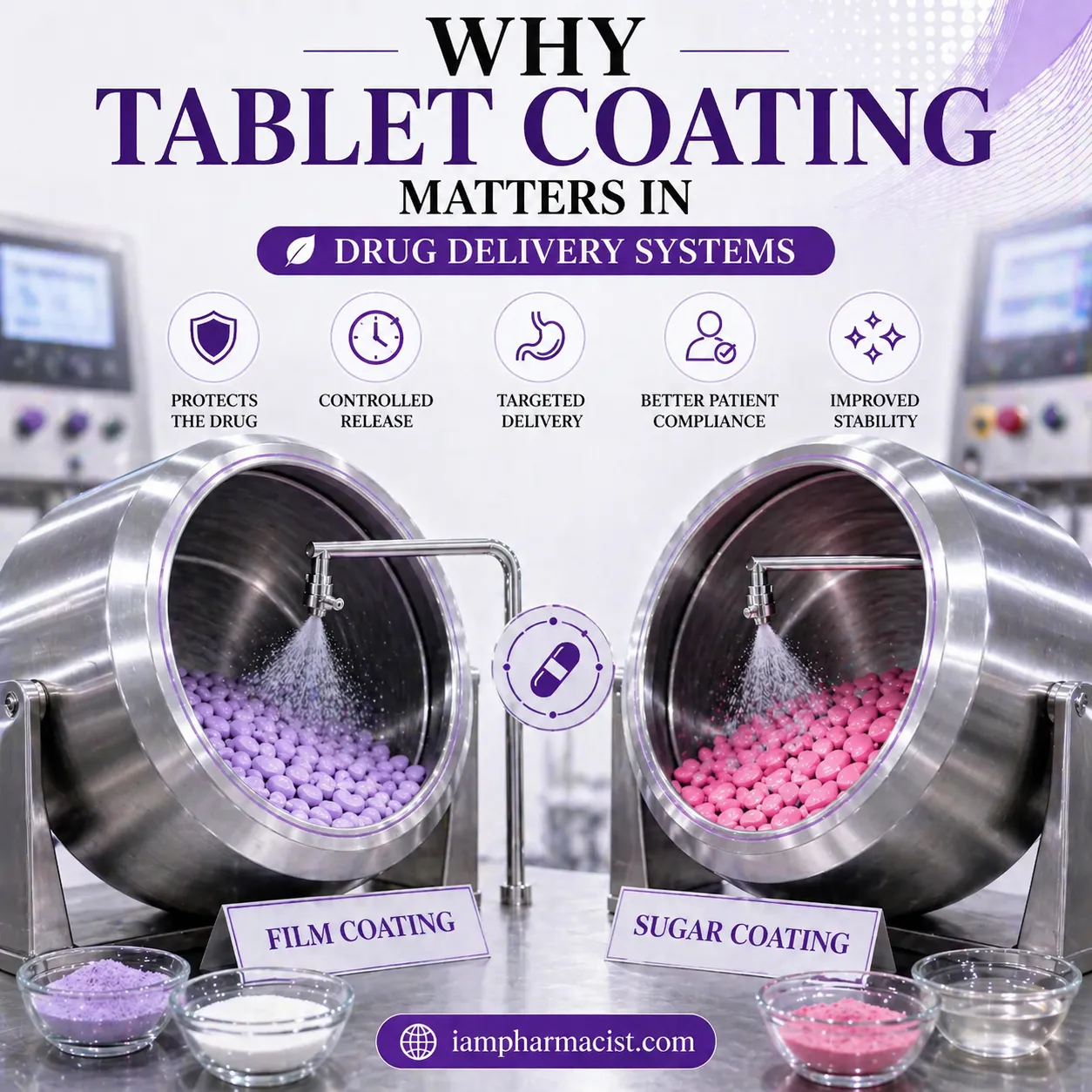

Discover why tablet coating matters in drug delivery systems. Learn its role in stability, release control, and patient compliance.
📌 Definition
Tablet coating is a pharmaceutical process in which a protective and functional layer is applied to a tablet to enhance stability, control drug release, and improve patient compliance.
💡 Introduction
Tablet coating has evolved from a manual, experience-based practice into a highly controlled, technology-driven process. Today, it plays a central role in modern drug delivery systems, ensuring that medications are not only effective but also safe, stable, and patient-friendly.
In advanced pharmaceutics, coating is no longer just about aesthetics—it directly impacts:
- Drug release kinetics
- Protection from environmental factors
- Targeted delivery within the body
With increasing regulatory expectations and innovation in materials, tablet coating has become a critical component of formulation science.
🎯 Why Tablet Coating Is Essential
Tablet coating influences drug delivery in multiple ways:
- Protects active ingredients from moisture, light, and oxygen
- Enables controlled and targeted drug release
- Enhances patient compliance through taste masking
- Improves mechanical strength and handling
- Supports product identification and branding
These functions ensure that the drug performs consistently and effectively in real-world conditions.
📊 Role of Tablet Coating in Drug Delivery Systems
| Function | Impact on Drug Delivery |
|---|---|
| Protection | Prevents degradation from environmental exposure |
| Taste Masking | Improves patient adherence |
| Controlled Release | Ensures proper timing of drug action |
| Targeted Delivery | Releases drug at specific GI locations |
| Stability Enhancement | Extends shelf life |
| Identification | Differentiates products and dosages |
🧬 Key Mechanisms Behind Coating Functionality
1. Controlled Drug Release
Coatings regulate how quickly the drug dissolves, enabling:
- Immediate release
- Sustained release
- Delayed release
2. Enteric Protection
pH-sensitive coatings prevent drug release in the stomach and allow release in the intestine.
3. Barrier Protection
Polymer films act as barriers against:
- Humidity
- Oxygen
- Light
⚙️ Step-by-Step Tablet Coating Process (HowTo)
Step 1: Polymer Selection
Choose appropriate polymers based on drug release requirements.
Step 2: Formulation Preparation
Prepare coating solution with polymers, plasticizers, and additives. https://www.webofpharma.com/2025/11/tablet-defects-in-pharmaceutical.html
Step 3: Equipment Setup
Load tablets into coating equipment (pan or fluid bed).
Step 4: Spraying Process
Apply coating solution uniformly using spray systems.
Step 5: Drying and Formation
Evaporate solvent to form a stable coating layer.
Step 6: Quality Evaluation
Check coating uniformity, thickness, and defects.
🧪 Advances in Tablet Coating Technology
Modern coating processes are driven by innovation:
- Process Analytical Technology (PAT): Real-time monitoring
- High-solids coating systems: Reduced solvent use
- Continuous coating systems: Improved efficiency
- Modeling and simulation: Better process understanding
Despite advancements, coating processes still present complex challenges in regulatory compliance and process control. https://iampharmacist.com/film-coating-vs-sugar-coating/
🔬 Factors Influencing Coating Performance
- Polymer type and concentration
- Tablet core properties (porosity, hardness)
- Coating equipment design
- Process parameters (temperature, spray rate)
Optimization of these factors ensures consistent product quality.
❓ FAQs
1. Why is tablet coating important in drug delivery?
It ensures stability, controlled release, and patient compliance.
2. How does coating affect drug release?
It controls the rate and location of drug dissolution.
3. What is enteric coating?
A coating that prevents release in the stomach and dissolves in the intestine.
4. What materials are used in coating?
Polymers, plasticizers, solvents, and colorants.
5. Can coating improve drug stability?
Yes, it protects against moisture, light, and oxygen.
6. What is controlled release coating?
A coating designed to release drug gradually over time.
7. What equipment is used in tablet coating?
Pan coaters and fluidized bed systems.
8. What challenges exist in coating processes?
Uniformity, scalability, and regulatory compliance.
9. What is PAT in coating?
Process Analytical Technology used for real-time monitoring.
10. Is coating necessary for all tablets?
Not all, but most modern formulations benefit from it.
{ “@context”: “https://schema.org”, “@type”: “Article”, “headline”: “Why Tablet Coating Matters in Drug Delivery Systems”, “description”: “Explore the importance of tablet coating in modern drug delivery systems.”, “author”: { “@type”: “Person”, “name”: “Pharma Content Specialist” } } { “@context”: “https://schema.org”, “@type”: “FAQPage”, “mainEntity”: [] } { “@context”: “https://schema.org”, “@type”: “HowTo”, “name”: “Tablet Coating Process”, “step”: [ {“@type”: “HowToStep”,”name”: “Select polymer”}, {“@type”: “HowToStep”,”name”: “Prepare formulation”}, {“@type”: “HowToStep”,”name”: “Apply coating”}, {“@type”: “HowToStep”,”name”: “Dry tablets”}, {“@type”: “HowToStep”,”name”: “Evaluate quality”} ] }