


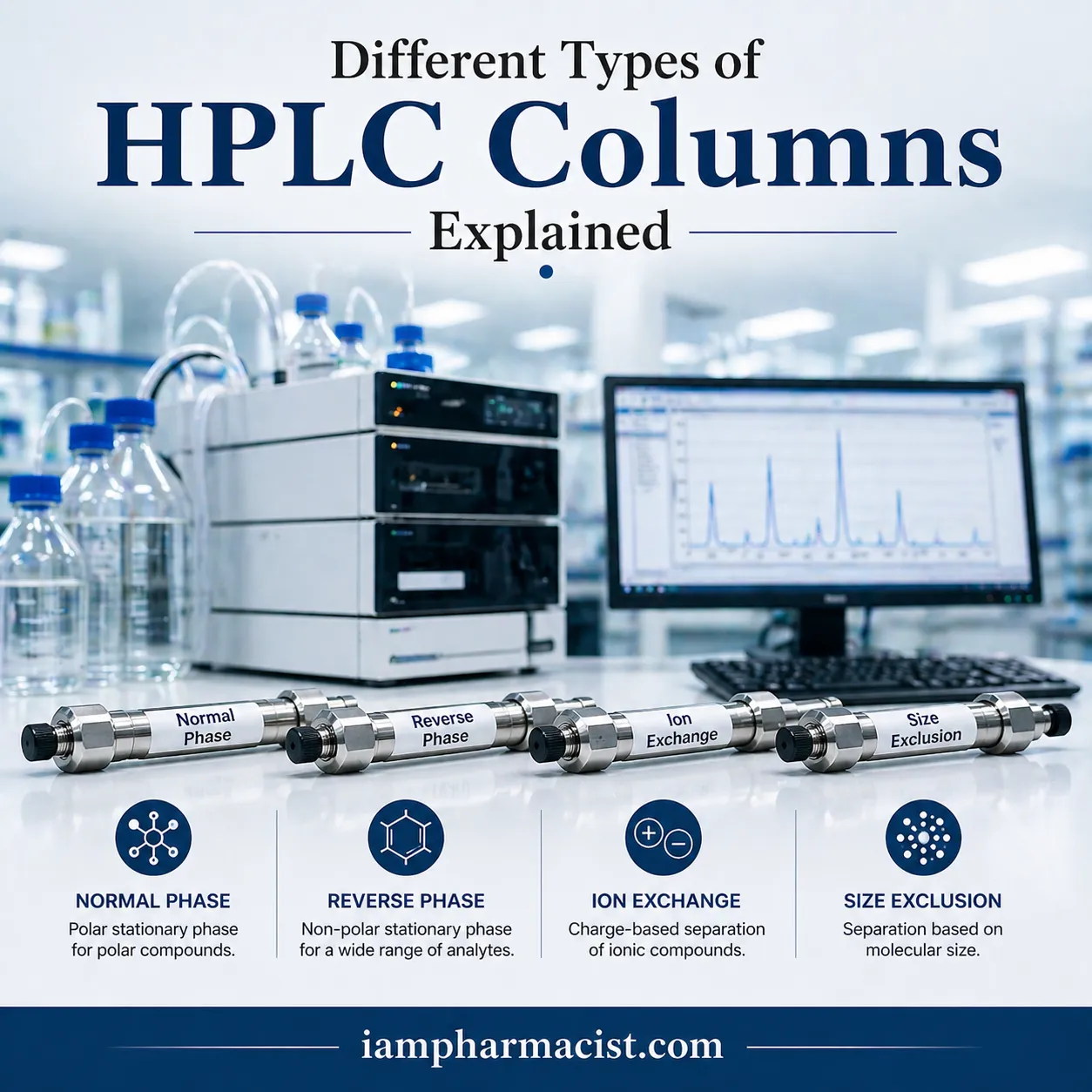

Explore different types of HPLC columns, their working principles, and selection criteria for accurate pharmaceutical analysis and separation.
Definition
HPLC columns are the core components of high-performance liquid chromatography systems, responsible for separating compounds based on interactions between the stationary phase and mobile phase.
Introduction
In high-performance liquid chromatography (HPLC), the column is where the actual separation happens. It determines how effectively compounds are resolved, identified, and quantified.https://www.sigmaaldrich.com/PK/en/technical-documents/technical-article/analytical-chemistry/small-molecule-hplc/hplc-troubleshooting-guide?srsltid=AfmBOop0K8FLmaQ2Q129yb2-W7X5StYMyN12YHnPnuzZUMpxkoE4PnZ_
Different pharmaceutical compounds require different separation mechanisms, which is why selecting the right type of HPLC column is essential. The stationary phase—commonly silica-based—plays a critical role due to its porosity, particle size, and chemical stability.
This guide explains the major types of HPLC columns, how they work, and how to select the right one for your analysis.https://iampharmacist.com/good-laboratory-practice-guidelines/
Why HPLC Columns Are Important
- Enable accurate separation of compounds
- Improve resolution and sensitivity
- Support method development and validation
- Ensure reliable analytical results
Types of HPLC Columns (Overview Table)
| Column Type | Stationary Phase | Separation Principle | Common Use |
|---|---|---|---|
| Normal Phase | Polar (silica) | Polarity | Non-polar compounds |
| Reverse Phase | Non-polar (C18, C8) | Hydrophobic interaction | Most pharma analysis |
| Ion Exchange | Charged resin | Ionic interaction | Ionizable compounds |
| Size Exclusion | Porous polymers | Molecular size | Biomolecules |
1. Normal Phase HPLC Columns
- Stationary Phase: Polar (silica)
- Mobile Phase: Non-polar solvents (hexane, chloroform)
Working Principle:
Separation occurs based on polarity. More polar compounds interact strongly with the stationary phase and elute later.
Best For:
- Lipids
- Non-polar organic compounds
2. Reverse Phase HPLC Columns
- Stationary Phase: Non-polar (C18, C8)
- Mobile Phase: Polar (water + methanol/acetonitrile)
Working Principle:
Opposite of normal phase. Non-polar compounds are retained longer due to hydrophobic interactions.
Best For:
- Pharmaceuticals
- Peptides
- Organic compounds
3. Ion Exchange HPLC Columns
- Stationary Phase: Charged (positive or negative)
- Mobile Phase: Aqueous buffer solutions
Working Principle:
Separation is based on ionic attraction between analytes and stationary phase.https://www.sciencedirect.com/science/article/abs/pii/S0026265X19323628
Best For:
- Proteins
- Amino acids
- Charged molecules
4. Size Exclusion HPLC Columns
- Stationary Phase: Porous polymers or silica
- Mobile Phase: Typically aqueous
Working Principle:
Separates molecules based on size. Larger molecules elute first as they cannot enter pores.
Best For:
- Biomolecules
- Polymers
How to Choose the Right HPLC Column
Step 1: Identify Sample Nature
- Determine polarity, size, and charge
Step 2: Select Separation Mode
- Polarity → Normal/Reverse phase
- Charge → Ion exchange
- Size → Size exclusion
Step 3: Choose Column Material
- Silica-based for general use
- Polymer-based for biomolecules
Step 4: Optimize Column Dimensions
- Length: 30–250 mm
- Particle size: 3–5 µm
Step 5: Match Mobile Phase
- Ensure compatibility with stationary phase
Step 6: Evaluate Performance
- Check resolution, retention time, and peak shape
- Replace column after heavy usage (~1000 runs)
FAQs
1. What are HPLC columns?
They are components used to separate compounds in chromatography.
2. Which HPLC column is most commonly used?
Reverse phase (C18) columns are widely used.
3. What is the difference between normal and reverse phase?
Normal phase uses polar stationary phase; reverse phase uses non-polar.
4. What is ion exchange chromatography?
It separates compounds based on charge interactions.
5. What is size exclusion chromatography?
It separates molecules based on size.
6. How do I choose an HPLC column?
Based on sample polarity, size, and chemical nature.
7. Why is silica used in HPLC columns?
Due to its stability, porosity, and inert nature.
8. What affects column performance?
Particle size, column length, and mobile phase.
9. How long does an HPLC column last?
Typically around 1000 runs depending on usage.
10. Can one column be used for all analyses?
No, column selection depends on the compound type.
{ “@context”: “https://schema.org”, “@type”: “Article”, “headline”: “Different Types of HPLC Columns Explained”, “description”: “Learn types of HPLC columns, working principles, and selection for pharmaceutical analysis.”, “author”: { “@type”: “Person”, “name”: “SEO Technical Writer” }, “datePublished”: “2026-04-25” } { “@context”: “https://schema.org”, “@type”: “FAQPage”, “mainEntity”: [ { “@type”: “Question”, “name”: “What are HPLC columns?”, “acceptedAnswer”: { “@type”: “Answer”, “text”: “HPLC columns are devices used to separate compounds in chromatography.” } } ] } { “@context”: “https://schema.org”, “@type”: “HowTo”, “name”: “How to Choose HPLC Column”, “step”: [ {“@type”: “HowToStep”,”name”: “Identify sample”}, {“@type”: “HowToStep”,”name”: “Select separation mode”}, {“@type”: “HowToStep”,”name”: “Choose column type”}, {“@type”: “HowToStep”,”name”: “Optimize conditions”} ] }