



Learn Good Laboratory Practice guidelines SOP to avoid analytical errors. Covers operation, calibration, cleaning, safety, and compliance for QC labs.
Definition
Good Laboratory Practice (GLP) SOP is a structured set of guidelines designed to ensure accuracy, consistency, and reliability in laboratory analysis by minimizing human, equipment, and environmental errors through standardized procedures.
| Section | Key Focus | Purpose |
|---|---|---|
| Operation | Handling, dilution, titration | Ensure accuracy and consistency |
| Calibration | Instruments and glassware | Maintain measurement reliability |
| Cleaning | Equipment and workspace hygiene | Prevent contamination and cross-errors |
Introduction
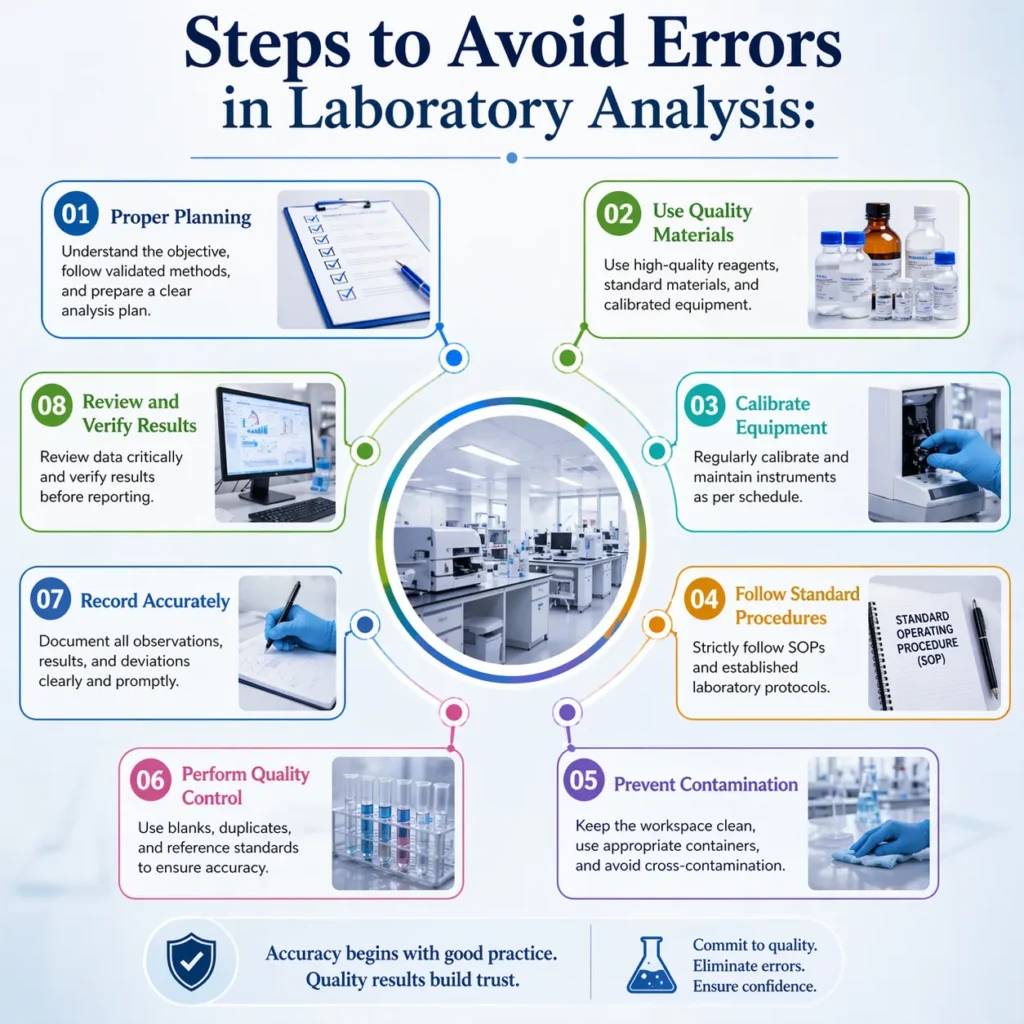
Errors in laboratory analysis can compromise data integrity, regulatory compliance, and product quality. Implementing a Standard Operating Procedure (SOP) aligned with Good Laboratory Practice (GLP) ensures reliable, reproducible, and safe analytical outcomes.
This guide provides a comprehensive SOP framework for QC and microbiology laboratories to minimize inherent analytical errors.
1.0 OBJECTIVE
To establish standardized practices that eliminate errors during laboratory analysis by strictly adhering to Good Laboratory Practices.
2.0 SCOPE
Applicable to all Quality Control (QC) laboratories performing chemical and microbiological analysis.
3.0 RESPONSIBILITY
Officer / Executive – Quality Control
4.0 ACCOUNTABILITY
Manager – Quality Control
5.0 PROCEDURE
5.1 General Operational Guidelines
- Always follow the approved SOP for each analysis
- Use only AR/GR grade reagents for standardization
- Maintain temperature (~25°C) during dilution and measurement
- Use calibrated volumetric glassware
- Never return unused reagents to containers
5.2 Safe Handling & Chemical Practices
- Add acid to water, never the reverse
- Avoid spills; clean immediately based on chemical type
- Wear PPE (goggles, masks, gloves)
- Do not adjust pH in narrow containers
- Never insert spatula into reagent containers
5.3 Titration & Analytical Accuracy
- Use correct meniscus reading (lower for clear, upper for colored)
- Fill burette properly and set to zero
- Use ~0.1 ml indicator unless specified
- Use iodine flask for iodometric titration
5.4 Storage & Labeling
- Label reagents with name, strength, date, and shelf life
- Store light-sensitive solutions in amber containers
- Store toxic/flammable chemicals securely
- Keep standards in designated areas
5.5 Microbiology & Safety Controls
- Turn on UV light after microbiological work
- Never look directly at UV light
- Keep LAF burner OFF during cleaning
6.0 SOP Sections
6.1 Operation
- Follow validated procedures strictly
- Use appropriate reagents and solvents
- Maintain environmental conditions
- Ensure proper documentation
6.2 Calibration
- Use calibrated instruments only
- Do not use damaged equipment
- Clean electrodes gently with water for injection
- Keep electrodes immersed properly
6.3 Cleaning
- Clean spills immediately
- Maintain clean workbench and glassware
- Avoid cross-contamination
- Dispose of waste properly
Abbreviations
- SOP – Standard Operating Procedure
- QC – Quality Control
- LAF – Laminar Air Flow
- LPG – Liquid Petroleum Gas
- UV – Ultraviolet
- AR – Analytical Reagent
- GR – General Reagent
FAQs
1. What is Good Laboratory Practice (GLP)?
GLP ensures quality, integrity, and reliability of laboratory data.
2. Why is SOP important in laboratories?
It standardizes procedures and reduces variability and errors.
3. How does calibration prevent errors?
It ensures instruments provide accurate and reproducible results.
4. What is the correct way to dilute acid?
Always add acid to water slowly.
5. Why should reagents not be returned to containers?
To prevent contamination of the entire batch.
6. What temperature should be maintained during analysis?
Approximately 25°C for accuracy.
7. How should light-sensitive chemicals be stored?
In amber-colored containers.
8. What PPE is required in QC labs?
Gloves, goggles, lab coat, and mask.
9. Why is labeling important in labs?
Ensures traceability and prevents misuse.
10. What happens if SOP is not followed?
It can lead to inaccurate results, compliance failure, and safety risks.
{ “@context”: “https://schema.org”, “@type”: “Article”, “headline”: “Standard Operating Procedure for Good Laboratory Practice”, “description”: “Comprehensive GLP SOP to avoid errors in laboratory analysis.”, “author”: { “@type”: “Organization”, “name”: “iampharmacist.com” }, “publisher”: { “@type”: “Organization”, “name”: “iampharmacist.com” } } { “@context”: “https://schema.org”, “@type”: “FAQPage”, “mainEntity”: [ { “@type”: “Question”, “name”: “What is GLP?”, “acceptedAnswer”: { “@type”: “Answer”, “text”: “GLP ensures quality and reliability of laboratory data.” } } ] } { “@context”: “https://schema.org”, “@type”: “HowTo”, “name”: “Avoid Errors in Laboratory Analysis”, “step”: [ {“@type”: “HowToStep”, “text”: “Follow SOPs”}, {“@type”: “HowToStep”, “text”: “Use calibrated instruments”}, {“@type”: “HowToStep”, “text”: “Maintain proper conditions”} ] }