


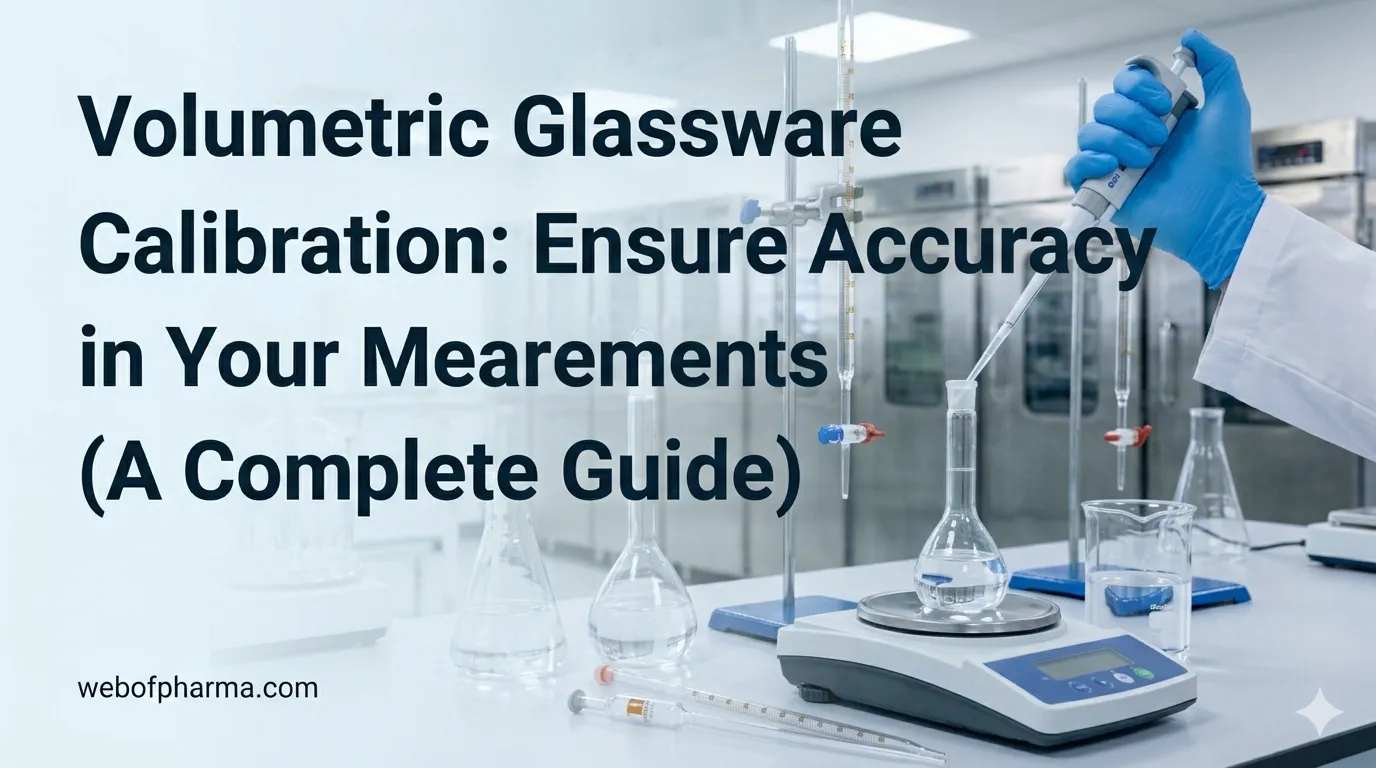

Worried about measurement accuracy? This comprehensive guide explains how to calibrate the Volumetric Glassware including flasks, pipettes and burettes. Learn the step-by-step procedure and essential tolerance limits for accurate lab work.
In any laboratory setting, precision is paramount. Whether you’re a chemist, a pharmacist, or a researcher, the accuracy of your measurements directly impacts the reliability of your results. Volumetric glassware is the backbone of measurement in the lab, but even the highest quality glassware can drift from its calibrated volume over time. Regular calibration is essential to maintain confidence in your data.
This blog post provides a clear, step-by-step procedure to calibrate the Volumetric Glassware including flasks, pipettes and burettes. We’ll cover the necessary formulas, essential tips for accurate calibration, and critical tolerance limits you need to know.
Why Is Volumetric Glassware Calibration Important?
Think of calibration as the quality assurance process for your measuring tools. For example, if you’re preparing a 1-molar solution, your volumetric flask must contain exactly the specified volume. If it’s off by even a fraction, your solution’s concentration will be incorrect, potentially invalidating all subsequent tests. This process helps ensure that your flasks, pipettes, and burettes are delivering or containing the volumes they are supposed to.
Now, let’s dive into the calibration procedures.
Step-by-Step Calibration Procedures
1. General Preparation:
- Cleanliness is Key: Ensure all glassware is meticulously clean and dry before starting the calibration. Contaminants can significantly affect the accuracy of your results.
- Water Temperature: Use recently boiled and cooled distilled water that has been allowed to reach room temperature. This is crucial as the density of water changes with temperature.
- Acurrate Weighing: Use a high-precision analytical balance that has been properly leveled and calibrated.
Procedure for Volumetric Flasks
- Weigh the Empty Flask: Determine and record the exact weight of the clean and dry volumetric flask.
- Fill the Flask: Carefully fill the flask with the prepared distilled water up to the graduation mark (the “meniscus” should be exactly on the line). Avoid overfilling.
- Weigh the Filled Flask: Place the filled flask back on the analytical balance and record its exact weight.
- Calculate Water Weight: Subtract the empty flask weight from the filled flask weight to get the weight of the contained water.
- Calculate the Volume: Use the following formula to determine the volume:Volume (in ml) = (Weight in g / 0.99602)
- This formula uses the density of water at 25°C, where 1 ml of water weighs approximately 0.99602 g. This provides a convenient conversion from mass to volume.
- For Larger Flasks (> 100 ml): For flasks with a capacity greater than 100 ml, it’s often more practical to dispense the water in multiple steps using a smaller, high-precision dispenser (like a Class A 100 ml burette). Note the total volume dispensed and use the same formula.
Procedure for One Mark Pipette / Graduated Pipette / Burette
- Fill the Glassware: Fill the pipette or burette with the prepared distilled water up to the zero or maximum capacity mark. For a one-mark pipette, fill it exactly to the mark. For burettes, ensure the area below the stopcock is filled and bubble-free.
- Drain the Water: Allow the water to drain into a previously weighed, clean, and dry beaker.
- For pipettes, ensure the correct tip technique is used.
- For burettes, drain the water specifically down to the lower mark of the measured volume.
- Weigh the Beaker with Water: Immediately weigh the beaker containing the collected water and record the weight.
- Calculate Water Weight: Subtract the initial empty beaker weight from the filled beaker weight.
- Calculate the Volume: Apply the same formula:Volume (in ml) = (Weight in g / 0.99602)
Tolerance Limits: The Standards of Accuracy
The calculated volume must fall within the specific tolerance limits defined for that piece of glassware and its class (Class A or Class B). These limits are generally based on standards like the Indian Pharmacopoeia or United States Pharmacopeia. Here are some common tolerance limits:
| Glassware Type | Capacity (ml) | Tolerance (±ml) – Class A | Tolerance (±ml) – Class B |
| Volumetric Flasks | 5 | 0.02 | 0.04 |
| 10 | 0.02 | 0.04 | |
| 25 | 0.03 | 0.06 | |
| 50 | 0.04 | 0.08 | |
| 100 | 0.06 | 0.15 | |
| 200 | 0.08 | 0.2 | |
| 250 | 0.1 | 0.2 | |
| 500 | 0.15 | 0.3 | |
| 1000 | 0.2 | 0.8 | |
| One Mark Pipette | 1 | 0.006 | 0.02 |
| 2 | 0.006 | 0.02 | |
| 5 | 0.01 | 0.03 | |
| 10 | 0.02 | 0.04 | |
| 15 | 0.02 | 0.04 | |
| 20 | 0.03 | 0.05 | |
| 25 | 0.03 | 0.06 | |
| 50 | 0.04 | 0.08 | |
| 100 | 0.06 | 0.12 | |
| Burettes | 10 | 0.01 | 0.02 |
| (Subdivision: 0.05 ml) | |||
| Burettes | 25 | 0.03 | 0.06 |
| (Subdivision: 0.05 ml) | |||
| Burettes | 50 | 0.05 | 0.1 |
| (Subdivision: 0.1 ml) | |||
| Burettes | 100 | 0.1 | 0.2 |
| (Subdivision: 0.1 ml) |
Frequency and Compliance
Frequency: Volumetric glassware should be calibrated:
- Initially: When the volumetric glassware is first purchased.
- Periodically: Follow your laboratory’s standard operating procedures (SOPs), which may mandate regular re-calibration based on use and criticality.
Compliance: If a piece of volumetric glassware fails to meet the specified tolerance requirements, it should not be used. It’s often recommended to return such glassware to the supplier or discard it, as using it can lead to systematic errors in your analytical results.
References:
This procedure is consistent with the general principles outlined in standards like:
- Indian Pharmacopoeia.
- United States Pharmacopeia.
By following this guide, you can ensure that your Volumetric Glassware including flasks, pipettes and burettes are functioning correctly, providing you with the accurate measurements you need for valid and reproducible laboratory results. For any further questions or specific SOP development, always consult with your quality assurance department.
10 Frequently Asked Questions (FAQ):
- Why do I need to calibrate my volumetric glassware? Calibration ensures the accuracy of your measurements, preventing systematic errors that can invalidate your experimental or analytical results. Even high-quality glassware can have slight deviations.
- How often should I calibrate my volumetric flasks and pipettes? Always perform an initial calibration upon purchase. The frequency of subsequent calibrations should be based on your laboratory’s usage frequency and the critical nature of the measurements being made, as defined in your SOPs.
- What if my volumetric flask’s capacity is larger than my balance can handle? For larger flasks (like 500 ml or 1000 ml), a practical approach is to dispense the required volume of water into the flask in smaller, measurable steps using a calibrated smaller pipette or burette (e.g., using a 100 ml burette to add water).
- Why is it important to use distilled water that has been boiled and cooled? Boiling and cooling removes dissolved gases (like CO2) which can affect the density of the water. Using water at room temperature is crucial because water’s density changes significantly with temperature.
- What’s the difference between Class A and Class B volumetric glassware? Class A glassware has stricter tolerance limits and is typically used for precise analytical work. Class B glassware has slightly looser tolerances and is suitable for more general applications.
- My calibration result is outside the tolerance limit. What should I do? If the calibrated volume falls outside the specified tolerance for its class, the glassware should not be used. It should be labeled as out-of-tolerance and either discarded, returned to the supplier, or used for non-critical applications.
- Is the temperature 25°C critical for the formula Volume = Weight / 0.99602? The formula uses 0.99602 g, which is a constant closely related to water’s density at 25°C. For the most precise work, you would ideally perform calibration and temperature correction according to specific density tables. However, for many lab procedures, using water at a consistent room temperature and this formula is a standard accepted practice.
- Can I use tap water for the calibration? No. Tap water contains dissolved minerals and impurities that alter its density, which will make your calibration inaccurate. Distilled or deionized water must be used.
- Should I use a meniscus reading to fill the glassware accurately? Yes, absolutely. For all volumetric glassware, you should always make sure the lower curve of the meniscus (the water surface) is aligned precisely with the graduation mark at eye level.
- Do I need special equipment to calibrate my glassware? You primarily need a high-precision analytical balance, a thermometer to verify water temperature, and clean beakers. The process requires a clean environment and correct technique.