


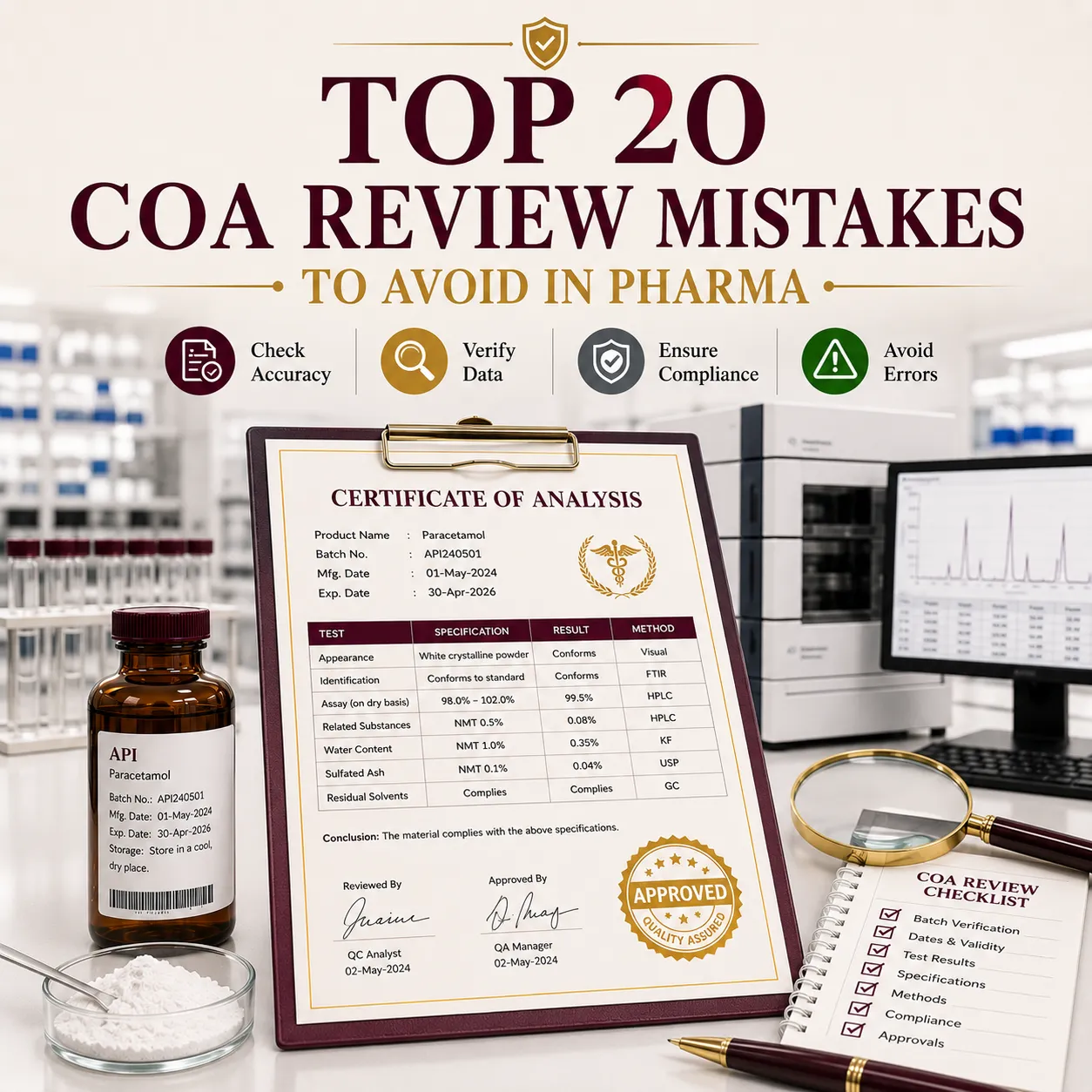

Discover the top 20 CoA review mistakes that can lead to GMP non-compliance, supplier issues, and material release errors.
Definition
The most common Certificate of Analysis (CoA) review mistakes include failing to verify batch numbers, accepting missing analytical data, overlooking data integrity issues, ignoring supplier specification differences, and releasing materials without proper GMP verification. These errors can lead to regulatory observations, quality failures, and product recalls.
A Certificate of Analysis (CoA) is one of the most critical quality documents reviewed by pharmaceutical Quality Assurance (QA), Quality Control (QC), Regulatory Affairs, and Supply Chain professionals. It serves as documented evidence that raw materials, APIs, excipients, packaging materials, and finished products comply with approved specifications.
However, even experienced reviewers can overlook critical details that lead to GMP violations, material release errors, supplier qualification issues, and regulatory observations.
This guide highlights the Top 20 mistakes to avoid during CoA review and provides practical strategies to strengthen compliance and reduce quality risks.
Why CoA Review Matters
An effective CoA review helps ensure:
- Material quality and safety
- Regulatory compliance
- Supplier reliability
- Data integrity
- Batch traceability
- Accurate release decisions
A single missed discrepancy can result in product failures, recalls, warning letters, or patient safety risks.
Top 20 CoA Review Mistakes
Category 1: Administrative Red Flags
1. Not Verifying Batch Numbers
One of the most common mistakes is failing to match the CoA batch number with:
- Material labels
- Shipping documents
- Goods receipt records
- ERP inventory data
Risk
Loss of traceability and potential material mix-ups.
2. Ignoring Manufacturing and Expiry Dates
Reviewers sometimes focus only on analytical results while overlooking:
- Manufacturing date
- Retest date
- Expiry date
Risk
Using expired or invalid materials in production.
3. Accepting Missing Authorized Signatures
Every CoA should be reviewed and approved by authorized personnel.
Verify
| Requirement | Must Be Present |
|---|---|
| Reviewer Name | Yes |
| Signature | Yes |
| Approval Date | Yes |
| Designation | Recommended |
Risk
Questionable document authenticity.
4. Ignoring Inconsistent Document Formatting
Unexpected changes in layout, logos, fonts, or document structure can indicate:
- Document manipulation
- Unofficial templates
- Fraudulent documentation
Risk
Acceptance of falsified analytical records.
5. Accepting Generic Batch Numbers
Examples:
❌ Batch-001
❌ 2025/001
Repeated use of generic batch numbers across deliveries is a warning sign.
Risk
Poor traceability and possible document recycling.
6. Overlooking Chronological Errors
Watch for impossible timelines such as:
| Event | Date |
|---|---|
| Analysis Date | 01-Jan-2025 |
| Manufacturing Date | 05-Jan-2025 |
Risk
Potential data integrity concerns.
Category 2: Data Integrity and Testing Red Flags
7. Accepting Results That Always Hit Specification Limits
Example:
Every batch reports exactly:
- Assay = 100.0%
- Moisture = 12.0%
Risk
Possible data fabrication.
Natural analytical variation should exist.
8. Not Reviewing Analytical Methods
Avoid vague statements such as:
❌ Moisture by oven method
❌ Standard test procedure
Preferred
✔ USP <921>
✔ EP 2.5.12
✔ AOAC Method Number
Risk
Unverifiable testing practices.
9. Relying Entirely on Supplier Testing
High-risk materials require:
- Verification testing
- Reduced testing justification
- Supplier qualification evidence
Risk
Undetected quality issues.
10. Ignoring OOS Investigation Documentation
If a batch experienced:
- OOS results
- Laboratory deviations
- Retesting events
Supporting investigation reports should be reviewed.
Risk
Approving problematic batches.
11. Accepting Unexplained Corrections
Watch for:
- White-outs
- Handwritten changes
- Altered values
- Missing correction justifications
Risk
ALCOA+ data integrity violations.
12. Ignoring Detection Limit Information
Results reported as:
“Not Detected”
should include:
- LOD
- LOQ
- Method sensitivity
Risk
False assumptions regarding contamination levels.
Category 3: Compliance and Regulatory Errors
13. Comparing Only Against Supplier Specifications
Always compare against:
- Internal specifications
- Regulatory requirements
- Quality agreements
Example
| Parameter | Supplier Spec | Internal Spec |
|---|---|---|
| Heavy Metals | NMT 20 ppm | NMT 10 ppm |
Meeting supplier limits alone may not be acceptable.
14. Missing Required Test Parameters
Common omissions include:
- Heavy metals
- Residual solvents
- Microbial limits
- Related substances
Risk
Incomplete quality assessment.
15. Using an Expired CoA
A CoA should be:
- Batch-specific
- Current
- Applicable to the received lot
Risk
Unsupported material release decisions.
16. Failing to Verify Laboratory Accreditation
Analytical laboratories should maintain:
- ISO/IEC 17025 accreditation
- Relevant scope of testing
Risk
Questionable reliability of results.
Category 4: Advanced Review and Validation Errors
17. Reviewing Only the Summary Page
Some reviewers never request:
- Raw data
- Chromatograms
- Spectra
- Full laboratory reports
Risk
Hidden quality issues remain undetected.
18. Ignoring Units of Measure
Examples:
- ppm
- mg/kg
- %
- μg/g
Risk
Major formulation or dosage calculation errors.
19. Not Trending Historical Supplier Data
Trend analysis can identify:
- Process changes
- Raw material source changes
- Quality drift
Example
| Batch | Assay |
|---|---|
| Batch 1 | 99.8% |
| Batch 2 | 99.6% |
| Batch 3 | 98.1% |
Sudden shifts warrant investigation.
20. Ignoring Laboratory Remarks and Comments
Technician notes often contain critical information.
Examples:
- Limited calibration performed
- Instrument maintenance overdue
- Sample integrity concerns
Risk
Missing important context behind reported results.
Step-by-Step CoA Review Checklist
Step 1
Verify batch number and traceability.
Step 2
Review manufacturing, expiry, and retest dates.
Step 3
Confirm authorized signatures.
Step 4
Compare results against internal specifications.
Step 5
Review analytical methods.
Step 6
Check OOS and deviation history.
Step 7
Verify laboratory accreditation.
Step 8
Review critical test parameters.
Step 9
Trend historical supplier data.
Step 10
Document QA approval decision.
Practical Example
Scenario
An excipient CoA shows:
| Parameter | Result |
|---|---|
| Heavy Metals | Blank |
| Assay | Pass |
| Method | Standard Procedure |
Review Findings
❌ Missing heavy metal result
❌ No numerical assay value
❌ Method not specified
Decision
Material Rejected Pending Clarification
GMP and Regulatory Insights
FDA Expectations
Under 21 CFR Part 211, manufacturers must establish scientifically sound procedures for reviewing incoming material quality.
ICH Q7 Requirements
Emphasizes:
- Supplier qualification
- Material verification
- Documentation controls
Data Integrity Expectations
Regulators increasingly focus on:
- ALCOA+ compliance
- Electronic records
- Audit trails
- Analytical data transparency
FAQs
1. What is the most common CoA review mistake?
Failing to verify batch numbers and material traceability.
2. Why are numerical results important on a CoA?
They provide transparency and support independent quality assessments.
3. Can a CoA be accepted without a signature?
No. Authorized approval is required for authenticity and GMP compliance.
4. Why should QA review analytical methods?
To confirm tests were performed using approved and validated procedures.
5. What are CoA data integrity red flags?
Unexplained corrections, identical results across batches, and missing signatures.
6. Why is laboratory accreditation important?
It helps demonstrate competence and reliability of analytical testing.
7. Should supplier specifications always be accepted?
No. They must be compared against internal and regulatory requirements.
8. What is the risk of using an expired CoA?
It may not accurately represent the quality status of the received material.
9. Why should historical supplier data be trended?
To detect quality drift and process changes.
10. What should be done if critical test results are missing?
The material should remain on hold until clarification or additional testing is completed.