


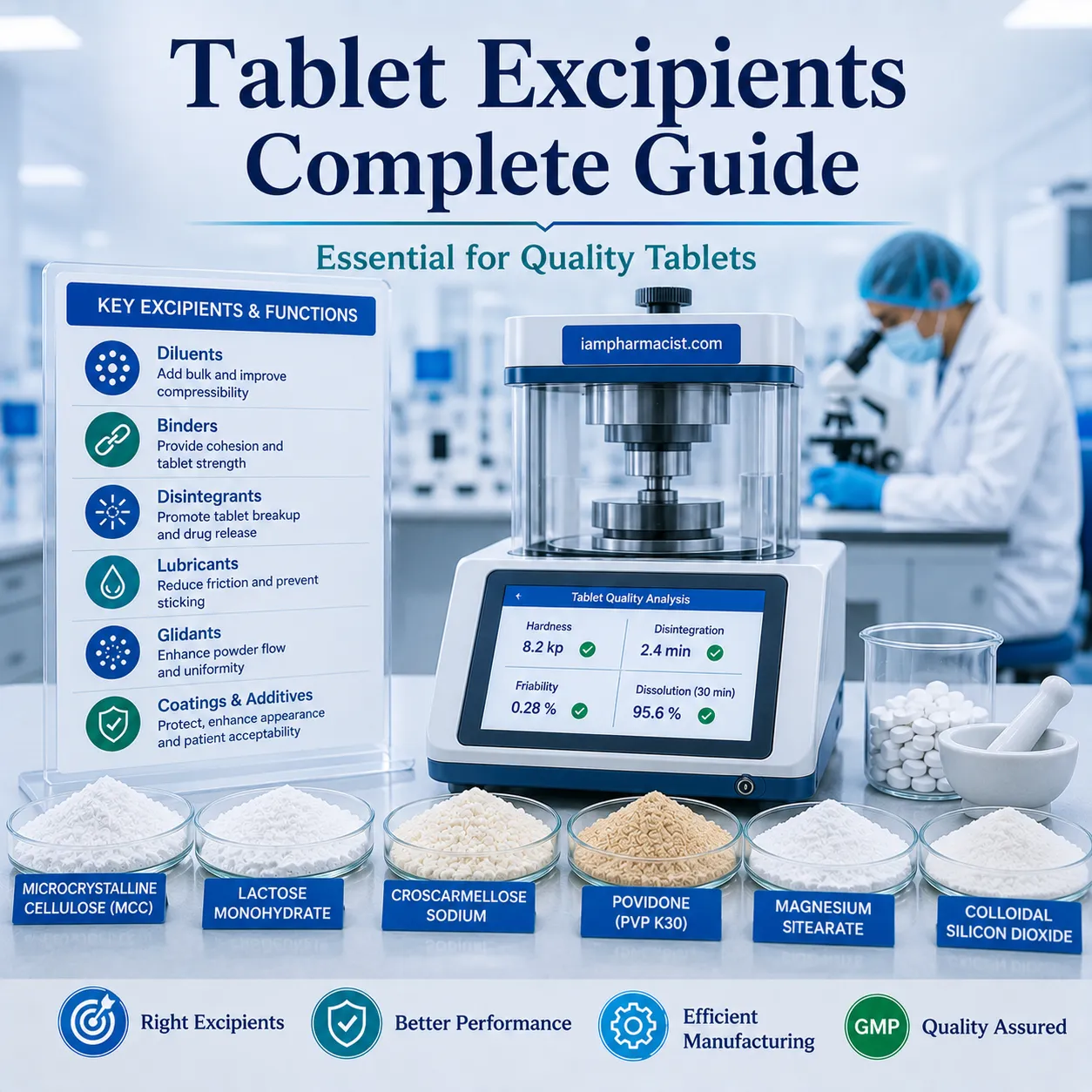

Learn the functions, types, selection criteria, and GMP requirements of tablet excipients used in pharmaceutical manufacturing and formulation development.
Definition
Tablet excipients are inactive pharmaceutical ingredients added to formulations to provide bulk, improve compressibility, enhance tablet strength, facilitate disintegration, improve powder flow, support drug release, and ensure consistent manufacturing performance. They are essential components of tablet formulation and directly influence product quality, stability, and bioavailability.
Introduction
Tablet dosage forms remain the most widely used pharmaceutical delivery system because of their convenience, stability, patient acceptance, cost-effectiveness, and scalability.
While the Active Pharmaceutical Ingredient (API) provides therapeutic activity, the success of a tablet formulation depends heavily on the selection and performance of excipients. These so-called “inactive ingredients” play a critical role in manufacturing efficiency, mechanical integrity, dissolution performance, and overall product quality.
Modern pharmaceutical development increasingly recognizes excipients as functional materials whose physical and chemical properties directly influence Critical Quality Attributes (CQAs) and Product Quality Attributes (PQAs).
This comprehensive guide explores the major categories of tablet excipients, their functions, formulation considerations, and regulatory requirements.
What Are Tablet Excipients?
Tablet excipients are substances intentionally incorporated into formulations alongside the API to facilitate manufacturing and ensure desired product performance.
Primary Functions
- Increase tablet bulk
- Improve powder flow
- Enhance compressibility
- Facilitate disintegration
- Prevent sticking during compression
- Improve appearance and patient acceptance
- Protect stability
- Modify drug release
Why Excipients Are Critical in Tablet Manufacturing
Without excipients, many APIs would be impossible to process into robust, reproducible tablets.
Benefits of Excipients
| Function | Manufacturing Benefit |
|---|---|
| Bulk Addition | Practical tablet size |
| Binding | Mechanical strength |
| Disintegration | Rapid drug release |
| Lubrication | Smooth tablet ejection |
| Flow Improvement | Weight uniformity |
| Coating | Stability and appearance |
Classification of Tablet Excipients
Major Categories
- Diluents (Fillers)
- Binders
- Disintegrants
- Lubricants
- Glidants
- Specialty Excipients
- Coating Materials
- Sweeteners and Flavoring Agents
- Coloring Agents
Diluents (Fillers)
What Are Diluents?
Diluents increase tablet mass when the API dose is too small to allow practical compression.
They are often the largest component of a tablet formulation.
Functions of Diluents
- Increase tablet size
- Improve compressibility
- Improve blend uniformity
- Support direct compression
Common Diluents
| Excipient | Key Characteristics |
|---|---|
| Lactose Monohydrate | Excellent compressibility |
| Anhydrous Lactose | Good flowability |
| Microcrystalline Cellulose (MCC) | Multifunctional excipient |
| Mannitol | Non-hygroscopic, pleasant taste |
| Sorbitol | Sweetening effect |
| Dextrose | Water-soluble filler |
| Dibasic Calcium Phosphate (DCP) | High density, insoluble |
Impact on Product Quality
Diluents influence:
- Tablet hardness
- Dissolution
- Compressibility
- Blend flowability
Binders and Adhesives
Purpose of Binders
Binders provide cohesion between powder particles and granules.
They ensure tablets remain intact during:
- Compression
- Packaging
- Transportation
- Handling
Common Binders
| Binder | Application |
|---|---|
| PVP (Povidone) | Wet granulation |
| HPMC | Controlled release |
| Starch Paste | Conventional granulation |
| Gelatin | Strong binding |
| Acacia | Natural binder |
| Methylcellulose | Wet granulation |
Impact on Tablet Performance
Benefits
- Increased hardness
- Reduced friability
- Improved granule formation
Risks of Excessive Binder Use
- Slow disintegration
- Delayed dissolution
- Reduced bioavailability
Disintegrants
What Are Disintegrants?
Disintegrants help tablets break apart when exposed to gastrointestinal fluids.
They are critical for immediate-release formulations.
Mechanisms of Action
Swelling
Water uptake causes expansion and tablet rupture.
Wicking
Capillary action draws water into the tablet matrix.
Common Disintegrants
| Excipient | Mechanism |
|---|---|
| Starch | Swelling |
| Crospovidone | Wicking |
| Croscarmellose Sodium | Swelling and wicking |
| Sodium Starch Glycolate | Rapid swelling |
Impact on Drug Release
Effective disintegration improves:
- Dissolution rate
- Drug absorption
- Bioavailability
Lubricants
Purpose of Lubricants
Lubricants reduce friction between tablet surfaces and compression tooling.
Benefits
- Prevent sticking
- Reduce wear on punches and dies
- Improve tablet ejection
- Reduce compression defects
Common Lubricants
| Lubricant | Characteristics |
|---|---|
| Magnesium Stearate | Most common lubricant |
| Stearic Acid | Effective friction reducer |
| Sodium Stearyl Fumarate | Less hydrophobic |
| Hydrogenated Vegetable Oils | Alternative lubricant |
| Talc | Secondary lubricant |
Challenges with Lubricants
Excessive lubrication may cause:
- Reduced hardness
- Slow dissolution
- Delayed disintegration
Example
Over-blending magnesium stearate can create a hydrophobic coating around particles, significantly reducing dissolution rates.
Glidants
Purpose of Glidants
Glidants improve powder flow before compression.
Good flow is essential for:
- Uniform die filling
- Weight consistency
- High-speed manufacturing
Common Glidants
| Excipient | Function |
|---|---|
| Colloidal Silicon Dioxide (Aerosil) | Superior flow enhancement |
| Talc | Flow promotion |
| Starch | Minor glidant activity |
Manufacturing Benefits
- Improved content uniformity
- Reduced weight variation
- Increased production efficiency
Specialty Excipients in Tablet Formulation
Sweeteners
Used primarily in:
- Chewable tablets
- Pediatric formulations
- Orally disintegrating tablets (ODTs)
Examples
- Aspartame
- Sucralose
- Mannitol
- Sorbitol
Flavoring Agents
Help mask unpleasant API tastes.
Examples:
- Mint
- Orange
- Vanilla
- Strawberry
Coloring Agents
Provide:
- Product identification
- Brand recognition
- Patient compliance
Examples:
- Iron Oxides
- Titanium Dioxide (where permitted)
- FD&C Colors
Tablet Coating Excipients
Why Tablets Are Coated
Tablet coatings provide:
- Moisture protection
- Taste masking
- Improved appearance
- Modified drug release
Common Coating Materials
| Coating Material | Function |
|---|---|
| HPMC | Film coating |
| PVA | Protective coating |
| Eudragit® Polymers | Enteric coating |
| Cellulose Acetate Phthalate | Delayed release |
| Shellac | Enteric protection |
Types of Tablet Coatings
Film Coating
Thin polymer layer applied to tablets.
Enteric Coating
Prevents release in the stomach.
Controlled-Release Coating
Modifies dissolution rate and drug release profile.
Multifunctional Excipients in Modern Tablets
Modern formulations increasingly use excipients with multiple functions.
Common Multifunctional Excipients
| Excipient | Functions |
|---|---|
| MCC | Diluent, binder, disintegrant |
| Pregelatinized Starch | Binder and disintegrant |
| Prosolv® SMCC | Flow aid and compressibility enhancer |
| Ludipress® | Binder, filler, disintegrant |
Advantages
- Simplified formulations
- Reduced segregation
- Improved manufacturability
- Faster development
Excipient Selection Criteria
Selecting excipients requires balancing formulation performance with manufacturing requirements.
Key Considerations
API Compatibility
Avoid chemical interactions.
Manufacturing Method
Choose excipients suitable for:
- Direct compression
- Wet granulation
- Dry granulation
Product Performance
Support target:
- Dissolution
- Stability
- Disintegration
Regulatory Acceptance
Ensure compliance with:
- USP-NF
- Ph. Eur.
- JP
- BP
How to Select Tablet Excipients
Step 1: Characterize the API
Evaluate:
- Solubility
- Stability
- Compressibility
- Hygroscopicity
Step 2: Define Dosage Form Requirements
Determine:
- Immediate release
- Modified release
- ODT
- Chewable tablet
Step 3: Select Functional Excipients
Choose:
- Diluents
- Binders
- Disintegrants
- Lubricants
- Glidants
Step 4: Conduct Compatibility Studies
Use:
- DSC
- FTIR
- HPLC
- XRPD
Step 5: Optimize Through Formulation Trials
Assess:
- Compression behavior
- Dissolution
- Stability
Step 6: Validate Manufacturing Performance
Confirm:
- Blend flow
- Weight uniformity
- Tablet quality attributes
Practical Example: Immediate-Release Tablet
Formulation Objective
Develop a direct-compression immediate-release tablet.
Selected Excipients
| Function | Excipient |
|---|---|
| Diluent | MCC |
| Binder | Pregelatinized Starch |
| Disintegrant | Crospovidone |
| Lubricant | Magnesium Stearate |
| Glidant | Colloidal Silicon Dioxide |
Outcome
- Excellent flowability
- Rapid disintegration
- Consistent tablet hardness
- Robust manufacturing process
Regulatory and GMP Considerations
Regulatory Expectations
Excipients should be supported by:
- Pharmacopeial compliance
- Compatibility studies
- Supplier qualification
- Risk assessments
GMP Requirements
Manufacturers should implement:
- Incoming material testing
- Excipient specifications
- Change control
- Traceability systems
- Supplier audits
Quality by Design (QbD)
Excipient selection should be linked to:
- Critical Material Attributes (CMAs)
- Critical Quality Attributes (CQAs)
- Critical Process Parameters (CPPs)
FAQs
1. What are tablet excipients?
Tablet excipients are inactive ingredients that support manufacturing, stability, drug release, and product quality.
2. What is the most common diluent used in tablet manufacturing?
Microcrystalline cellulose (MCC) and lactose are among the most widely used diluents.
3. Why are binders added to tablets?
Binders provide cohesion and mechanical strength to granules and tablets.
4. What is the role of disintegrants?
Disintegrants help tablets break apart after administration to facilitate drug release.
5. Why is magnesium stearate used in tablets?
It reduces friction during compression and improves tablet ejection.
6. What are glidants used for?
Glidants improve powder flow and ensure consistent die filling.
7. What are multifunctional excipients?
Excipients that perform multiple functions such as filling, binding, and disintegration.
8. How do excipients affect bioavailability?
They influence dissolution, disintegration, solubility, and absorption.
9. What are enteric coating excipients?
Specialized coating materials that prevent drug release in the stomach.
10. Which regulations govern pharmaceutical excipients?
USP-NF, Ph. Eur., JP, GMP requirements, and ICH guidelines govern excipient quality and use.