


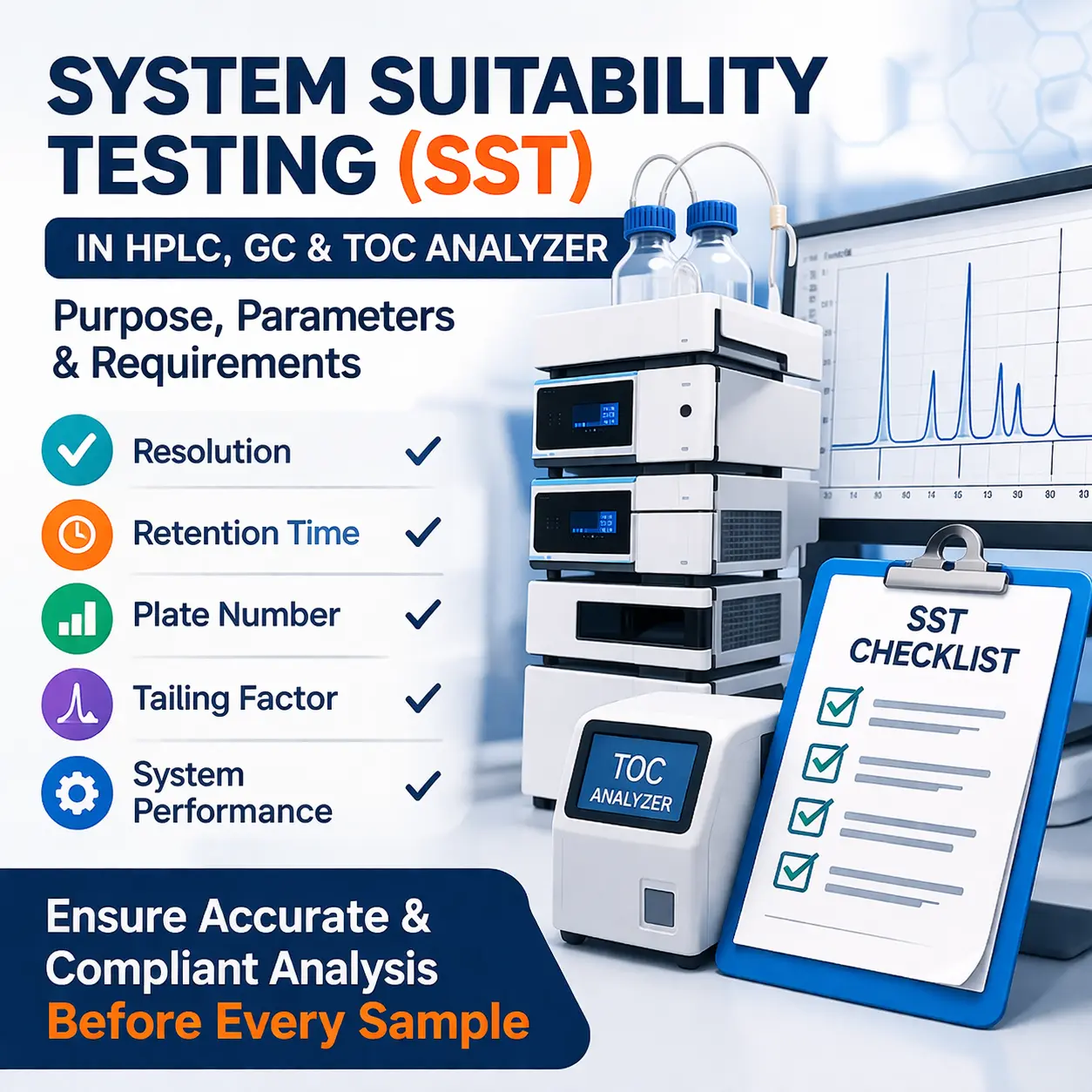

Learn why System suitability Testing is to prove that system is working perfectly before the analysis on HPLC, GC, TOC analyzer or any other system. It is required to done before every sample analysis. Understand key SST parameters, regulatory guidelines, and best practices for reliable analytical results.
Introduction to System Suitability Testing in Pharmaceutical Analysis
System Suitability Testing (SST) is a critical requirement in pharmaceutical laboratories to ensure that analytical instruments are functioning properly before sample analysis begins. Instruments such as HPLC, Gas Chromatography (GC), and Total Organic Carbon (TOC) analyzers must demonstrate consistent performance to produce reliable and accurate results.
In simple terms, System suitability is to prove that system is working perfectly before the analysis on HPLC, GC, TOC analyzer or any other system. It is required to done before every sample analysis. This practice ensures data integrity, regulatory compliance, and product quality.
What is System Suitability Testing (SST)?
System Suitability Testing is a set of predefined checks performed on an analytical system to verify that the system meets established performance criteria before analyzing samples.
It confirms that:
- The instrument is functioning correctly
- The analytical method is performing as expected
- The system can produce reliable results
- The method meets regulatory requirements
Three-Step Approach to Analytical System Performance
Most pharmaceutical companies follow a structured approach to verify system performance.
1. Initial System Qualification
This step ensures that the instrument is installed and operates according to manufacturer specifications.
2. Method Validation
Method validation confirms that the analytical method is suitable for its intended purpose.
3. System Suitability Testing (SST)
SST verifies system performance before routine sample analysis.
Why System Suitability Testing is Important
System Suitability Testing plays a vital role in maintaining analytical reliability in pharmaceutical laboratories.
Key Benefits
- Ensures accurate analytical results
- Prevents instrument failure during analysis
- Supports regulatory compliance
- Maintains data integrity
- Reduces analytical errors
- Improves laboratory efficiency
- Ensures product quality
Regulatory authorities expect SST to be performed consistently before sample analysis.
Common Applications of System Suitability Testing
System Suitability Testing is routinely performed in various pharmaceutical analyses.
Typical Applications
- Active ingredient assay
- Impurity determination
- Dissolution testing
- Stability testing
- Content uniformity testing
- Cleaning validation
- Water quality testing
- Environmental monitoring
Regulatory Guidelines for System Suitability Testing
System Suitability Testing requirements are defined in international regulatory standards.
Key Regulatory References
- United States Pharmacopeia (USP)
- International Council for Harmonisation (ICH)
- Center for Drug Evaluation and Research (CDER)
- Good Manufacturing Practices (GMP)
These guidelines specify acceptance criteria and performance parameters for analytical systems.
Key Parameters Checked in System Suitability Testing
System suitability involves evaluating several chromatographic and instrument performance parameters.
1. Resolution
Resolution measures the separation between two adjacent peaks.
Purpose
- Ensures critical separation
- Confirms method selectivity
- Verifies analytical accuracy
Poor resolution may indicate:
- Column degradation
- Incorrect mobile phase
- Method issues
2. Retention Time
Retention time is the time taken for a compound to pass through the column and reach the detector.
Importance
- Confirms method consistency
- Identifies analyte peaks
- Detects system variation
Retention time should remain consistent within defined limits.
3. System Pressure
Pressure monitoring ensures the system operates within safe limits.
Why It Matters
- Prevents equipment damage
- Detects blockages
- Maintains system stability
4. Column Efficiency (Plate Number)
Column efficiency indicates how well a column separates compounds.
Key Indicator
Higher plate numbers generally indicate better separation performance.
5. Repeatability
Repeatability measures the consistency of results under the same conditions.
Example
Multiple injections of the same standard should produce similar results.
6. Tailing Factor (Symmetry Factor)
The tailing factor measures peak symmetry.
Importance
- Ensures accurate quantification
- Detects column problems
- Improves method performance
7. Signal-to-Noise Ratio (S/N Ratio)
The signal-to-noise ratio evaluates system sensitivity.
Purpose
- Detects low concentration analytes
- Confirms method sensitivity
- Ensures reliable detection
When Should System Suitability Testing Be Performed?
System suitability testing must be performed at specific times to ensure consistent performance.
Required Situations
- Before starting sample analysis
- After instrument maintenance
- After column replacement
- After mobile phase preparation
- During long analytical sequences
- At defined intervals during analysis
This reinforces the principle that System suitability is to prove that system is working perfectly before the analysis on HPLC, GC, TOC analyzer or any other system. It is required to done before every sample analysis.
Best Practices for Effective System Suitability Testing
Recommended Laboratory Practices
- Use freshly prepared standards
- Follow validated methods
- Monitor system performance regularly
- Document all results
- Maintain instrument calibration
- Review system trends
- Investigate failures immediately
These practices help maintain reliable analytical performance.
Common Reasons for System Suitability Failure
Typical Causes
- Column deterioration
- Incorrect mobile phase preparation
- Detector malfunction
- Air bubbles in system
- Contaminated samples
- Instrument calibration errors
- System leaks
- Temperature variation
Identifying the cause quickly helps restore system performance.
Summary
System Suitability Testing is a fundamental requirement in pharmaceutical laboratories to ensure analytical reliability and regulatory compliance. By verifying instrument performance before sample analysis, laboratories can prevent errors, maintain data integrity, and ensure product quality.
Understanding that System suitability is to prove that system is working perfectly before the analysis on HPLC, GC, TOC analyzer or any other system. It is required to done before every sample analysis helps analysts maintain consistent and compliant laboratory operations.
Frequently Asked Questions (FAQs)
1. What is System Suitability Testing (SST)?
System Suitability Testing is a procedure used to verify that an analytical system is functioning correctly before analyzing samples.
2. Why is system suitability required before sample analysis?
It ensures the system is working properly and can produce accurate and reliable results.
3. Which instruments require system suitability testing?
Common instruments include:
- HPLC
- GC
- TOC analyzer
- UV spectrophotometer
- Dissolution apparatus
4. What are the most important system suitability parameters?
Key parameters include:
- Resolution
- Retention time
- Plate number
- Tailing factor
- Repeatability
- Signal-to-noise ratio
5. How often should system suitability testing be performed?
System suitability testing should be performed before every sample analysis and periodically during long analytical runs.
6. What happens if system suitability fails?
Sample analysis must not proceed until the issue is investigated and resolved.
7. Is system suitability required by regulatory agencies?
Yes. Regulatory bodies such as USP, ICH, and FDA require system suitability testing.
8. What is the acceptance criteria in system suitability testing?
Acceptance criteria are predefined limits for system performance parameters such as resolution, tailing factor, and retention time.
9. Who sets system suitability limits?
System suitability limits are established during method validation by analytical scientists.
10. What is the difference between system suitability and method validation?
Method validation confirms the method is suitable for its purpose, while system suitability verifies the instrument is performing correctly before analysis.