


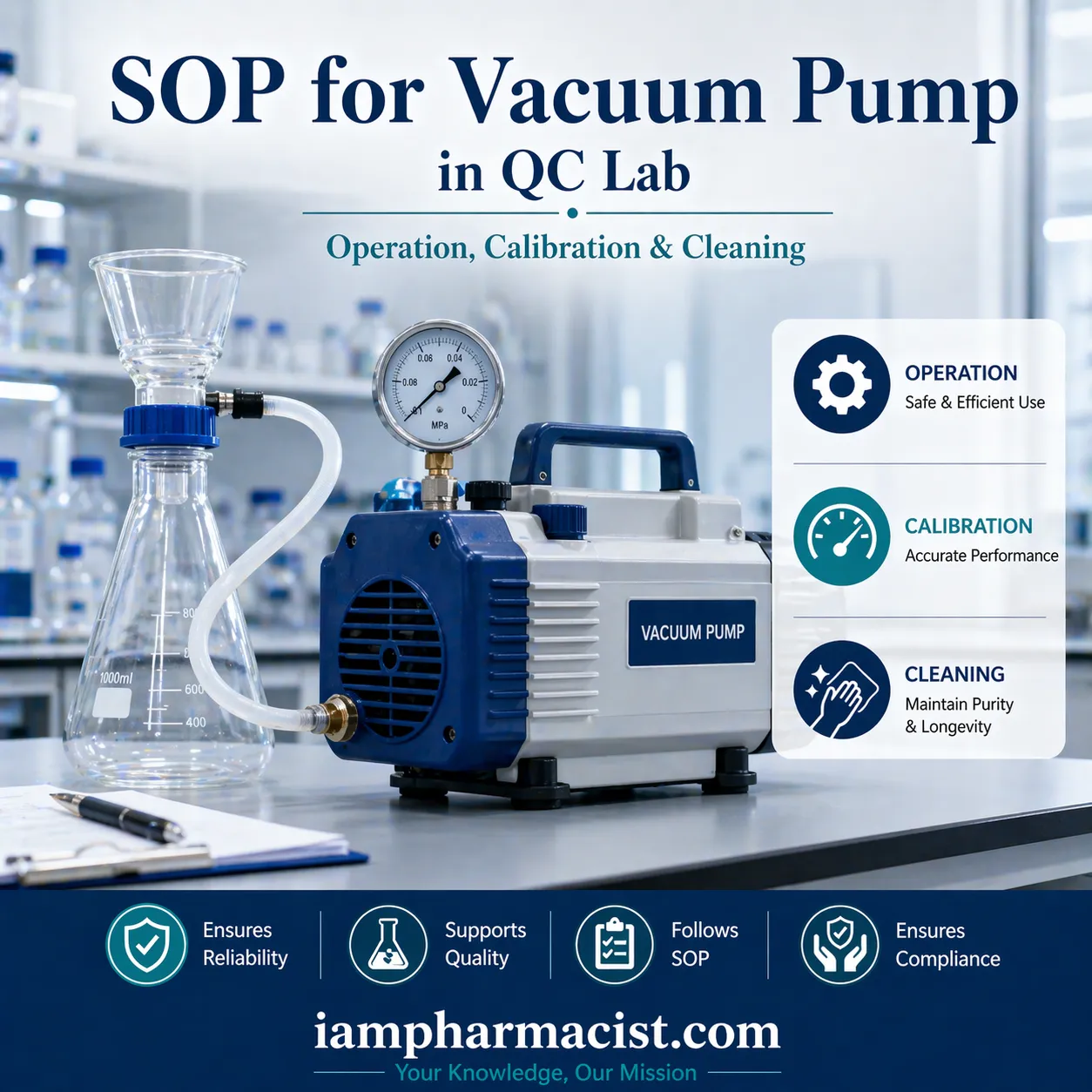

Learn SOP for vacuum pump in QC lab including operation, calibration, and cleaning for safe and efficient mobile phase filtration.
Introduction
In pharmaceutical quality control laboratories, filtration of mobile phase is a critical step to ensure particle-free solvents for techniques like HPLC. The vacuum pump plays a vital role in this process by creating suction for efficient filtration.
A properly defined SOP for vacuum pump operation, calibration, and cleaning ensures system efficiency, prevents contamination, and extends equipment life. This guide provides a structured and GMP-compliant procedure for handling vacuum pumps used in laboratory filtration processes.
Definition
Vacuum pump in laboratory is a device used to create negative pressure (vacuum) to assist in filtration, drying, or degassing processes, especially for mobile phase preparation in analytical testing.
| Parameter | Description |
|---|---|
| Vacuum Pressure | Suction strength generated |
| Tubing Connection | Pathway for vacuum transfer |
| Filtration Setup | Assembly connected to pump |
| Pump Type | Diaphragm / Rotary |
| Safety Precaution | Prevent liquid entry |
| Application | Mobile phase filtration |
Step-by-Step Process
- Place pump on stable surface
- Connect tubing to filtration setuphttps://www.scribd.com/document/862952640/QC-040-00-Preparation-of-Mobile-phases
- Ensure system readiness
- Switch ON pump
- Perform filtration
- Switch OFF after completion
- Prevent liquid entry
1.0 OBJECTIVE
To lay down the standard operating procedure for the vacuum pump.
2.0 SCOPE
This procedure is applicable to vacuum pump in Quality Control Department.
3.0 RESPONSIBILITY
Chemist
4.0 ACCOUNTABILITY
Department Head
5.0 PROCEDURE
5.1 Operation Procedure
- Ensure the unit is placed on a sturdy and leveled surface
- Verify all electrical and tubing connections are proper
Setup
- Attach silicon or rubber tubing to pump outlet
- Connect other end to filtration assembly or vacuum oven
Pre-Start Check
- Ensure complete system setup
- Confirm no leakage or loose connections
Running the Pump
- Switch ON mains and pump
- Allow vacuum to build
- Perform filtration of mobile phase
Shutdown
- Turn OFF pump after completion
- Disconnect tubing if required
5.2 Calibration Procedure
- Verify vacuum pressure using calibrated gauge
- Ensure consistent suction performance
- Check tubing integrity and leakage
- Perform periodic validation as per SOP
- Record calibration results in logbook
5.3 Cleaning Procedure
- Switch OFF and unplug the pump
- Clean external surface with dry cloth
- Ensure no solvent residues
- Replace or clean tubing regularly
- Prevent contamination of filtration system
5.4 Precautions
- Never allow liquid to enter the pump
- Avoid overloading or continuous long operation
- Use compatible tubing material
- Ensure proper ventilation
6.0 ABBREVIATIONS
- SOP – Standard Operating Procedure
Technical Insight: Importance in HPLC Preparation
Vacuum filtration removes particulate matter from solvents, preventing column blockage and ensuring accurate chromatographic results. It is a critical step in mobile phase preparation.
FAQs
1. What is vacuum pump used for in QC lab?
It is used for filtration and degassing of solvents.
2. Why is filtration important for mobile phase?
To remove particles and prevent column damage.
3. What tubing is used in vacuum pump?
Silicon or rubber tubing.
4. What precaution is critical?
Prevent liquid entry into pump.
5. How to calibrate vacuum pump?
Using vacuum gauge and performance checks.
6. Can vacuum pump run continuously?
Not recommended without monitoring.
7. What happens if liquid enters pump?
It may damage internal components.
8. How often cleaning is required?
Regularly as per SOP.
9. What is filtration assembly?
A setup used to filter liquids using vacuum.
10. Which lab uses vacuum pumps?
Pharmaceutical, chemical, and research labs.