


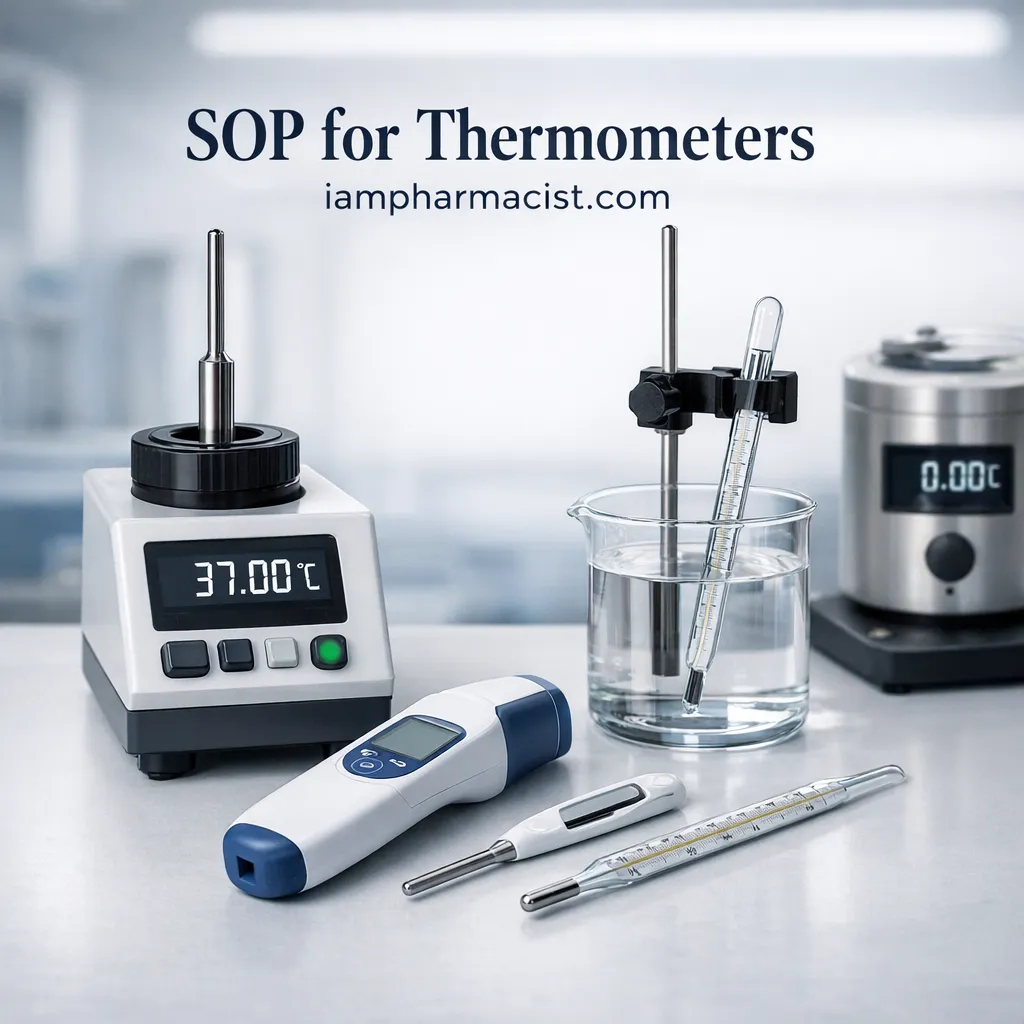

Learn SOP for thermometers (operating, calibrating, and cleaning) using certified standards. Ensure GMP compliance, accuracy, and traceability.
Introduction
Accurate temperature measurement is critical in pharmaceutical manufacturing, directly impacting product quality, stability, and compliance. A validated SOP for operating, calibrating, and cleaning thermometers ensures precision, traceability, and adherence to GMP standards.
This guide provides a complete SOP aligned with QC practices and regulatory expectations.
📌 Definition
Thermometer calibration is the process of comparing a working thermometer with a certified standard thermometer under controlled conditions to ensure accurate temperature measurement within acceptable limits.
📊 Calibration Temperature Table (Annexure I)
| Range of Thermometer | Set Temperatures |
|---|---|
| -10°C to 50°C | 12°C, 25°C, 38°C, 50°C |
| -10°C to 110°C | 25°C, 50°C, 80°C, 110°C |
| -10°C to 250°C | 60°C, 120°C, 180°C, 220°C |
| -10°C to 360°C | 60°C, 120°C, 180°C, 250°C |
Note: Use certificate-defined ranges for pre-calibrated thermometers.
📋 Step-by-Step Calibration Process
- Fill a beaker with silicon oil (or water for low temperatures)
- Place beaker in oil bath with stirrer
- Immerse certified standard thermometer vertically
- Immerse test thermometer at same depth
- Ensure both bulbs are at same level
- Start stirrer without touching thermometers
- Heat oil bath at 2°C per minute
- Record readings at defined temperature points
- Compare readings with standard thermometer
- Accept if deviation ≤ ±2°C, otherwise reject
1.0 OBJECTIVE
To define the procedure for calibration of thermometers.
2.0 SCOPE
Applicable to all thermometers used in pharmaceutical operations.
3.0 RESPONSIBILITY
- Execution: Quality Control Executive
4.0 ACCOUNTABILITY
- Manager – Quality Control
5.0 PROCEDURE
5.1 Operation of Thermometer
- Ensure thermometer is clean and intact
- Verify identification number and calibration status
- Use within specified temperature range
- Avoid sudden temperature shocks
- Handle carefully to prevent mercury separation
5.2 Calibration Procedure
5.2.1 Equipment Requirements
- Mercury-in-glass thermometer
- Certified standard thermometer (Approved Laboratory)
- Oil bath with stirrer
- Silicon oil / water
5.2.2 Calibration Setup
- Fill 1000 ml beaker with ~850 ml silicon oil
- Use:
- Water → for 0–50°C
- Silicon oil → above 50°C
- Place beaker in oil bath
- Position stirrer 2 cm above bottom
5.2.3 Thermometer Placement
- Immerse standard thermometer:
- Depth: ~8 cm
- Keep expansion chamber exposed
- Immerse test thermometer:
- Same level as standard thermometer bulb
5.2.4 Calibration Execution
- Start stirrer (avoid contact)
- Heat oil bath at 2°C/minute
- Record readings at specified increments
5.2.5 Acceptance Criteria
- Allowed deviation: ±2°C
- If deviation exceeds limit → Reject thermometer
5.2.6 Special Case
- For minimum/maximum thermometers:
- Both arms must show identical readings
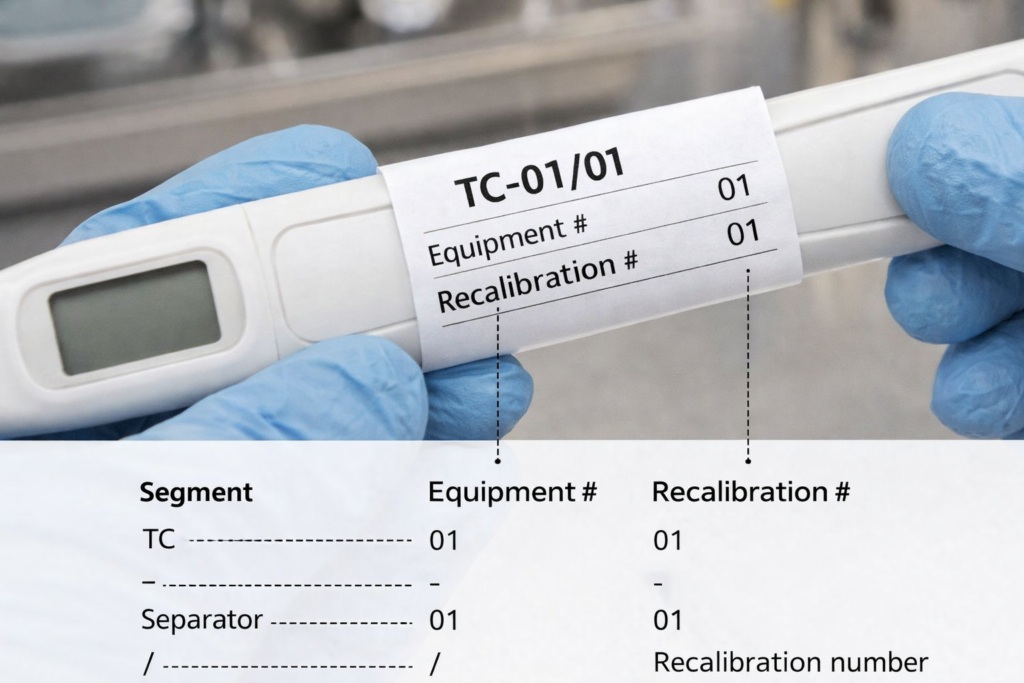
5.3 Identification Number System
5.3.1 Labeling Requirements
- Each thermometer must have:
- Identification number
- Standardization date
5.3.2 Calibration Frequency
- Calibration: Once per year
- Maintain records (Annexure II)
5.3.3 Standard Thermometer
- Sent for re-calibration as per certificate
- Alternatively, use pre-calibrated certified thermometer
5.4 Cleaning Procedure
- Clean thermometer before and after use
- Remove:
- Oil residues
- Contaminants
- Use appropriate cleaning agents
- Ensure no residue remains
- Dry completely before storage
6.0 ABBREVIATIONS
| Term | Meaning |
|---|---|
| SOP | Standard Operating Procedure |
| QC | Quality Control |
| QA | Quality Assurance |
| R&D | Research & Development |
| CCF | Change Control Format |
| NA | Not Applicable |
📑 Annexure II – Standardisation Record (Summary)
- Equipment name
- Thermometer number
- Set temperature
- Observed readings
- Correction values
- Remarks
- Calibration & verification signatures
FAQs
1. What is thermometer calibration?
It is the comparison of a thermometer with a certified standard.
2. Why is calibration important in pharma?
To ensure accurate temperature measurement and product quality.
3. What is the acceptable deviation?
±2°C.
4. What liquid is used for calibration?
Water (low temp) and silicon oil (high temp).
5. How often should thermometers be calibrated?
Once a year.
6. What is the heating rate during calibration?
2°C per minute.
7. What happens if deviation exceeds limits?
Thermometer is rejected.
8. Why use a standard thermometer?
For traceability and accuracy.
9. What is TC-01/01 format?
It is the identification numbering system.
10. Can pre-calibrated thermometers be used?
Yes, if certified.
{ “@context”: “https://schema.org”, “@type”: “Article”, “headline”: “Thermometer Calibration SOP in Pharma Production”, “description”: “SOP for operating, calibrating, and cleaning thermometers using certified standards.”, “author”: { “@type”: “Person”, “name”: “Pharma Technical Expert” }, “publisher”: { “@type”: “Organization”, “name”: “iampharmacist.com” } }