


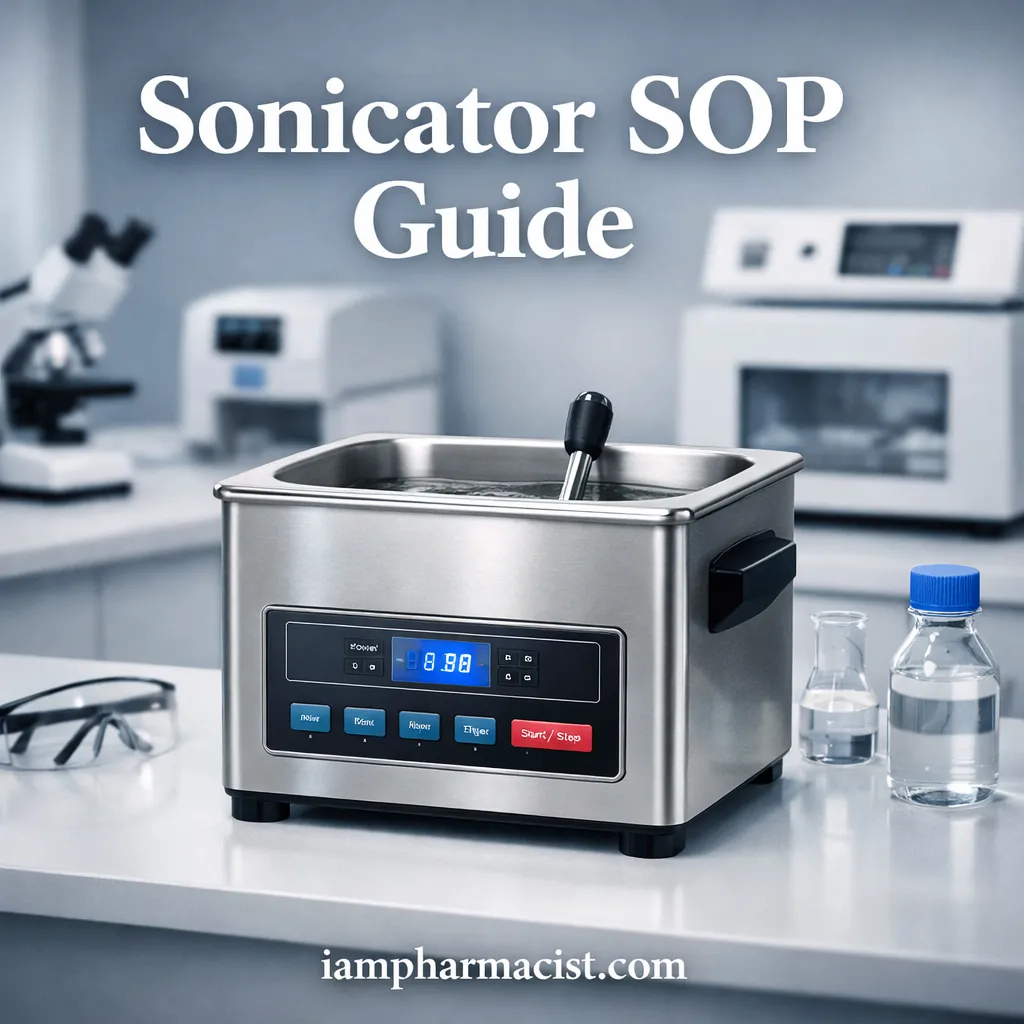

Learn a complete SOP for sonicator operation, calibration, and cleaning in Quality Control labs with step-by-step procedures and compliance tips.
Definition
A Sonicator SOP (Standard Operating Procedure) is a documented protocol used in Quality Control laboratories to ensure the proper operation, calibration, and cleaning of ultrasonic bath sonicators for consistent and reliable sonication of solutions.
| Section | Purpose | Key Actions |
|---|---|---|
| Operation | Ensure effective sonication | Set time, temperature, and sonic strength |
| Calibration | Verify performance accuracy | Check frequency, temperature, timer |
| Cleaning | Maintain hygiene and prevent contamination | Drain, wipe, refill purified water |
Step-by-Step SOP
- Clean instrument and workspace
- Fill bath with purified water
- Power ON and set parameters
- Load samples safely
- Start sonication cycle
- Monitor process
- Stop and unload
- Clean and maintain unit
Introduction
In pharmaceutical and analytical laboratories, sonication plays a critical role in sample preparation, degassing, and dissolution. A well-defined Sonicator SOP ensures accuracy, repeatability, and compliance with regulatory standards such as GMP and GLP.
This guide provides a complete, practical, and compliance-ready SOP for operating, calibrating, and cleaning a sonicator used in Quality Control (QC) environments.
1.0 OBJECTIVE
To describe the procedure for operation, calibrationhttps://iampharmacist.com/sop-for-ph-meter-operation-calibration-cleaning/, and cleaning of a sonicator.
2.0 SCOPE
Applicable to all sonicators used in Quality Control laboratories for sonication of solutions.
3.0 RESPONSIBILITY
Officer / Executive – Quality Control
4.0 ACCOUNTABILITY
Manager – Quality Control
5.0 PROCEDURE
5.1 Operation of Sonicator
Pre-Operation Checks
- Ensure instrument and surrounding area are clean
- Verify no visible damage
- Confirm availability of purified water
Operating Steps
- Ensure the area and instrument are clean
- Fill purified water in the bath up to the optimum level
- Switch ON main power supply
- Press POWER button to ON
- Slowly place the lower tray into the bath
- Select SONIC mode using MODE button
- Adjust sonic strength as required
- Select TIME using MODE button
- Set operating time using UP/DOWN buttons
- Select TEMP using MODE button
- Set required temperature
- Press START/STOP to begin sonication
- Monitor operation during cycle
- After completion, remove items carefully
- Press START/STOP and then POWER OFF
Operational Tips
- Avoid overloading the bath
- Ensure samples are properly sealed
- Maintain consistent water level
5.2 Calibration of Sonicator
Calibration Frequency
- Monthly or as per internal SOP
- After major maintenance
Calibration Parameters
- Timer accuracy
- Temperature accuracy
- Ultrasonic frequency/power
Calibration Procedure
- Timer Calibration
- Set a known time (e.g., 10 minutes)
- Compare with calibrated stopwatch
- Temperature Calibration
- Set temperature (e.g., 40°C)
- Verify using calibrated thermometer
- Ultrasonic Efficiency Test (Foil Test)
- Place aluminum foil in bath
- Run for 1–2 minutes
- Observe uniform perforation pattern
- Record results in calibration log
Acceptance Criteria
- Timer deviation: ±5%
- Temperature deviation: ±2°C
- Uniform cavitation observed
5.3 Cleaning of Sonicator
Cleaning Frequency
- Daily after use
- Weekly deep cleaning
Cleaning Procedure
- Switch OFF and unplug the unit
- Drain the water from bath
- Wipe inner tank using lint-free cloth
- Use mild detergent if required
- Rinse thoroughly with purified water
- Dry the bath completely
- Refill with fresh purified water
Precautions
- Do not use abrasive materials
- Avoid water entering electrical parts
- Ensure unit is dry before reuse
6.0 ABBREVIATIONS
- SOP – Standard Operating Procedure
- QC – Quality Control
FAQs
1. What is a sonicator used for in QC?
A sonicator is used to disperse, dissolve, or degas samples using ultrasonic waves.
2. How often should a sonicator be calibrated?
Typically monthly or as per laboratory SOP.
3. What is the foil test in sonication?
It checks cavitation efficiency using aluminum foil perforation.
4. Why is purified water used in a sonicator?
To prevent contamination and ensure consistent ultrasonic transmission.
5. What happens if sonicator temperature is not controlled?
It can affect sample stability and test accuracy.
6. Can a sonicator be used without water?
No, it can damage the instrument.
7. How do you clean a sonicator bath?
Drain, wipe, rinse, and refill with purified water.
8. What is cavitation in sonication?
Formation and collapse of bubbles producing ultrasonic energy.
9. What are key calibration parameters?
Time, temperature, and ultrasonic efficiency.
10. What safety precautions should be followed?
Avoid direct contact, use PPE, and ensure proper grounding.
{ “@context”: “https://schema.org”, “@type”: “Article”, “headline”: “Sonicator SOP: Operation, Calibration & Cleaning Guide”, “description”: “Complete SOP for sonicator operation, calibration, and cleaning in QC labs.”, “author”: { “@type”: “Organization”, “name”: “Quality Control SOP Experts” }, “datePublished”: “2026-04-21” } { “@context”: “https://schema.org”, “@type”: “FAQPage”, “mainEntity”: [ { “@type”: “Question”, “name”: “What is a sonicator used for?”, “acceptedAnswer”: { “@type”: “Answer”, “text”: “A sonicator is used to disperse and dissolve samples using ultrasonic waves.” } } ] } { “@context”: “https://schema.org”, “@type”: “HowTo”, “name”: “How to Operate a Sonicator”, “step”: [ {“@type”: “HowToStep”, “text”: “Fill bath with purified water”}, {“@type”: “HowToStep”, “text”: “Set time and temperature”}, {“@type”: “HowToStep”, “text”: “Start sonication”} ] }