


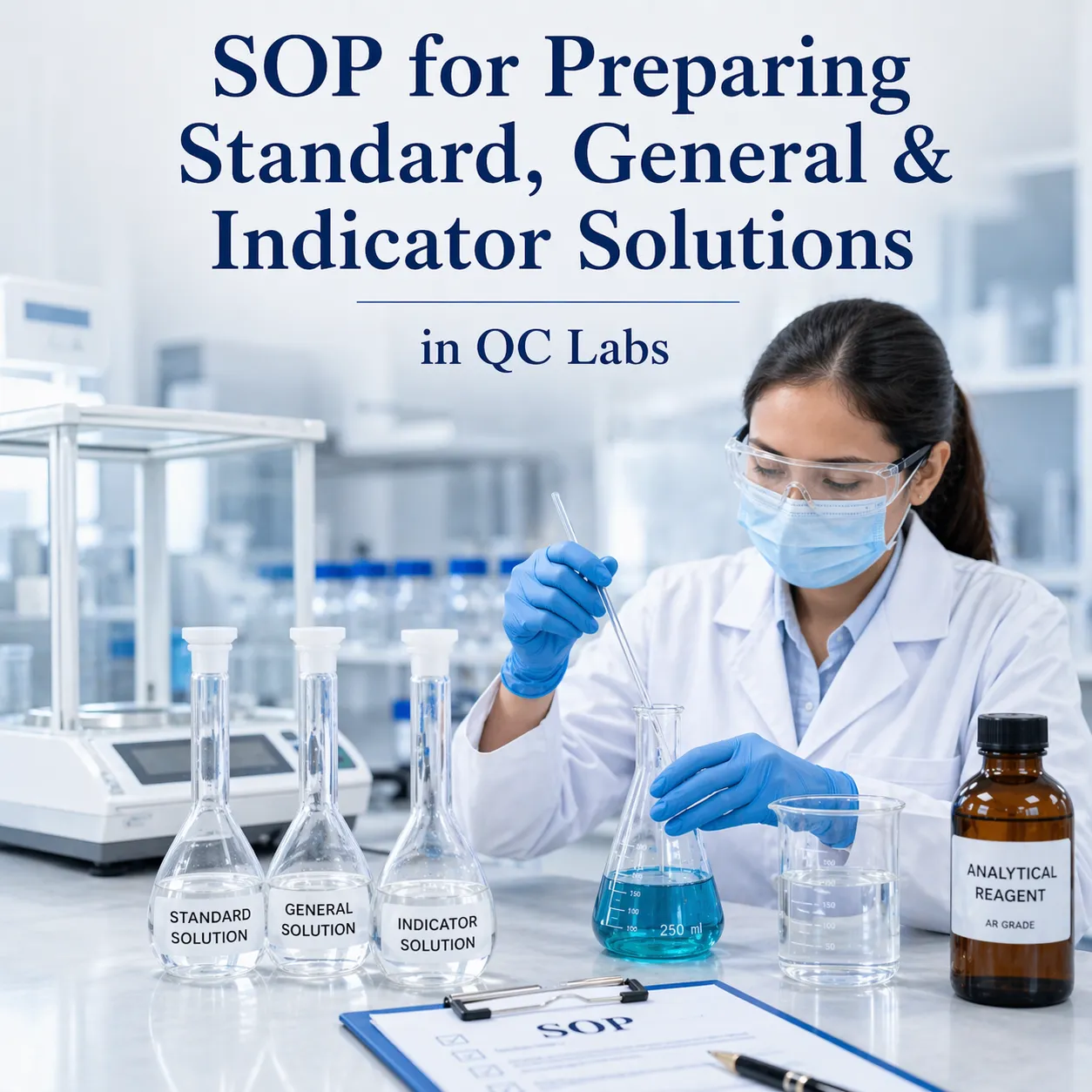

Learn SOP for preparing standard, general & indicator solutions in QC labs. Covers procedure, storage, labeling, and compliance guidelines.
Definition
A standard operating procedure (SOP) for preparation of standard, general, and indicator solutions is a documented method that ensures accurate preparation, labeling, storage, and usage of chemical solutions in quality control laboratories to maintain consistency, reliability, and compliance.
Introduction
In quality control laboratories, the accuracy of chemical analysis heavily depends on the proper preparation of solutions. Whether it’s standard solutions for calibration, indicator solutions for titration, or general reagents, even minor errors can lead to incorrect analytical results.
This SOP outlines a systematic and compliant procedure for preparing, labeling, storing, and maintaining solutions used in chemical analysis. Following this ensures data integrity, reproducibility, and regulatory compliance in pharmaceutical and industrial laboratories.
1.0 OBJECTIVE
To lay down the procedure for preparation of standard, general, and indicator solutions.
2.0 SCOPE
Applicable to all preparations of standard, general, and indicator solutions used in quality control laboratories.
3.0 RESPONSIBILITY
Officer / Executive – Quality Control
4.0 ACCOUNTABILITY
Manager – Quality Control
5.0 PROCEDURE
5.1 General Requirements
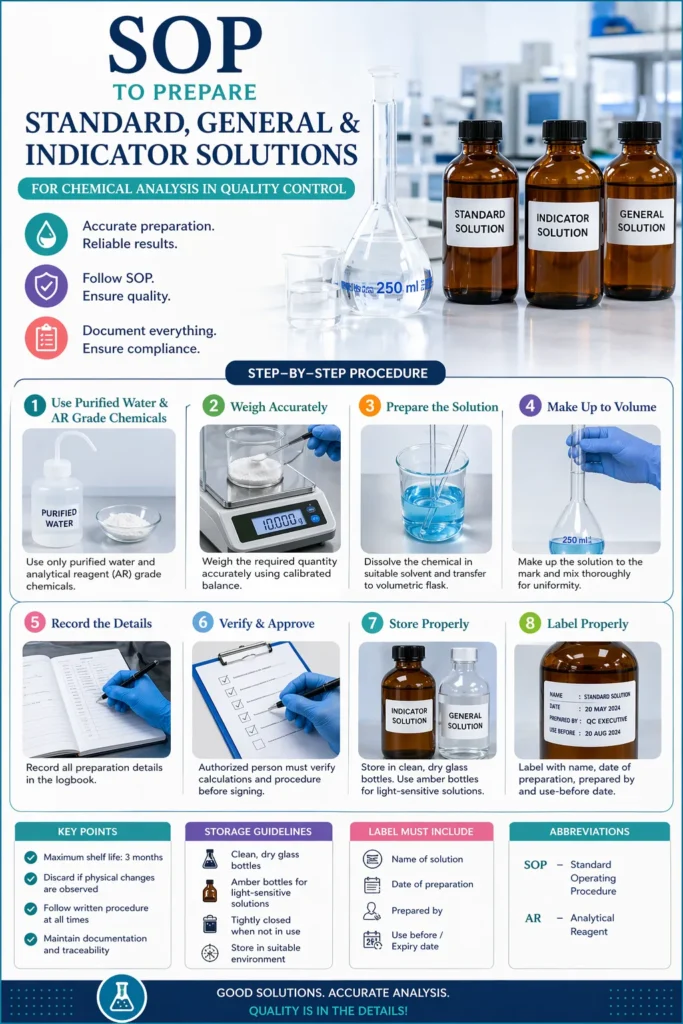
- Use purified water for all preparations
- Use analytical reagent (AR grade) chemicals
- Follow approved written procedureshttps://iampharmacist.com/qc-lab-behavior/
- Ensure glassware is clean and dry
5.2 Preparation Procedure
- Weigh chemicals accurately using calibrated balance
- Dissolve in appropriate solvent (usually purified water)
- Transfer to volumetric flask and make up to volume
- Mix thoroughly to ensure homogeneity
5.3 Documentation & Verification
- Record all preparation details in logbook
- Include:
- Name of solution
- Batch/lot number
- Date of preparation
- Prepared by & checked by
- Authorized person must verify:
- Calculations
- Method compliance
5.4 Storage Requirements
- Store in clean, dry glass bottles
- Use amber bottles for light-sensitive solutions
- Avoid contamination by proper sealing
5.5 Shelf Life & Stability
- Maximum storage period: 3 months
- Discard if:
- Color changes
- Precipitation occurs
- Any physical change observed
5.6 Labeling Requirements
Each solution must include:
- Name of solution
- Date of preparation
- Prepared by
- Expiry/use-before date
5.7 Commercial Solutions
- Label with:
- Date of opening
- Expiry date
- Use-before date
| Parameter | Requirement |
|---|---|
| Water Quality | Purified Water |
| Reagents | Analytical Grade (AR) |
| Storage | Glass / Amber Bottles |
| Shelf Life | Maximum 3 Months |
| Documentation | Mandatory |
| Labeling | Complete Details Required |
Calibration Considerations
- Use calibrated balances for weighing
- Verify volumetric glassware accuracy
- Ensure pipettes and burettes are calibrated
- Maintain calibration records
Cleaning Procedure
- Clean glassware with suitable detergent
- Rinse with purified water
- Dry completely before use
- Avoid cross-contaminationhttps://iampharmacist.com/sop-for-cleaning-quality-control-laboratory/
Abbreviations
- SOP – Standard Operating Procedure
- AR – Analytical Reagent
FAQs
1. What is a standard solution?
A solution with a known concentration used for calibration.
2. What is an indicator solution?
A chemical that shows color change during titration.
3. Why use purified water?
To avoid contamination and ensure accuracy.
4. What is AR grade chemical?
High-purity chemicals suitable for analytical work.
5. How long can solutions be stored?
Maximum of three months unless specified.
6. Why is labeling important?
Ensures traceability and prevents misuse.
7. What if solution changes color?
It must be discarded immediately.
8. Who verifies preparation?
Authorized QC personnel.
9. Can commercial solutions be used?
Yes, with proper labeling and documentation.
10. Why is documentation critical?
Ensures compliance and reproducibility.
{ “@context”: “https://schema.org”, “@type”: “Article”, “headline”: “SOP for Standard & Indicator Solutions in QC”, “description”: “Complete SOP for preparation, storage, and labeling of laboratory solutions.”, “author”: { “@type”: “Organization”, “name”: “iampharmacist.com” }, “publisher”: { “@type”: “Organization”, “name”: “iampharmacist.com” } } { “@context”: “https://schema.org”, “@type”: “FAQPage”, “mainEntity”: [ { “@type”: “Question”, “name”: “What is a standard solution?”, “acceptedAnswer”: { “@type”: “Answer”, “text”: “A solution with a known concentration used for calibration.” } } ] } { “@context”: “https://schema.org”, “@type”: “HowTo”, “name”: “Preparation of Laboratory Solutions”, “step”: [ {“@type”: “HowToStep”,”text”: “Use purified water and AR-grade chemicals”}, {“@type”: “HowToStep”,”text”: “Weigh accurately”}, {“@type”: “HowToStep”,”text”: “Prepare solution in volumetric flask”}, {“@type”: “HowToStep”,”text”: “Record details”}, {“@type”: “HowToStep”,”text”: “Label and store properly”} ] }