


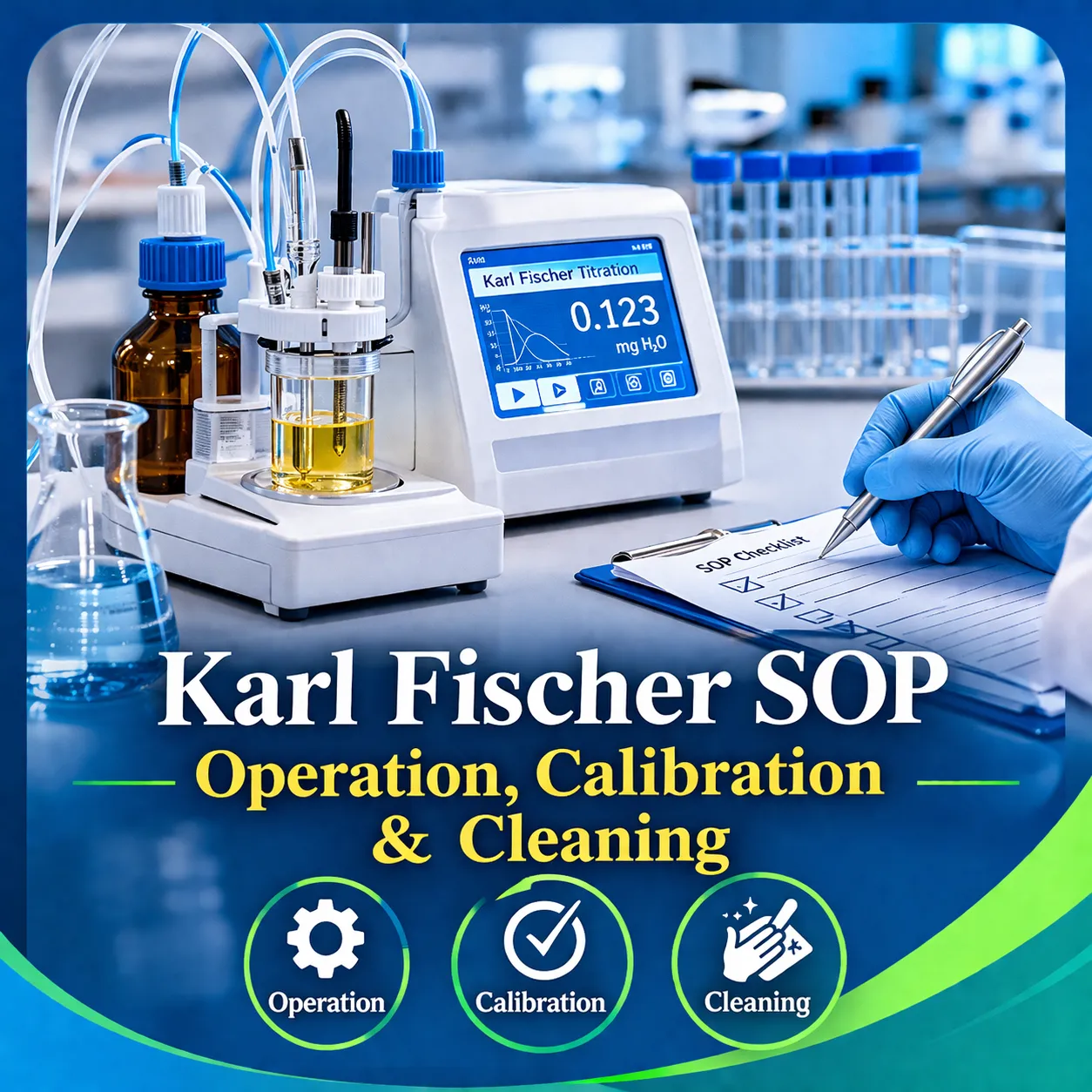

Learn SOP for Karl Fischer operation, calibration, and cleaning in QC labs to ensure accurate moisture determination and compliance.
Introduction
The Karl Fischer apparatus is a critical analytical instrument used in pharmaceutical quality control laboratories for accurate moisture determination. Moisture content plays a key role in product stability, shelf life, and quality.
To ensure precise and reliable results, it is essential to follow a well-defined SOP for operation, calibration, and cleaning of the Karl Fischer titrator. This guide provides a comprehensive procedure aligned with GMP and laboratory best practices.
1.0 Objective
To define a standardized procedure for the operation, calibration, and cleaning of the Karl Fischer apparatus.
2.0 Scope
This SOP applies to the Karl Fischer apparatus installed in the Quality Control (QC) laboratory.
3.0 Responsibility
- Doing: Technical Assistant
- Checking: Executive / Manager
4.0 Accountability
- Head of the Department
5.0 Step-by-Step SOP for Karl Fischer Apparatus
5.1 Operation of Karl Fischer Apparatus
5.1.1 Pre-Operation Checks
- Ensure instrument is clean and calibrated
- Check availability of Karl Fischer reagent and methanol
- Verify dryness of titration vessel
5.1.2 Sample Preparation
- Prepare sample as per method
- Avoid moisture contamination
5.1.3 Titration Process
- Add sample into titration vessel
- Start titration using instrument controls
- Record moisture content displayed
5.1.4 Completion
- Save results in system/logbook
- Proceed to flushing and cleaning
5.2 Calibration of Karl Fischer Apparatus
5.2.1 Standardization
- Use water standard or sodium tartrate
- Perform titration and compare expected value
5.2.2 Factor Determination
- Calculate KF reagent factor
5.2.3 Frequency
- Perform calibration daily or as per SOP
5.2.4 Documentation
- Record calibration results and factor
5.3 Cleaning Procedure
5.3.1 Flush System
- Press FLUSH switch to transfer reagent to storage bottle
5.3.2 Clean Test Compartment
- Remove solution from compartment
- Wash with methanol
- Wipe knob with tissue paper
5.3.3 Switch Off Instrument
- Turn OFF instrument and mains
5.3.4 Waste Disposal
- Collect waste in designated beaker
- Dispose immediately to avoid corrosion
5.3.5 External Cleaning
- Clean outer surface using isopropyl alcohol (IPA)
- Dry with tissue paper
5.3.6 Documentation
- Record cleaning activity in log card
6.0 Abbreviations
- SOP: Standard Operating Procedure
Safety Precautions
- Handle Karl Fischer reagent carefully (corrosive)
- Use PPE (gloves, goggles, lab coat)
- Avoid moisture exposure during testing
- Ensure proper ventilation
- Dispose waste properly
Common Mistakes to Avoid
- Not flushing reagent after use
- Moisture contamination in sample
- Skipping calibration
- Improper waste handling
- Not drying system properly
Best Practices
- Perform daily calibration
- Keep system dry at all times
- Use fresh reagents
- Maintain proper documentation
- Train staff regularly
FAQs (Frequently Asked Questions)
1. What is Karl Fischer used for?
To determine moisture content in samples.
2. Why is flushing important?
To prevent reagent degradation and contamination.
3. What solvent is used for cleaning?
Methanol is commonly used.
4. Why is calibration required?
To ensure accurate moisture measurement.
5. How often should calibration be done?
Daily or as per SOP.
6. What happens if system is not dry?
It leads to inaccurate results.
7. Who is responsible for operation?
Technical staff performs; Manager verifies.
8. What PPE is required?
Gloves, goggles, lab coat.
9. Why is waste disposal important?
To prevent corrosion and hazards.
10. Is documentation necessary?
Yes, for compliance and traceability.