


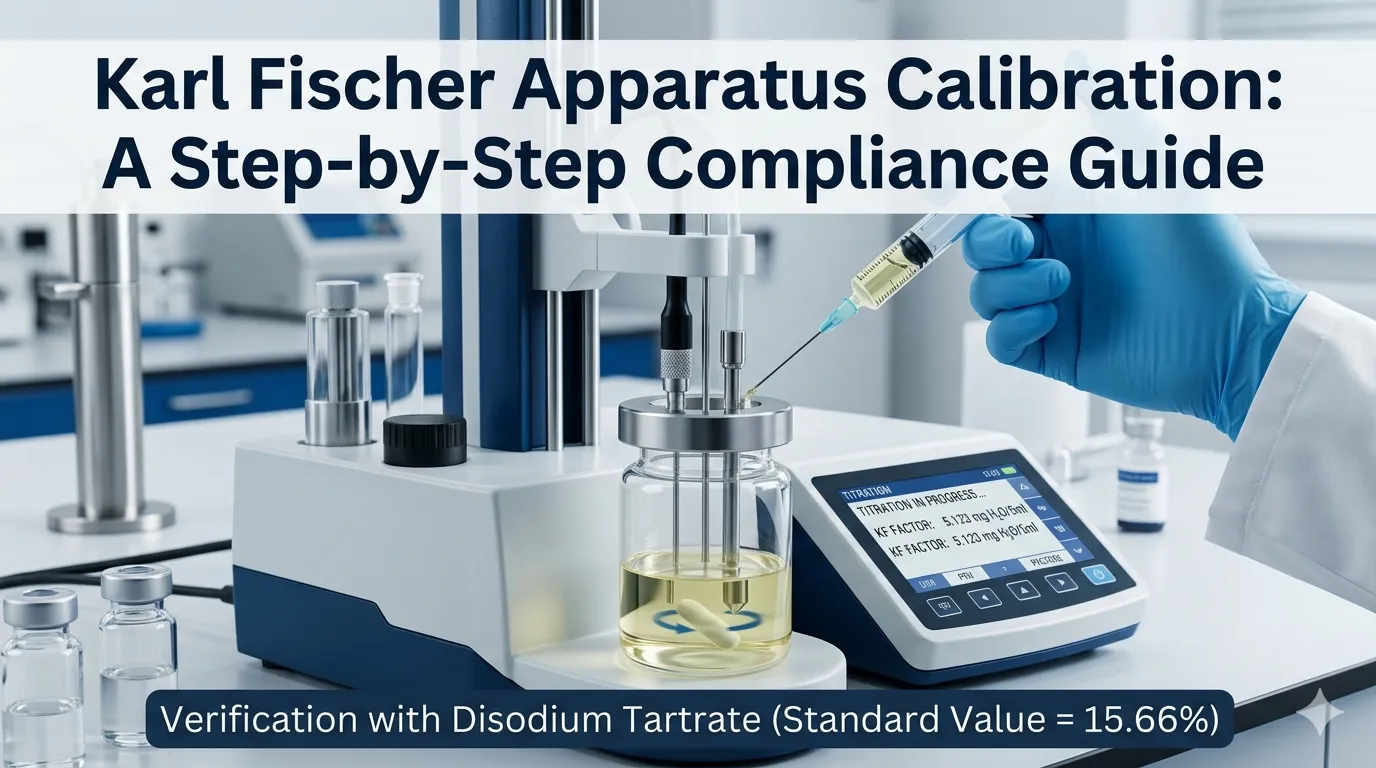

Master the procedure to calibrate the Karl Fischer Apparatus using Disodium Tartrate (Standard value = 15.66%). Ensure accurate moisture analysis with our laboratory-tested guide.
In pharmaceutical quality control, determining the moisture content of a sample is critical for stability and efficacy. The Karl Fischer (KF) titration is the gold standard for this analysis. However, to ensure your results are reliable, you must regularly calibrate the Karl Fischer Apparatus using Disodium Tartrate (Standard value = 15.66 %).
This calibration process involves two main phases: determining the KF Reagent factor (standardization) and verifying the instrument’s performance using a certified reference material.
Preparation and Neutralization
Before starting, ensure the titration vessel is clean and the desiccant is fresh.
- Power Up: Switch on the main power and the instrument according to the manufacturer’s operating manual.
- Mode Selection: Reset the instrument and press the “MODE” key until the indicator light glows at the “CONC” (Concentration) position.
- Neutralization: Press “RUN” to neutralize any moisture in the methanol. Once the instrument reaches the “READY” state, you are prepared to begin.
Phase 1: Determining the KF Reagent Factor
Before checking the standard, you must find the strength of your Karl Fischer reagent.
- Weighing: Use a high-precision syringe to weigh between 5 mg and 50 mg (0.005 to 0.05 g) of pure distilled water.
- Data Entry: Enter the exact weight into the instrument.
- Titration: Press “RUN” to start the titration. The indicator will move to “BUSY.”
- Results: Once finished, the display will show the result in mg H₂O / 5 ml of KF reagent.
- Consistency: Repeat this three times. The three values must not differ by more than 0.3%. Calculate the mean and save it to the instrument’s memory.
Phase 2: Calibration Using Disodium Tartrate
Once the reagent factor is set, you must calibrate the Karl Fischer Apparatus using Disodium Tartrate (Standard value = 15.66 %) to verify accuracy.
- Prepare the Standard: Weigh accurately between 0.05 g and 0.15 g of Disodium Tartrate.
- Input Weight: Reset the instrument, ensure it is in the “WEIGH” position, and enter the weight of the tartrate in grams.
- Titrate: Press “RUN” and set a stir time if required. Press “RUN” again to begin the titration.
- Final Verification: The display will show the water content as a percentage.
- Acceptance Criteria: Repeat the procedure three times. The mean water content must be within ± 0.3% of the standard value (15.66%). This means your results should fall between 15.36% and 15.96%.
Post-Calibration Steps
- Labeling: Affix a calibration label with the “Next Due Date” on the instrument.
- Maintenance: Drain the titration vessel and ensure the electrodes are dipped in methanol to prevent them from drying out.
- Documentation: Record all weights and factors in the Calibration Log for audit readiness.
Frequently Asked Questions (FAQ)
1. Why is Disodium Tartrate used as a standard for Karl Fischer calibration?
Disodium Tartrate Dihydrate is a stable primary standard with a very specific, chemically bound water content (15.66%). Unlike pure water, its solid form makes it easier to handle in small quantities without evaporation errors.
2. What should I do if my three factor values differ by more than 0.3%?
If the deviation is high, it indicates inconsistency. Check for air bubbles in the burette, ensure the titration vessel is airtight, and verify that the methanol is fully neutralized before starting.
3. How often should I calibrate the Karl Fischer apparatus?
Standardization (reagent factor) should be done daily or whenever a new bottle of reagent is opened. A full calibration with Disodium Tartrate is typically done monthly or according to your lab’s SOP.
4. Why must the electrode be kept in methanol when not in use?
Storing the electrode in methanol keeps the sensing tips conditioned and prevents the buildup of sulfur or iodine crusts, ensuring a fast response time during titration.
5. Can I use a different weight of water for the reagent factor?
The recommended range is 5 mg to 50 mg. Using too little water increases the impact of weighing errors, while too much water can deplete your reagent too quickly.
6. What does the “BUSY” light indicate on the apparatus?
The “BUSY” light indicates that the titration is in progress and the instrument is actively detecting the endpoint by monitoring the change in electrical current.
7. Does temperature affect the KF calibration?
Yes. KF reagents are sensitive to temperature changes. Calibration should be performed at a stable room temperature to avoid fluctuations in the reagent’s volume and strength.
8. What is the role of methanol in this process?
Methanol acts as the solvent that dissolves the sample and participates in the chemical reaction. It must be “neutralized” (all trace water removed) before the actual sample is added.
9. What happens if the Disodium Tartrate result is 16.00%?
Since 16.00% is outside the ±0.3% limit (maximum 15.96%), the instrument is considered “Out of Calibration.” You must investigate the cause, recalibrate the reagent factor, and retest.
10. Is the standard value always 15.66%?
For Disodium Tartrate Dihydrate ($Na_2C_4H_4O_6 \cdot 2H_2O$), the theoretical water content is 15.66%. However, always check the Certificate of Analysis (CoA) provided by your chemical supplier for the exact certified value of your batch.