


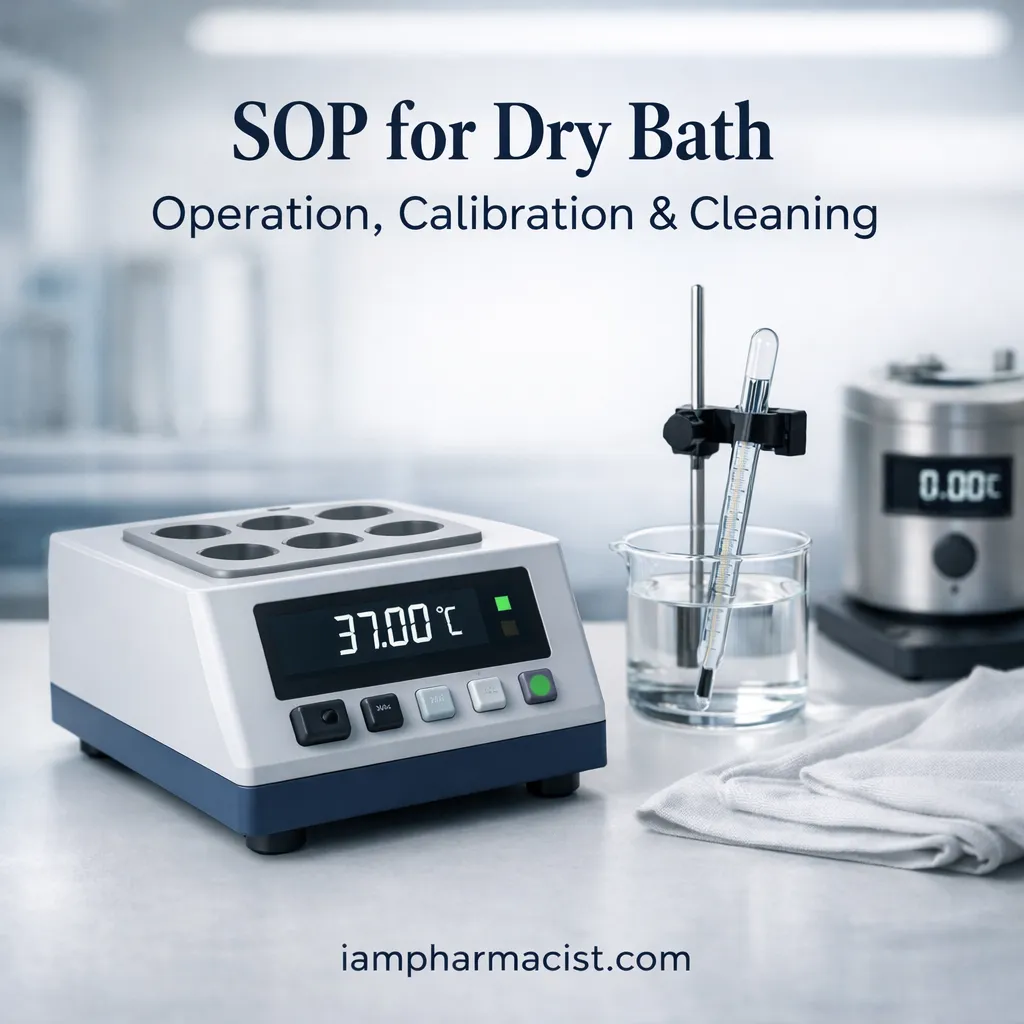

Complete SOP for Dry Bath (Operation, Calibration & Cleaning) using thermometer. Step-by-step guide with QA compliance and documentation.
🔬 Definition
A dry bath SOP is a documented procedure outlining standardized steps for operating, calibrating and cleaning a dry bath incubator using a calibrated thermometer to ensure accurate temperature control, compliance, and reproducibility in laboratory processes.
📊 Key SOP Overview Table
| Section | Key Activity | Frequency | Responsibility |
|---|---|---|---|
| Operation | Set & monitor temperature | Daily | Microbiologist (QC) |
| Calibration | Verify temperature with thermometer | Monthly | QC Department |
| Cleaning | External & internal cleaning | Daily/Weekly | Lab Personnel |
| Documentation | Record calibration observations | Monthly | QA/QC |
📌 Introduction
A dry bath incubator is a critical instrument in microbiology and pharmaceutical laboratories, ensuring precise temperature control for sample incubation. To maintain accuracy and compliance with GMP/GLP standards, a well-defined SOP is essential.
This guide provides a complete, SEO-optimized SOP for dry bath operation, calibration using a calibrated thermometer, and cleaning—ensuring reliability, traceability, and audit readiness.
1.0 OBJECTIVE
To ensure that the dry bath is operated, calibrated, and cleaned properly for accurate and consistent performance.
2.0 SCOPE
Applicable to all dry bath equipment used in microbiology and quality control laboratories.
3.0 RESPONSIBILITY
- Microbiologist – Quality Control
4.0 ACCOUNTABILITY
- Manager – Quality Control
5.0 PROCEDURE
🧼 5.1 Cleaning Procedure
Daily Cleaning
- Ensure the power supply is switched OFF before cleaning.
- Clean external surfaces using a dry, lint-free cloth.
- Wipe interior surfaces daily to remove dust or residues.
Weekly Cleaning
- Use mild soap solution for wet cleaning of external surfaces.
- Remove adhered dust and stains.
- Wipe thoroughly with a clean dry cloth to eliminate moisture.
💡 Tip: Avoid excess moisture to prevent electrical hazards.
⚙️ 5.2 Operating Procedure
Featured Snippet: Steps to Operate Dry Bath
- Connect the dry bath to the power supply.
- Switch ON the main power and instrument switch.
- Set temperature (e.g., 37°C) using the control panel.
- Allow the system to stabilize.
- Monitor and record temperature daily.
Detailed Instructions
- Verify proper installation before use.
- Use soft keys or SET knob to adjust temperature.
- Ensure uniform heating before placing samples.
🌡️ 5.3 Calibration Procedure
Step-by-Step Calibration
- Switch ON the instrument.
- Fill glycerol solution in all five positions (4 corners + center).
- Allow stabilization for 15 minutes.
- Insert calibrated thermometer at each position sequentially.
- Record readings after stabilization.
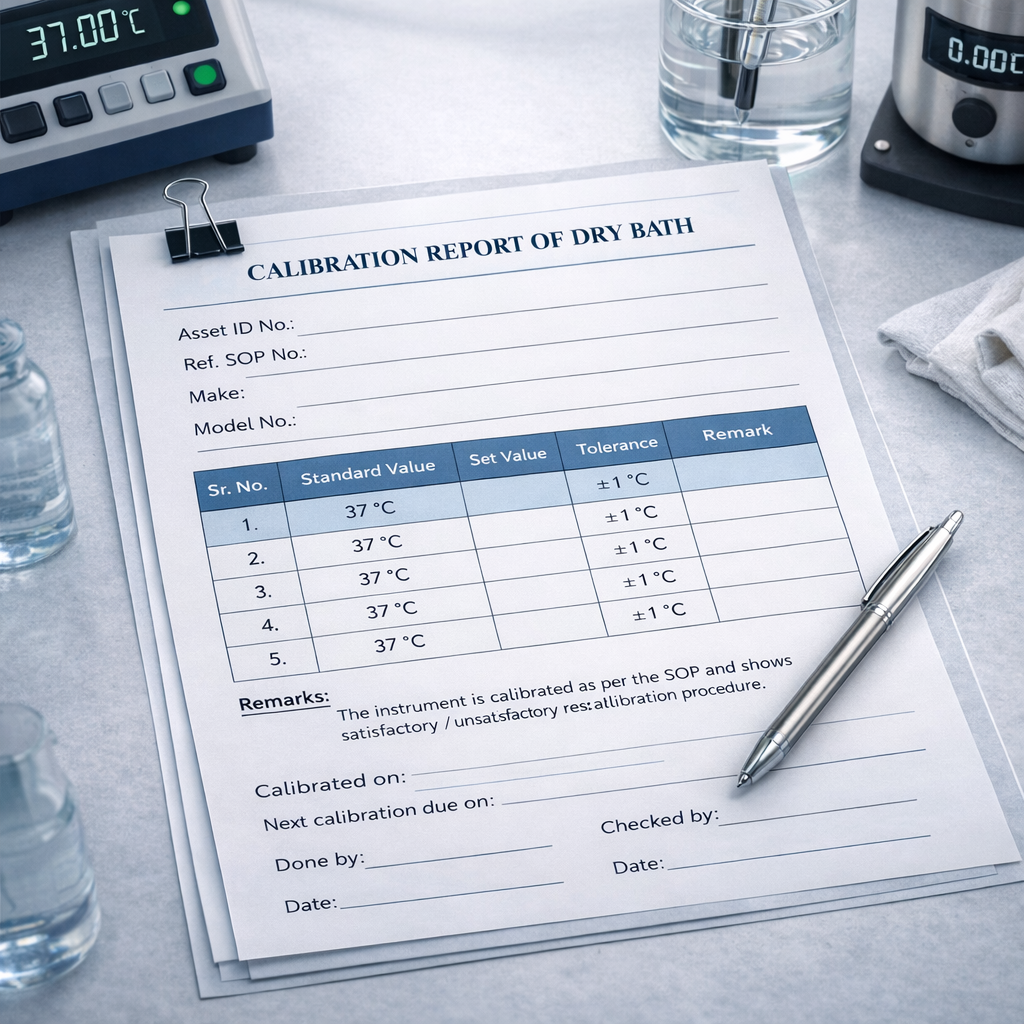
- Compare with standard value (37°C ±1°C).
- Document results in calibration report.
Frequency
- Perform calibration once per month
📑 Annexure I: Calibration Report Template
6.0 ABBREVIATIONS
- SOP – Standard Operating Procedure
- QA – Quality Assurance
- QC – Quality Control
- CCF – Change Control Format
❓ FAQs
1. What is a dry bath SOP?
A documented procedure for operating, calibrating, and cleaning dry bath equipment.
2. Why is calibration of dry bath important?
It ensures accurate temperature control and reliable experimental results.
3. How often should a dry bath be calibrated?
Calibration should be performed monthly.
4. What is the standard calibration temperature?
Typically 37°C ±1°C for microbiology applications.
5. What liquid is used during calibration?
Glycerol solution is commonly used for uniform heat transfer.
6. Who is responsible for dry bath SOP?
Microbiologist (QC) is responsible; QC Manager is accountable.
7. Can water be used instead of glycerol?
Glycerol is preferred due to better thermal stability.
8. What happens if calibration fails?
The instrument must be serviced and recalibrated before use.
9. How to clean a dry bath safely?
Switch OFF power, clean with dry cloth daily and mild detergent weekly.https://www.fda.gov/inspections-compliance-enforcement-and-criminal-investigations/inspection-guides/validation-cleaning-processes-793
10. What documents are required for compliance?
Calibration reports, SOP records, and QA logs.https://iampharmacist.com/water-bath-sop/
{ “@context”: “https://schema.org”, “@type”: “Article”, “headline”: “Dry Bath SOP: Operation, Calibration & Cleaning”, “description”: “Complete SOP for dry bath including operation, calibration using thermometer, and cleaning procedure.”, “author”: { “@type”: “Organization”, “name”: “iampharmacist.com” }, “publisher”: { “@type”: “Organization”, “name”: “iampharmacist.com” } } { “@context”: “https://schema.org”, “@type”: “FAQPage”, “mainEntity”: [ { “@type”: “Question”, “name”: “How often should dry bath be calibrated?”, “acceptedAnswer”: { “@type”: “Answer”, “text”: “Dry bath should be calibrated monthly.” } } ] } { “@context”: “https://schema.org”, “@type”: “HowTo”, “name”: “How to Calibrate Dry Bath”, “step”: [ {“@type”: “HowToStep”, “text”: “Switch ON instrument”}, {“@type”: “HowToStep”, “text”: “Add glycerol solution”}, {“@type”: “HowToStep”, “text”: “Insert calibrated thermometer”}, {“@type”: “HowToStep”, “text”: “Record readings”} ] }