


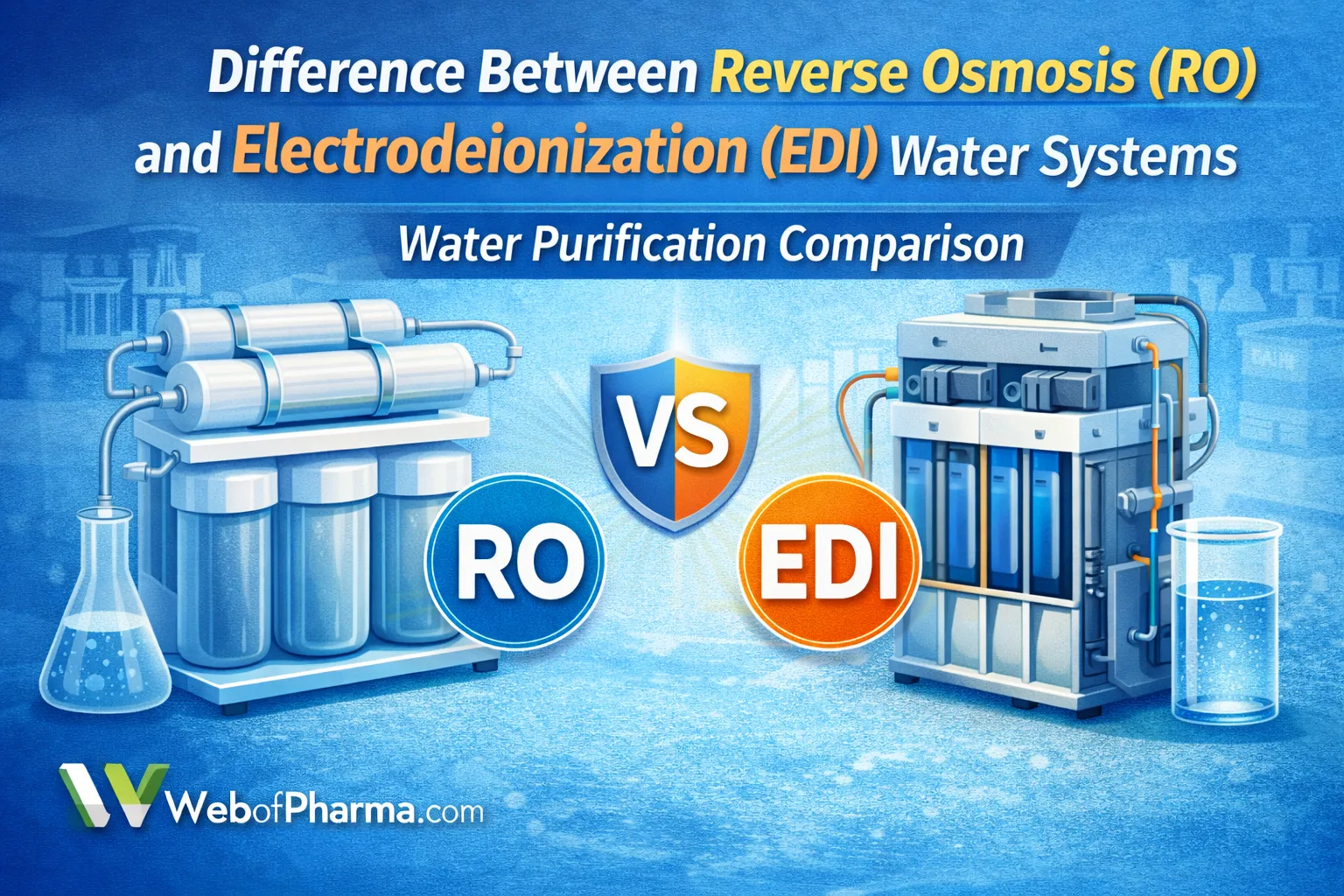

Learn the difference between Reverse osmosis water (RO) and Electrodeionization (EDI) water systems both are used in pharmaceuticals for water purification. Understand working principles, components, advantages, disadvantages, and applications of RO vs EDI systems.
Water is one of the most critical raw materials used in pharmaceutical manufacturing. It plays a central role in drug formulation, equipment cleaning, and production processes. Maintaining high-quality purified water is essential to ensure product safety, regulatory compliance, and patient protection.
Two of the most widely used technologies in pharmaceutical water treatment are Reverse Osmosis (RO) and Electrodeionization (EDI) systems. Understanding the difference between Reverse osmosis water purification systems (RO) and Electrodeionization (EDI) water system both are used in pharmaceuticals for water purification is essential for selecting the appropriate system for producing Purified Water (PW) and Water for Injection (WFI).
Importance of Water Purification in Pharmaceuticals
Water purification systems are designed to remove contaminants such as:
- Dissolved salts
- Microorganisms
- Organic compounds
- Endotoxins
- Suspended particles
- Chemical impurities
Proper water purification ensures:
- Product quality
- Regulatory compliance
- Equipment protection
- Process reliability
- Patient safety
Pharmaceutical water systems must meet strict standards defined by:
- Good Manufacturing Practice (GMP)
- Pharmacopoeial specifications
- Regulatory authorities
What is Reverse Osmosis (RO) Water Purification System?
The Reverse Osmosis (RO) system is a membrane-based water purification technology that uses pressure to force water through a semi-permeable membrane. This process removes impurities, dissolved solids, and contaminants from water.
How Reverse Osmosis (RO) Works
The RO system operates through multiple filtration stages:
- Water enters the system through the supply line
- Water passes through pre-filters
- Sediments and particles are removed
- Water flows through the semi-permeable membrane
- Impurities are rejected and discharged
- Purified water is stored in a tank
- Post-filters improve taste and odor
This process produces highly purified water suitable for pharmaceutical and industrial applications.
Major Components of Reverse Osmosis (RO) System
Typical components include:
- Pre-filters (sediment and carbon filters)
- RO membrane
- Storage tank
- Drain line
- Flow restrictor
- Check valve
- Automatic shut-off valve
- Post filters
- Water faucet
Applications of Reverse Osmosis (RO) System
RO systems are commonly used in:
- Pharmaceutical water purification
- Boiler feed water treatment
- Whole-house water systems
- Industrial water treatment plants
- Commercial water purification systems
Advantages of Reverse Osmosis (RO) System
- Produces highly purified water
- Removes dissolved salts and contaminants
- Improves water taste and odor
- Easy maintenance
- Reliable filtration performance
- Widely used technology
Disadvantages of Reverse Osmosis (RO) System
- Requires large installation space
- Consumes higher energy
- Generates wastewater
- Higher maintenance costs
- Membrane replacement required
What is Electrodeionization (EDI) Water System?
The Electrodeionization (EDI) system is an advanced water purification technology that combines ion exchange and membrane separation processes. It uses electrical current to remove dissolved ions from water and produce high-purity water continuously.
EDI systems are commonly used as a polishing step after RO treatment in pharmaceutical water purification systems.
How Electrodeionization (EDI) Works
The EDI process involves the following steps:
- Water enters the deionization chamber
- Ion exchange resin captures dissolved ions
- Electric current drives ions through membranes
- Ions move into concentrate chambers
- Purified water exits the system
The system continuously regenerates the ion exchange resin without the need for chemical regeneration.
Major Components of Electrodeionization (EDI) System
Typical components include:
- Ion exchange resin
- Cation exchange membrane
- Anion exchange membrane
- Electrodes
- Dilute spacer
- Concentrate spacer
- Power supply
- Flow channels
Applications of Electrodeionization (EDI) System
EDI systems are widely used in:
- Pharmaceutical purified water systems
- Water for Injection (WFI) preparation
- Microelectronics manufacturing
- Food and beverage industry
- Boiler feed water treatment
- Laboratory water purification
Advantages of Electrodeionization (EDI) System
- Produces ultra-pure water
- Continuous operation
- Low chemical usage
- Reduced maintenance
- Energy efficient
- Environmentally friendly
- Compact system design
Disadvantages of Electrodeionization (EDI) System
- Requires pretreated water (usually RO-treated water)
- Sensitive to hardness and scaling
- Higher initial installation cost
- Requires monitoring of carbon dioxide levels
5 Major Differences Between RO and EDI Water Systems
| Parameter | Reverse Osmosis (RO) | Electrodeionization (EDI) |
|---|---|---|
| Working Principle | Pressure-driven membrane filtration | Electric current and ion exchange |
| Water Purity Level | High purity | Ultra-high purity |
| Chemical Usage | Minimal | None for regeneration |
| Maintenance | Moderate | Low |
| Typical Use | Primary purification | Final polishing step |
When to Use RO vs EDI in Pharmaceutical Water Systems
Use RO when:
- Removing dissolved solids
- Reducing microbial load
- Producing purified water
- Pre-treating feed water
Use EDI when:
- Producing ultra-pure water
- Eliminating ionized impurities
- Maintaining continuous operation
- Reducing chemical regeneration
In pharmaceutical facilities, the most common configuration is:
RO + EDI Combined System
This combination provides:
- High purification efficiency
- Stable water quality
- Regulatory compliance
- Reduced operational risk
Key GMP Considerations for RO and EDI Systems
Pharmaceutical manufacturers must ensure:
- System validation
- Routine monitoring
- Preventive maintenance
- Microbial control
- Calibration of instruments
- Proper documentation
- Compliance with regulatory requirements
These practices support:
- Product quality
- Data integrity
- Inspection readiness
- Patient safety
Conclusion
Understanding the difference between Reverse osmosis water purification systems (RO) and Electrodeionization (EDI) water system both are used in pharmaceuticals for water purification is essential for designing efficient pharmaceutical water treatment systems. While RO removes contaminants using membrane filtration, EDI provides continuous deionization and ultra-pure water production. In modern pharmaceutical facilities, combining RO and EDI technologies ensures reliable water purification, regulatory compliance, and consistent product quality.
Frequently Asked Questions (FAQ)
1. What is the main difference between RO and EDI systems?
RO uses pressure and membranes to remove impurities, while EDI uses electrical current and ion exchange to remove ions.
2. Can EDI be used without RO?
No. EDI typically requires pretreated water from an RO system to function effectively.
3. Which system produces higher purity water?
EDI produces higher purity water compared to RO alone.
4. Why are RO and EDI systems used together?
They provide efficient multi-stage purification and ensure consistent water quality.
5. Is chemical regeneration required in EDI?
No. EDI systems regenerate ion exchange resin automatically using electricity.
6. What industries commonly use RO and EDI systems?
Industries include:
- Pharmaceuticals
- Biotechnology
- Food and beverage
- Power plants
- Microelectronics
7. Which system requires more maintenance?
RO systems generally require more maintenance due to membrane replacement and cleaning.
8. What is the typical role of RO in pharmaceutical water systems?
RO acts as the primary purification step to remove dissolved solids and contaminants.
9. What is the role of EDI in pharmaceutical water systems?
EDI acts as a polishing step to produce ultra-pure water.
10. Are RO and EDI systems required for GMP compliance?
Yes. Properly designed and validated water purification systems are essential for GMP compliance in pharmaceutical manufacturing.