


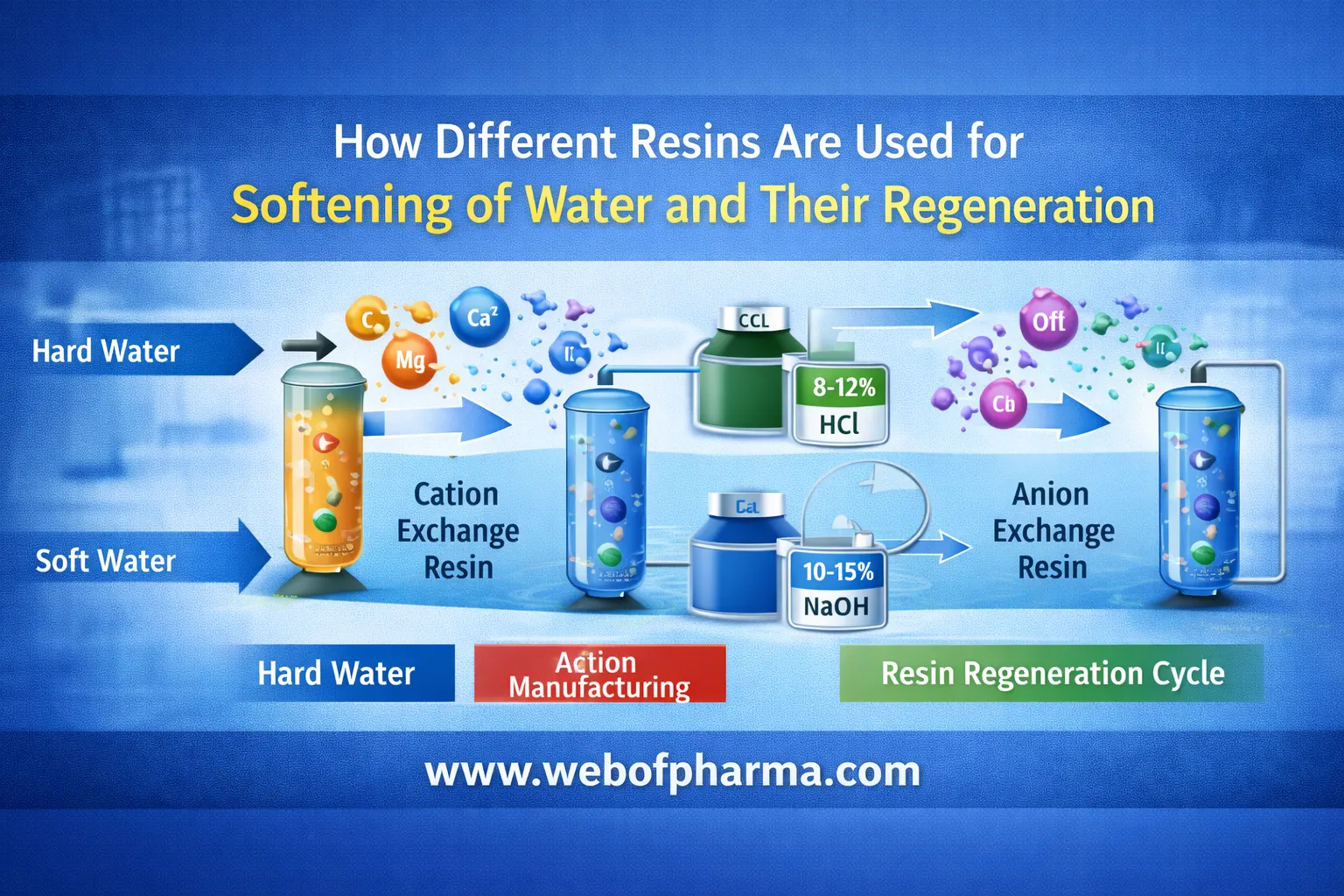

Learn how different resins are used for softening of water used to feed the water system and their regeneration. Understand ion exchange process, resin types, and pharmaceutical water treatment.
Water purification is a critical step in pharmaceutical manufacturing, as water is widely used in production, cleaning, and formulation processes. However, raw water contains suspended particles and dissolved ions that must be removed to meet stringent quality standards.
While suspended impurities can be removed using filtration methods like activated carbon filters, dissolved ions—especially calcium and magnesium—require a different approach. These ions are responsible for water hardness and must be removed through a process called water softening.
This article explains how different resins are used for softening of water used to feed the water system and their regeneration, particularly in pharmaceutical applications.
What is Hardness of Water?
Water hardness is caused by the presence of dissolved salts of:
- Calcium (Ca²⁺)
- Magnesium (Mg²⁺)
Hard water can:
- Damage equipment
- Reduce cleaning efficiency
- Affect product quality
Softening removes these ions, producing soft water suitable for pharmaceutical use.
Why Ion Exchange Resins Are Used
Ion exchange resins are widely used in pharmaceutical water systems to remove hardness ions effectively.
Characteristics of Resins:
- Synthetic polymer beads
- Size: ~0.5 to 1.0 mm
- Porous structure for ion exchange
- White to yellow in color
- Measured in liters (despite being solid)
These resins work by exchanging undesirable ions in water with desirable ions attached to the resin.
Types of Resins Used in Water Softening
To understand how different resins are used for softening of water used to feed the water system and their regeneration, it’s important to know the two main types:
1. Cation Exchange Resins
- Exchange positive ions (cations)
- Replace calcium (Ca²⁺) and magnesium (Mg²⁺) with hydrogen (H⁺) or sodium (Na⁺) ions
Working Principle:
- Hard water passes through the resin
- Ca²⁺ and Mg²⁺ ions are trapped
- Resin releases H⁺ or Na⁺ into the water
2. Anion Exchange Resins
- Exchange negative ions (anions)
- Replace ions like chloride (Cl⁻), sulfate (SO₄²⁻) with hydroxyl (OH⁻) ions
Working Principle:
- Anions are captured by resin
- OH⁻ ions are released into water
- OH⁻ combines with H⁺ to form pure water (H₂O)
Ion Exchange Process in Softening
The softening process involves:
- Hard water enters the ion exchange column
- Cation resins remove Ca²⁺ and Mg²⁺
- Anion resins remove negatively charged ions
- Clean, softened water exits the system
This process ensures removal of ionic impurities and improves water quality.
Regeneration of Ion Exchange Resins
Over time, resins become saturated with hardness ions and lose efficiency. Therefore, regeneration is essential.
Cation Resin Regeneration:
- Regenerated using 8–12% Hydrochloric Acid (HCl)
- Restores H⁺ ions on resin surface
- Effluent pH: ~2–3
Anion Resin Regeneration:
- Regenerated using 10–15% Sodium Hydroxide (NaOH)
- Restores OH⁻ ions on resin surface
- Effluent pH: ~7.5–9.5
How Regeneration Works
During regeneration:
- Chemical solutions flush through resin beds
- Trapped calcium and magnesium ions are removed
- Active ions (H⁺ or OH⁻) are restored on resin surface
- Resin becomes ready for reuse
This regeneration cycle is essential to maintain continuous operation of water systems.
Importance in Pharmaceutical Water Systems
Understanding how different resins are used for softening of water used to feed the water system and their regeneration is crucial because:
- Prevents scaling in pipelines and equipment
- Ensures compliance with GMP standards
- Improves efficiency of downstream purification systems
- Maintains consistent water quality
Conclusion
Ion exchange resins play a vital role in pharmaceutical water treatment. By removing hardness ions and enabling efficient regeneration, they ensure a continuous supply of high-quality water.
A clear understanding of how different resins are used for softening of water used to feed the water system and their regeneration helps maintain system performance, regulatory compliance, and product quality.
Frequently Asked Questions (FAQs)
1. What is water softening in pharmaceuticals?
Water softening is the removal of calcium and magnesium ions to reduce hardness.
2. Why are ion exchange resins used?
They effectively remove dissolved ions that cannot be removed by filtration.
3. What are the types of ion exchange resins?
Cation exchange resins and anion exchange resins.
4. How do cation resins work?
They replace calcium and magnesium ions with hydrogen or sodium ions.
5. How do anion resins work?
They replace negatively charged ions with hydroxyl ions.
6. Why is resin regeneration necessary?
To restore the ion exchange capacity after saturation.
7. What chemicals are used for regeneration?
Hydrochloric acid (HCl) for cation resins and sodium hydroxide (NaOH) for anion resins.
8. What happens if resins are not regenerated?
They lose efficiency and fail to remove hardness ions.
9. What is the typical size of resin beads?
Around 0.5 to 1.0 mm.
10. Why is soft water important in pharma?
It prevents scaling, ensures product quality, and protects equipment.