


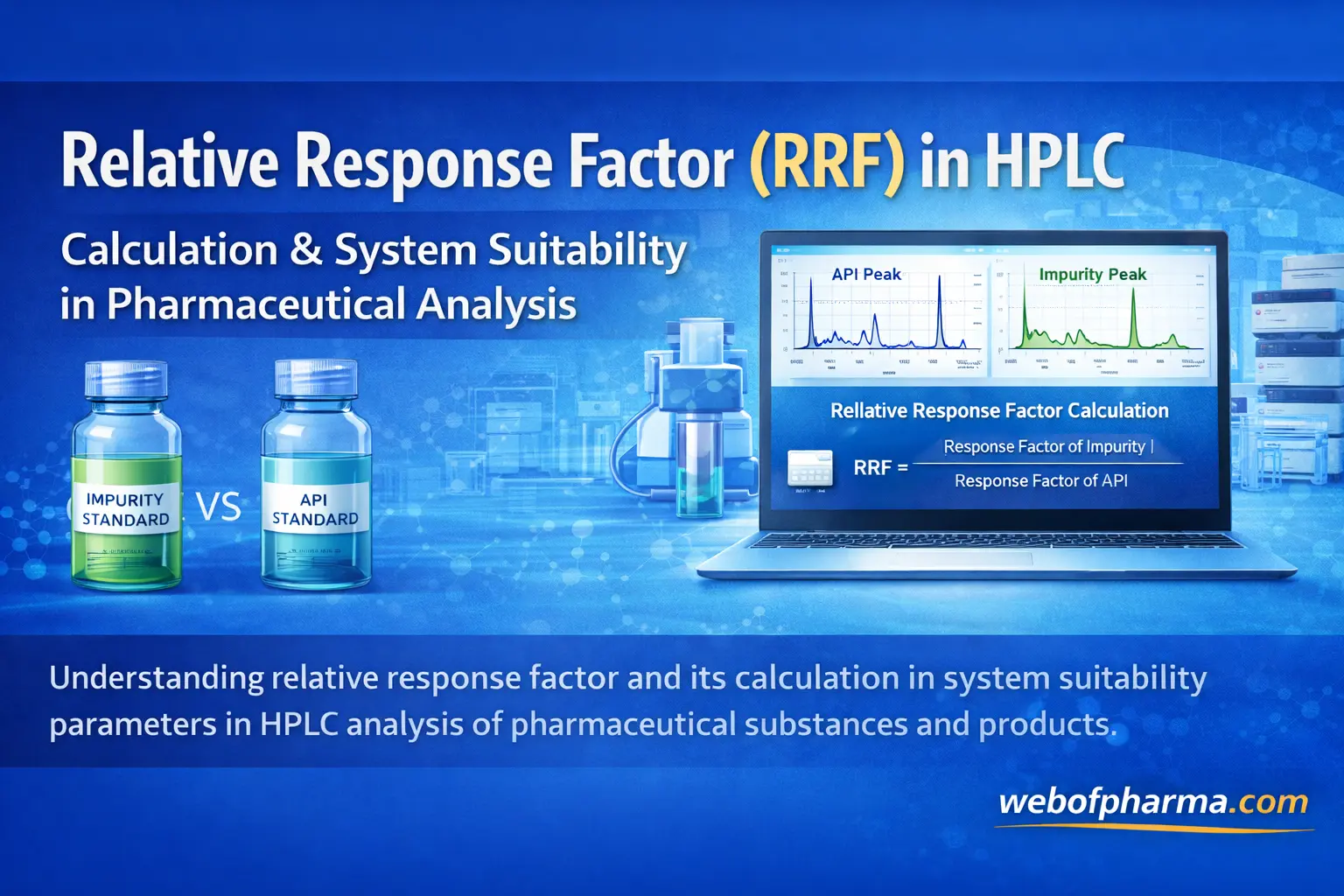

Learn about relative response factor and its calculation in system suitability parameters in HPLC analysis of pharmaceutical substances and pharmaceutical products. Understand RRF formula, ICH guidelines, and impurity quantification.
During the manufacturing of pharmaceutical substances, unwanted components known as impurities are often formed. These impurities may originate from synthesis, degradation, or interactions within the formulation. Monitoring and quantifying these impurities is critical to ensure drug safety and regulatory compliance.
In many cases, impurity standards are not readily available. This is where relative response factor and its calculation in system suitability parameters in HPLC analysis of pharmaceutical substances and pharmaceutical products becomes highly important.
Why Impurity Analysis is Important in Pharmaceuticals
Pharmaceutical impurities must be identified and quantified within acceptable limits defined by regulatory authorities such as ICH. According to ICH Q3B(R2):
- Reporting threshold – level at which impurities must be reported
- Identification threshold – level at which impurities must be identified
- Quantification threshold – level at which impurities must be quantified
Accurate impurity estimation ensures product safety, efficacy, and compliance.
What is Relative Response Factor (RRF)?
The Relative Response Factor (RRF) is a correction factor used in HPLC to estimate impurity levels when impurity reference standards are unavailable.
It is defined as the ratio of the detector response of an impurity to that of the active pharmaceutical ingredient (API) under identical chromatographic conditions.
This approach allows analysts to calculate impurity concentrations using API calibration data.
Principle of Relative Response Factor in HPLC
In HPLC analysis, different compounds may produce different detector responses even at the same concentration. Therefore, a correction factor (RRF) is applied to normalize these differences.
The concept of relative response factor and its calculation in system suitability parameters in HPLC analysis of pharmaceutical substances and pharmaceutical products ensures accurate impurity quantification despite varying detector sensitivities.
Formula for RRF Calculation
Response Factor (RF):
RF=Concentration (mg/mL)Peak Area
Relative Response Factor (RRF):
RRF=Response Factor of APIResponse Factor of Impurity
How to Calculate RRF in HPLC
The calculation involves the following steps:
- Prepare standard solutions of API and impurity at known concentrations
- Inject at least three different concentration levels into the HPLC system
- Record peak areas for each concentration
- Plot calibration curves (area vs concentration)
- Determine the slope for API and impurity
- Calculate RRF using slope ratios
This method ensures reliable results in system suitability parameters in HPLC analysis of pharmaceutical substances and pharmaceutical products.
Role of RRF in System Suitability Parameters
System suitability tests ensure that the HPLC system is performing correctly before analysis. RRF plays a key role in:
- Accurate impurity quantification
- Method validation and reproducibility
- Ensuring consistency in chromatographic performance
It is important to note that RRF is:
- Specific to each compound
- Dependent on detector type
- Not transferable across different analytical methods or detectors
Important Considerations for RRF
- Must be determined under identical chromatographic conditions
- Should be validated during method development
- Cannot be used across different detectors (e.g., UV vs fluorescence)
- Must be periodically verified for accuracy
Conclusion
The relative response factor and its calculation in system suitability parameters in HPLC analysis of pharmaceutical substances and pharmaceutical products is a critical concept in impurity profiling. It enables accurate estimation of impurities even when reference standards are unavailable.
By following ICH guidelines and adopting a scientific approach to RRF calculation, pharmaceutical laboratories can ensure reliable, compliant, and high-quality analytical results.
Frequently Asked Questions (FAQs)
1. What is Relative Response Factor (RRF) in HPLC?
RRF is the ratio of detector response of an impurity to that of the API under the same conditions.
2. Why is RRF important in pharmaceutical analysis?
It helps quantify impurities when impurity standards are not available.
3. How is RRF calculated?
By comparing response factors (or slopes) of impurity and API calibration curves.
4. What is the formula for response factor?
Response Factor = Peak Area / Concentration.
5. Can RRF be used across different detectors?
No, RRF is detector-specific and cannot be transferred between detectors.
6. What guidelines mention RRF?
ICH Q3B(R2) provides guidance on impurity analysis and use of response factors.
7. How many concentrations are needed for RRF calculation?
At least three concentration levels are recommended.
8. What is the role of RRF in system suitability?
It ensures accurate and consistent impurity quantification.
9. What happens if RRF is not accurate?
It may lead to incorrect impurity estimation and regulatory non-compliance.
10. Is RRF required for all impurities?
It is mainly used when impurity reference standards are unavailable.